

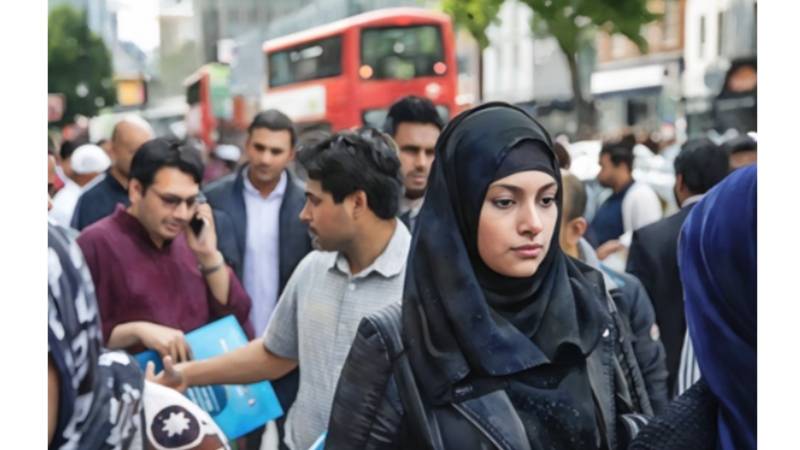
The headlines felt like a physical blow. I scrolled through the images: a sea of St. George’s flags, not as a symbol of sporting pride I’ve seen in pubs, but wielded as a weapon of exclusion; faces contorted in anger; mounted police officers, islands of hi-vis in a turbulent human sea. And at the centre of it all, the pugnacious figure of Tommy Robinson.
A deep ache settled in my chest. It’s a very specific type of melancholy, a cocktail of anger, fear, and a deep, weary disappointment. It’s the feeling of realising that the home you’ve built, the identity you’ve woven from British and Pakistani threads, is seen by a terrifyingly large number of your fellow citizens as an illegitimate, hostile takeover.
I am a British Pakistani. I was born in Lahore, but I have lived in the UK for over thirty years. I came as a boy, learned to love the rain-soaked greens of the Midlands, the dry wit of my school friends, the unspoken rules of queueing. I paid my taxes, I built a business, I raised my children here. They speak with broad Brummie accents, and their worldview is instinctively, unquestioningly British. Yet, watching that footage, I felt a chilling question form: is the Britain I thought I knew, the Britain of quiet tolerance and grudging decency, completely receding into history?
The rhetoric spewed from that stage in Whitehall was not new. It was the same old poison, now distilled to a potent, industrial strength. Elon Musk, dialling in from his gilded universe, pontificating on the “erosion of Britain” – a man who has never queued for a GP appointment or navigated the complexities of a British high street, let alone understood the fabric of our communities. Éric Zemmour, exporting France’s toxic grand remplacement theory, telling a cheering crowd they are being “colonised by our former colonies.” The sheer, breathtaking historical irony of that statement, bellowed in the very heart of an empire that was built on colonisation, was apparently lost on everyone.
But the most personal sting came from Robinson himself. His deliberate, venomous listing: “Somalians, Afghanis, Pakistanis.” We are not neighbours, not fellow citizens, not even individuals. We are a monolithic, threatening “them.” Our rights, he claims, “supersede yours.” This is the core of the racist conspiracy theory: that there is a deliberate, shadowy plot to displace the “native” white population, and that the government and courts are complicit. It is a narrative that replaces complex socio-economic issues – austerity, crumbling public services, a lack of affordable housing – with a simple, hateful scapegoat: me. My family. My community.
The 1990s and early 2000s felt different. The blatant, violent racism seemed to recede. There was a sense, perhaps naive, that Britain was getting more comfortable with itself
To understand the disquiet this stirs in someone like me, you have to understand our history here. The Pakistani community’s relationship with Britain did not begin with us asking for refuge; it began with an invitation. We were the “sons of empire” called upon to help rebuild the “mother country” after the war. Our grandfathers came in the 1950s and ‘60s to work the night shifts in the mills of Bradford and Rochdale, to man the forges of the Black Country, to drive the buses and trains of London. They came because Britain needed their muscle and their labour. They endured the “No Blacks, No Dogs, No Irish” signs in boarding house windows. They faced the racist violence of Teddy Boys and later, the National Front.
Some of our elders told stories of being chased down the street simply for having the wrong colour skin. This was the Britain they encountered – often hostile, cold, and unwelcoming. But they endured. They saved, they sent money home, and eventually, they sent for their families. We arrived into a Britain that was still grappling with what it meant to be multicultural. The Race Relations Acts of the 1960s and ‘70s were imperfect but crucial steps, a legal acknowledgement that a multi-ethnic society needed protection from the poison of discrimination.
The 1980s were marred by the National Front and the British Movement. Their marches through Asian areas were not protests; they were acts of intimidation, promises of violence. And the resistance was led not just by the anti-fascists of the ANL, but by our parents’ generation, who organised to defend their neighbourhoods. This history is in our blood. It is the unspoken reason for the slight tension when your son comes home late. It is the memory of places like Southall and Brick Lane under siege.
Then came a period of hope. The 1990s and early 2000s felt different. The blatant, violent racism seemed to recede. There was a sense, perhaps naive, that Britain was getting more comfortable with itself. We had our first Asian MPs, our celebrities, our corner shops became a national cliché of reliability. The 2012 London Olympics felt like a high-water mark – a confident, diverse, modern Britain proudly presenting itself to the world. For my children, this was their normal. They believed the battle had been won. I, cautiously, allowed myself to hope they were right.
How fragile that hope seems today.
The resurgence of this new, digitally supercharged far-right, embodied by Robinson, feels like a betrayal of that progress. It didn’t emerge from a vacuum. It was fertilised by the divisive rhetoric of Brexit, where “taking back control” was often cynically coded as controlling immigration in a way that singled out people who look like me. It was amplified by a media ecosystem that treats Muslim communities as a permanent problem, where every story about grooming gangs or extremism (very real, condemnable issues) is sensationalised and generalised, while our quiet contributions to British life – the doctors, the entrepreneurs, the charity volunteers – are ignored.
This constant drip-drip of othering creates the permission structure for where we are in September 2025. It allows the woman from Merseyside in the massive xenophobic rally to say, with apparent sincerity, “It’s not about race,” while attending a rally headlined by men spouting explicitly racist conspiracy theories. It allows her to fondly remember living alongside Pakistani neighbours in one breath, and decry the “overcrowding” of the country by the same people in the next. This cognitive dissonance is the engine of modern prejudice. It’s not the old-fashioned hatred that the world thinks of instinctively; it’s the respectable, sanitised anxiety of the person who believes they are “just asking questions” or being “patriotic.”
And what of this patriotism?
I love this country. I love its landscape, its literature, and its commitment, however flawed, to fair play. My patriotism is not expressed through a flag, but through my deep investment in this society. It is the pride I feel when my daughter aces her A-levels, when my son volunteers at the local food bank, when my business provides jobs for people from all backgrounds. It is a patriotism of contribution, of quiet belonging.
The patriotism on display in London that day seemed to be one of pure negation. It is not for anything but against – against Muslims, against migrants, against “the elite,” against change. It is a hollowed-out identity, defined not by shared values but by a perceived shared enemy. They chant “Whose street? Our street!” on the very streets built by the labour and taxes of generations of immigrants, including my own father.
The most painful realisation is that this movement is not an alien invasion; it is a homegrown product. These are not fringe monsters. They are our neighbours, the people we stand behind in supermarkets, the parents at the school gate.
These people are not caricatures; they are people who feel a genuine, if tragically misdirected, sense of loss and anxiety. Their Britain has changed, and the economic realities of the last fifteen years have left them behind and angry. Their anger is real and legitimate. But it has been expertly, cynically hijacked and channelled towards a target that is not responsible for their plight: us.
So where does this leave me? It leaves me worried for my children. The Britain I wanted for them was one where their identity was a matter of fact, not a subject for debate or a cause for suspicion. Now, I find myself having the same conversations with them that my father had with me: be aware of your surroundings, keep your head down, don’t provoke. We have gone backwards.
The counter-protest of trade unionists and anti-fascists is a vital reminder that this is not the whole of Britain. The bravery of the police officers who faced down bottles and flares, suffering broken teeth and concussions, is a testament to the institutions that still hold the line.
The struggle for Britain’s soul is not over. It is, however, entering a more dangerous and overt phase. It is no longer enough to be passively non-racist. It requires active anti-racism. It requires those of good will, from all backgrounds, to speak up, to challenge the poisonous narratives in their own circles, to support the communities being scapegoated, and to loudly reaffirm a vision of a Britain that is confident, inclusive, and generous.
The crowds following Tommy Robinson are a shock, a wake-up call. They must not be allowed to represent a new normal. The Britain I know and love – the one built by the Windrush generation, by the Asian mill workers, by all of us who have chosen to contribute to this messy, complicated, and ultimately wonderful project – is still here. It is quieter, perhaps, less given to grand rallies and flag-waving. Its patriotism is found in community centres, in schools, in workplaces, in the simple, unacknowledged act of living together.
That Britain must now find its voice, and it must speak with a courage and conviction equal to the hate that marched through London. The shadow over the Thames was long and dark, but the river itself keeps flowing, as it always has, through a city and a country that belongs to all of us who call it home. Our task, now, is to ensure that light, not shadow, defines its waters in the years to come.