

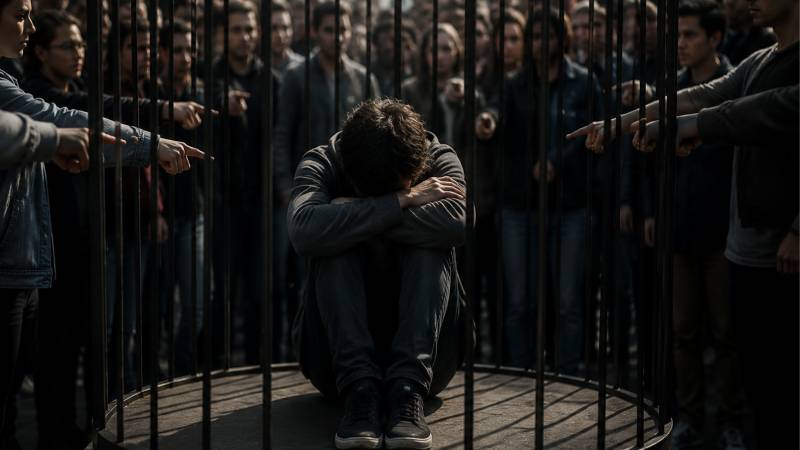
Whether the words belong to a philosopher or merely to common wisdom is almost irrelevant. What matters is that modern society has quietly transformed this fear into a social system. No civilization collapses because people think alike. It begins to weaken when people are no longer allowed to think differently. The pressure rarely arrives as law. It appears in laughter. In raised eyebrows. In subtle comparisons. In the innocent-looking question, "Why always the same?" Behind that question hides a far more dangerous assumption, that repetition is failure, simplicity is inadequacy, and personal contentment is something that requires public justification.
This is the paradox of the twenty-first century. Humanity has never celebrated individuality more loudly, yet conformity has never been rewarded more generously. A generation raised on the promise of self-expression increasingly finds itself imprisoned by invisible expectations. The expectation to own what everyone admires. To visit what everyone photographs. To experience what everyone approves. To become a carefully edited version of oneself rather than an honest one.
French philosopher Jean-Jacques Rousseau once observed, "Man is born free, and everywhere he is in chains." Those chains have changed their appearance. They are no longer forged from iron but from comparison. They no longer restrict movement but judgment. The modern individual walks freely, yet often chooses according to the audience rather than the conscience.
This phenomenon extends far beyond lifestyle. It has reshaped education, careers, relationships, ambitions, and even happiness itself. Success is increasingly measured not by fulfillment but by visibility. Satisfaction has become suspicious unless it is extraordinary. Ordinary joys are dismissed because they cannot compete with extraordinary performances.
The rarest luxury today is not exclusivity. It is the freedom to remain unchanged in a world addicted to making everyone the same.
The danger lies not in wealth, ambition, or exploration. None of these are enemies of a healthy society. The danger begins when preference loses its legitimacy, when choosing differently is interpreted as lacking vision, lacking taste, or lacking success. A society that ridicules simplicity does more than mock a choice; it impoverishes freedom itself. Diversity does not merely mean accepting different languages, cultures, or beliefs. It also means accepting different definitions of happiness. Moreover, the most alarming consequence of conformity is not that it produces similar lifestyles, but that it gradually erodes independent judgment. When acceptance becomes more valuable than authenticity, people cease to examine their own convictions and begin outsourcing their choices to the expectations of others. What to admire, what to pursue, what to celebrate, even what to condemn increasingly becomes a collective decision rather than a personal one. Such a society may appear harmonious on the surface, yet beneath that uniformity lies a dangerous intellectual dependence. As Ralph Waldo Emerson wrote, "To be yourself in a world that is constantly trying to make you something else is the greatest accomplishment." The loss of that accomplishment is not merely a personal tragedy; it is a societal one. The Roman emperor and Stoic philosopher Marcus Aurelius wrote, "Very little is needed to make a happy life." Centuries later, the modern world continues searching for happiness by adding more, while forgetting the quiet strength found in needing less.
Perhaps the greatest crisis of this generation is not materialism but imitation. When admiration becomes competition, authenticity becomes rebellion. When approval becomes currency, character becomes collateral. When trends begin dictating identity, freedom quietly disappears. History has never remembered civilizations for the restaurants they visited, the brands they purchased, or the destinations they displayed. It has remembered those who possessed the courage to remain themselves while the crowd demanded imitation. The future of any society depends less on producing successful people than on producing independent minds. For a civilization where every life begins to resemble the next may achieve uniformity, but it will never achieve wisdom. It may become efficient, polished, and impressive, yet still remain spiritually poor.
A healthy society is not one in which every citizen makes identical choices, but one in which different choices are met with equal respect. True pluralism is measured not by slogans celebrating diversity but by the willingness to accept lives that do not resemble our own. Civilizations flourish when they protect the freedom to define success in different ways, for uniformity may create order, but only diversity of thought can cultivate wisdom. A society that refuses to make room for different ways of living ultimately narrows not only individual freedom but its own collective imagination.
And perhaps that freedom begins with a simple act of courage: choosing what is true over what is trendy, what is meaningful over what is admired, and what is enough over what is endlessly promoted. In that choice lays not only personal dignity but the possibility of a healthier society. The rarest luxury today is not exclusivity. It is the freedom to remain unchanged in a world addicted to making everyone the same.