

Technological advancements, expedited digital integration and access, merging geo-economic significance and green transition are some of the major drivers that have transformed the face of the occupational market today, requiring completely different skill sets than were required previously. The ongoing uptick in demand for new skills via reskilling to connect with today’s realities has created an urgency to replace the out-of-focus skills with emerging and relevant skills. Such urgency can be met through reorienting and realigning the skills taught in the curricula of Pakistan’s pedagogy.
The World Economic Forum’s 2025 report explicitly mentions that the demand for 39 percent of ‘core skills’ that workers had in 2024 will change by 2030. That means within five years more than a quarter of the skills workers have today will become mostly irrelevant, mainly about manual dexterity. The industrial landscape will continue demanding a higher degree of specialisation that combines manual skills with technological literacy. For instance, the top three skills highest in demand by 2030 will be AI and big data, especially in the automotive and aerospace industry, networks and cyber security in financial and capital markets and overall technological literacy in all fields. The demands for such ‘augmented’ human skills will accordingly displace various jobs even in low-income countries.
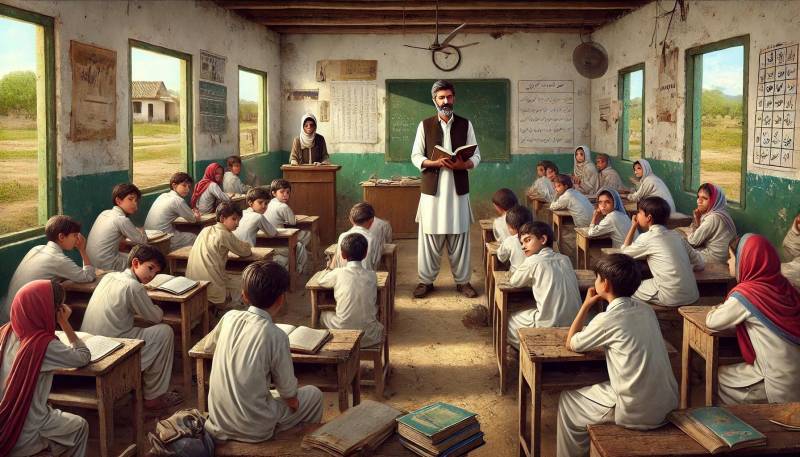
In such transitional times, it is crucial to reassess and reevaluate the education system and structure of Pakistan, which is currently educating 62.3 percent of its population to create a future-ready workforce. At present, the curricula in Pakistan, based on colonial standards, aim to instill three basic skills in the learners, across elementary level to higher level; career skills, life skills, and literacy skills. However, it requires deeper scrutiny of whether they meet today’s standards and are effective in creating innovative thinkers aligned with today’s global market.
As for career skills, there is a continual change in the demand for these skills. For instance, the World Economic Forum report of 2020 ranked analytical thinking and innovation as the most relevant skills for the year 2025, and as the year has arrived, it is clear that entrepreneurial talents produce more outcomes in today’s economic structure. In Pakistan, although the adoption of AI tools such as intelligent tutoring systems (ITS) and learning management systems (LMS) has been highly incorporated in educational practices, the content remains outdated and centralised where even educators lack clarity on learning objectives. The scant attention towards learning outside the textbooks and stagnancy in evolving content to align it with contemporary needs halts the inculcation of required analytical skills to create a future-ready workforce.
The focus on memorisation of textbooks must be supplanted with hands-on learning like computational thinking exercises to increase mental capabilities and expand targeted skills development efforts
Likewise, life skills that are crucial in instilling personal and social competence that leads to an out-of-the-box thinking approach are often thwarted by traditional ways of rote learning encouraged by assessment methods that require cramming and reproducing the same content on exam day. Although Pakistan has been making efforts in this area, particularly through National Education Policy 2017-2025 which incorporated various life skills, the transition remains slow because of weak implementation. Interactive or project-based learning still constitutes a minor part of content-focused and packed curriculums.
The third basic skill—literacy skills—provide constructive framework for the character education through inculcating information literacy, media literacy, and technology literacy to instil values and insights necessary for overcoming ethical and moral challenges in online life. By 2030, technological literacy will become inevitably non-negotiable ‘in-demand’ skill. Within this context, the need to undergo a major transformation in current curriculums becomes even more urgent.
Starting with academic skills, the focus on memorisation of textbooks must be supplanted with hands-on learning like computational thinking exercises to increase mental capabilities and expand targeted skills development efforts. Such changes in learning methods will also require completely different methods of evaluation and assessments, mainly revolving around project-based assessments rather than paper-based reproductions of the memorised corpus. Finland, having one of the best education systems, is leading such practices, especially in the form of their ‘Capstone projects’ in their curriculums, where students are required to apply their learning to a practical issue.
Similarly, to inculcate life skills, the home economics courses in government schools of Pakistan already serve as a model for better incorporating practical life skills into curriculums. Aligning these courses with modern demands, can prove extremely effective in teaching how to budget, cook, and care for textiles. It also ought to transcend traditional gender roles and include skills applicable to the broader world. When it comes to digital literacy, the foremost essential requirement is to facilitate data access across vertical hierarchies of society. Technological literacy will naturally follow if access is there but it also requires facilitators/teachers who will instill digital ethics and communicate responsible use of technologies.
Nevertheless, such reskilling efforts in education system can never culminate into something fruitful if ‘will’ is not generated within the pedagogy and to generate this shift from traditional pedagogy to a constructivist one, a holistic redressal is needed which not only addresses learning and evaluation methods but also cover pedagogues’ concerns.