

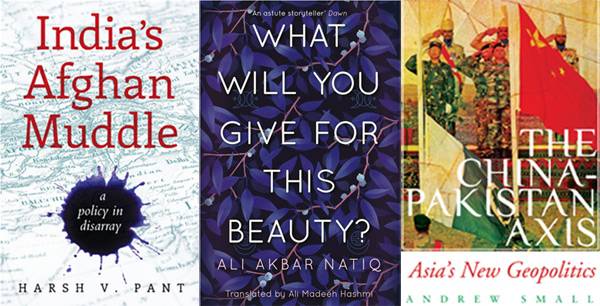
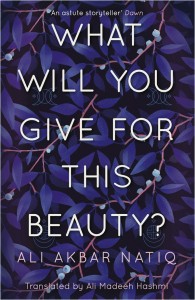
What Will You Give For This Beauty?
Ali Akbar Natiq, transl. Ali Madeeh Hashmi
Hamish Hamilton [hardback], 2015
PRs 795
Qaim Deen sneaks across the Sutlej into India to steal cattle – braving cobras, wild boar and the border patrol – and gives generously of his earnings to those in need. Young Nauman’s forbidden love for Nuzhat leads him to seek refuge in a holy place, at a terrible cost to his family. Maulvi Abdur Rahman and his neighbour’s bull terrier engage in a hilarious and unrelenting battle of wits. Could Kareema’s beauty, which hits the village like a storm, be the salvation of Ghafoora the Dimwit?
Ali Akbar Natiq brings vividly alive the world of the Punjab countryside, with its undercurrent of violence and poverty, through feuds and feasts, hunts and weddings, mobs and floods, elopements and gossip. Acrobats, holy men, thieves, peasants, landowners, masons and courtesans populate the stories of his virtuoso debut collection. Possessed of dark irony and a searing moral vision, Natiq is a storyteller of exceptional talent and manifest power.
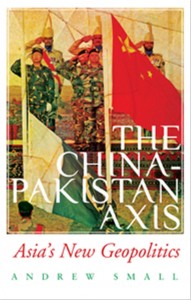
The China–Pakistan Axis: Asia’s New Geopolitics
Andrew Small
Hurst Publishers [hardback], 2015
PRs 2,195
The Beijing–Islamabad axis plays a central role in Asia’s geopolitics, from India’s rise to the prospects for a post-American Afghanistan, from the threat of nuclear terrorism to the continent’s new map of mines, ports and pipelines. China is Pakistan’s great economic hope and its most trusted military partner; Pakistan is the battleground for China’s encounters with Islamic militancy and the heart of its efforts to counterbalance the emerging US–India partnership. For decades, each country has been the other’s only ‘all-weather’ friend. Yet the relationship is still little understood. The wildest claims about it are widely believed, while many of its most dramatic developments are hidden from the public eye.
This book sets out the recent history of Sino-Pakistani ties and their ramifications for the West, for India, for Afghanistan, and for Asia as a whole. It tells the stories behind some of its most sensitive aspects, including Beijing’s support for Pakistan’s nuclear program, China’s dealings with the Taliban, and the Chinese military’s planning for crises in Pakistan. It describes a relationship increasingly shaped by Pakistan’s internal strife, and China’s own dilemmas between the need for regional stability and the imperative for strategic competition with India and the US.
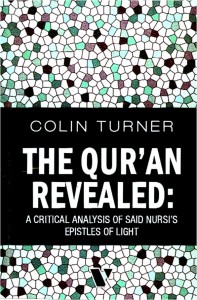
The Qur’an Revealed: A Critical Analysis of Said Nursi’s Epistles of Light
Colin Turner
Repr. Vanguard [hardback], 2014
PRs 1,495
Colin Turner’s analysis of Nursi’s ‘Epistles of Light’ presents the latter’s commentary on the Qur’an in an especially interesting manner for English-speaking audiences. The Epistles focus on a range of theological and philosophical themes, including nature and causality, belief and unbelief, righteous action, sincerity and brotherhood, love, and politics, running the gamut of human existence and reflections on humankind’s place in the universe. Turner’s interpretation is a remarkable exercise in “thick description” – a method of critical inquiry associated with anthropologist Clifford Geertz, which places a text or set of events in a context that allows outsiders to understand its significance.
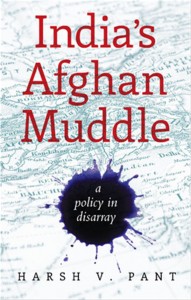
India’s Afghan Muddle: A Lost Opportunity
Harsh V. Pant
HarperCollins India [hardback], 2014
PRs 895
It is 2014. Afghanistan’s biggest watershed since 2001, the year the war on terror began, is upon it. American forces are in the middle of a pull-out that is likely to result in a much smaller US military footprint after this year. On the face of it, the stage is set for India – a regional power with global aspirations – to rise to the occasion, bank on Afghan goodwill, and help rebuild the nation. But, presented with a golden opportunity, India has been found wanting.
This book examines the changing trajectory of Indian policy towards Afghanistan and argues that New Delhi has responded to a strategic environment shaped by other actors without developing an autonomous posture. By refusing to be proactive, India has lost the initiative and done some long-term damage to its vital interests, the least of which is gaining access to energy-rich Central Asia while the biggest is to foil Pakistan and the Taliban’s designs of once again rising to prominence in Afghanistan. The way in which India’s foreign policy shapes up this year – or if it does at all – will determine the consequences for Indian security once Western forces depart. As Afghanistan braces itself for the most important year in its political history since 2001, India’s Afghan Muddle sets the terms for the debate on why 2014 is no less important for India as well.
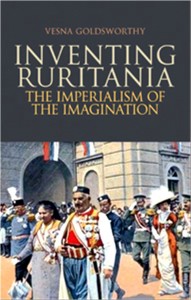
Inventing Ruritania: The Imperialism of the Imagination
Vesna Goldsworthy
Hurst Publishers [paperback], 2013
PRs 3,015
First published in 1998, Inventing Ruritania achieved a rare combination of critical success, broad readership and enduring academic influence. It is now recognized as a key contribution to the study of Balkan and European identity. Now in an updated edition, the book is just as topical in the context of Europe’s current turmoil as it was when it first appeared.
Goldsworthy explores the origins of the ideas that underpin Western perceptions of the Balkans, the ‘Wild East’ of Europe. European and Oriental at the same time, the Balkans are tantalisingly ambiguous – an exciting alternative to the familiar ennui of the West, both completely different from ‘us’ and exactly as ‘we’ used to be. Writers and filmmakers in Western Europe and America have found in the peninsula a rich mine of images for literature and film. In her prodigiously researched but readable volume, Goldsworthy shows how this lucrative exploitation of Balkan history and geography by the entertainment industry has affected attitudes toward the region. She considers the religious, national and sexual taboos projected onto Balkan lands and discusses the political exploitation and media uses of Balkan archetypes.