

Pakistan’s 2025–26 budget is not a roadmap to revival—it is a confession of failure. Its pages speak a brutal arithmetic: the state borrows ever more to pay for its past, even as it bleeds revenue through colossal legal giveaways that benefit only the few. When the Economic Survey peels back the façade, three stark truths emerge that define our moment:
People work and pay taxes, which are used to service debt
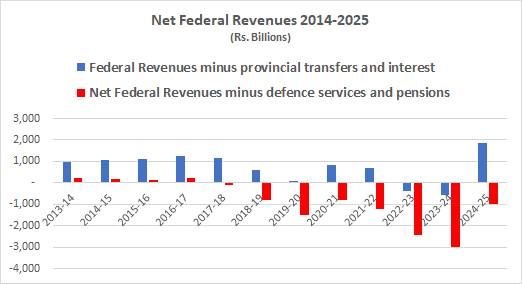
More than 80 percent of net federal revenues—every rupee raised in taxes, customs duties and levies—is used pay to interest on past borrowings. The government raised nearly Rs 8.5 trillion in fresh loans last year, not to build schools or hospitals, but simply to plug financing gaps and honour previous debt. Each tranche of new borrowing becomes tomorrow’s claim, leaving almost nothing for public services.
Tax subsidies for the powerful cost more than defence and education combined
Hidden in the Economic Survey is a more painful truth: “legal subsidies”—exemptions, rebates and loopholes—total Rs 5.84 trillion (~USD 21 bn) representing about 5 percent of GDP in 2024–25, were up 51% from last year, as reported in the Economic Survey. It is the revenue the government forgoes due to tax exemptions, concessions, and reliefs.
That sum exceeds defence spending (nearly 3 percent of GDP), dwarfs combined outlays on health and education, and flows almost entirely to politically connected landowners, real-estate magnates, power producers, and luxury‐goods importers. They pay no capital-gains tax, escape sectoral surcharges, and import high-end items under preferential rates, while small exporters and service firms navigate a Kafkaesque tax code that throttles growth.
Investment in infrastructure and people has all but disappeared
Education spending remains stuck below 1 percent of GDP, leaving millions of children in overcrowded, under-resourced classrooms and excluding nearly 26 million from schooling. Health allocations follow a similar pattern, with rural clinics often out of medicine and urban hospitals forced to turn patients away. Meanwhile, debt service swallows more revenue than these sectors receive combined, causing provinces to make deep cuts to critical welfare programs even as poverty intensifies.
As debt service and privileged exemptions dominate the ledger, ordinary Pakistanis will see their hopes mortgaged to the very system that fails them
This bleak federal picture is only part of the story in a federation. Although provinces have yet to finalize their budgets for 2025–26, available data from provincial Annual Development Plans (ADPs) shows they consistently plan far greater development spending than the federal government. In 2023–24, provinces together allocated nearly three times the federal PSDP’s actual disbursement. But these provincial plans are also funded largely through federal transfers—transfers now under severe pressure as debt service continues to climb. Without a more reliable federal revenue base, those provincial commitments may remain merely lines on paper, with stalled projects and unfulfilled services as the provinces have failed to mobilise resources on their own despite the devolution of powers more than a decade ago under the 18th Amendment.
These three dynamics—sky-high debt service, massive tax giveaways, and underinvestment in infrastructure and human capital, —are not isolated. They form a vicious loop. Exemptions hollow out the revenue base, forcing fresh borrowing. Borrowing swells debt-service claims, which in turn crowds out spending on essential services, deepening social discontent even as the elite remain insulated.
The federal Public Sector Development Programme illustrates this decay. Branded as a Rs 1 trillion commitment to roads, bridges and power, it is in fact a monument to broken promises. In 2023–24 the PSDP carried Rs 12 trillion in project commitments but received only Rs 950 billion in actual funds, leaving a Rs 10.45 trillion backlog of half-built highways, skeletal hospitals, abandoned irrigation schemes and ghost schools. At current disbursement rates, it will take more than a decade merely to clear past projects—by which time inflation, graft and political meddling will have more than doubled their original cost estimates.
Cost overruns are not anomalies but systemic features. Contracts awarded without competitive bids, invoices inflated by insiders, audits weakened by deliberate loopholes—every step feeds the same patronage networks. Contractors with political connections reap windfalls, while citizens wait for water that never flows and power that never comes. Each rupee wasted in overruns adds to the borrowing requirement—and thus to next year’s interest bill.
If defence spending at 3 percent of GDP draws criticism, it must be seen in context: it pales beside a haemorrhage of 5 percent of GDP in tax expenditures. Yet scrutiny falls more readily on the uniform than on the loophole. The armed services remain sacrosanct, defended as essential to national security, while exemptions for the wealthy are lauded as “incentives” for growth. In reality, these concessions are privileges carved out by power rather than productivity.
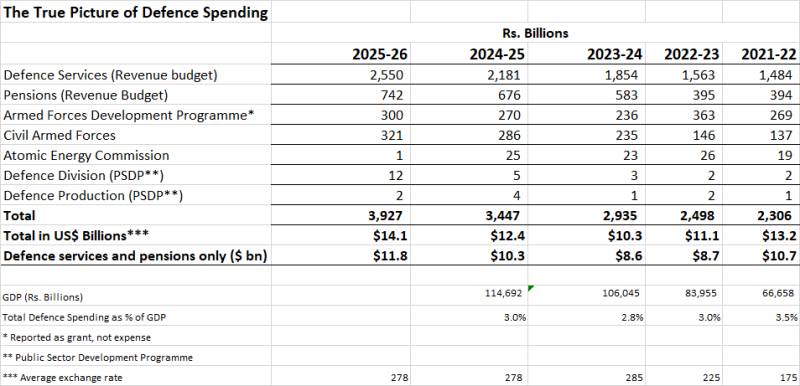
Here is a table for the defence spending, which contrary to public perceptions, has not increased much in real terms since 2020-21, although the 2025-26 budget (excluding pensions) shows an increase of 17%. Last year, it was around $10.3 billion (compared to India’s $86 billion) and this year’s budget is only marginally more than Pakistan spent on defence in FY 2021-22 in US dollar terms.
Citizens hear that subsidies on food and fuel cannot be spared, that welfare programs must be tightened, and that school and hospital budgets must be trimmed. But legal subsidies face no squeeze. Those exemptions cost twice as much as defence, yet no committee demands their rationalisation. The state borrows for every crisis—currency stabilisation, food imports, flood relief—while sparing those whose voices carry the most weight in Islamabad’s corridors of power.
International lenders applaud headline deficit reduction—from nearly 6 percent of GDP to around 4 percent—and promise more support if “reform continues.” But what do they mean by “structural reforms”? But without tackling the twin scourges of runaway borrowing and privileged exemptions, those targets amount to accounting sleight-of-hand. The government meets its numbers by shifting the burden onto the most vulnerable, even as entrenched interests remain untouched.
What hope remains? A budget that devotes over 80 percent of revenues to debt service and forgoes 5 percent of GDP to tax subsidies leaves precious little for development. Schools cannot be built, clinics cannot be stocked, highways cannot be completed. Instead of a roadmap to prosperity, what we have is a cycle of debt, dependence, and deferred dreams.
Pakistan’s future depends on breaking this cycle. It requires confronting the dual maladies of runaway borrowing and extravagant exemptions. Every exemption is a rupee not available for teachers’ salaries or rural clinics. Every loan taken today is a debt our children will pay tomorrow in taxes and foregone services. And every rupee channelled into debt service is a rupee denied to human capital.
Until the budget acknowledges these hard truths—and unless policymakers find the political will to act—Pakistan will remain trapped. A nation that cannot stabilise its finances cannot invest in its people; a country that cannot invest in its people cannot hope to prosper. And so long as debt service and privileged exemptions dominate the ledger, ordinary Pakistanis will see their hopes mortgaged to the very system that fails them.