

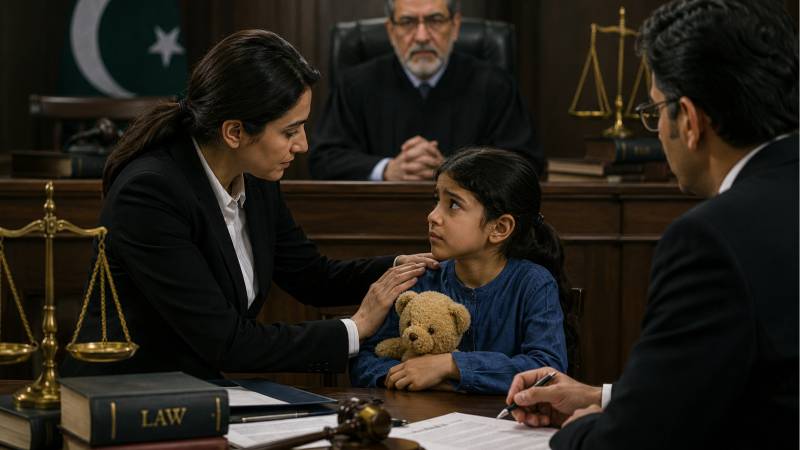
The Supreme Court of Pakistan, in its recent landmark judgment, in Younas Masih v. The State, authored by Justice Salahuddin Panhwar, deals with appreciating evidence when a child victim is raped. The judgment is in conformity with the UN General Assembly Resolution 40/34. Declaration of Basic Principles of Justice for Victims of Crime and Abuse of Power; as well as the UN Guidelines on Justice in Matters involving Child Victims and Witnesses of Crime.
The judgment refuses to disclose the identity of the child victim and refers the said victim as “M”, and by doing this, it is protecting the identity, privacy and dignity of the child victim. The child victim was ten years old, and the accused was a sweeper at the school, and he took the child victim to a secluded part of the school to commit rape.
The judgment addresses the issue of forensic evidence as it was argued by the accused that the absence of seminal material on the vaginal and anal swabs destroys the charge of penile penetration. It was held that a forensic descriptor must not be converted into a moral judgment or a conclusion about prior sexual history. The judgment explains that the absence of seminal material on the vaginal and anal swabs is important, but it is not decisive, as the offence of rape does not require proof of ejaculation nor does the law require detection of semen as a condition precedent to conviction.
The judgment further elaborates that biological recovery is time-sensitive and can be affected by the interval between occurrence and examination, the nature of the act, non-ejaculation, using condom, preservation issues, cleaning and other variables, and while the forensic report was negative for semen, the medical observations were otherwise present, and the child victim’s account remained direct and credible.
This judgment has allowed the legislature to amend the Qanun-e-Shahadat Order, 1984, and the Anti-Rape (Investigation and Trial) Act, 2021, in order to facilitate investigation agency and trial court to collect and record evidence in gender-based violence cases.
On the issue of delay in lodging FIR, the judgment states that the facts of the case do not merely explain delay on the part of a frightened child and her mother, but also disclose an institutional silence after the matter had come to the notice of school personnel, and after medical aid was provided to the child victim by the school authorities, within the school premises, and because the school administration did not promptly report the matter to the police, a child victim and her mother cannot be prejudiced by such institutional reticence, particularly where the school administration chose to remain silent to save their reputation.
The mother of the child victim is a widow and a household lady, and she did not receive a formal legal complaint from an adult witness, instead she observed behavioural change in her child, and upon disclosure by the child victim, approached the authorities. The judgment explains that in sexual offences, particularly involving children, silence and delay can be from fear, shame, confusion, dependence, family pressure, apprehension of stigma, and the inability of a child to articulate the wrong, and even trauma may affect victim’s memory, confidence and willingness to speak.
Under Article 3 of the Qanun-e-Shahadat Order, 1984, every person is competent to testify unless the court finds that tender years, old age, or disease prevents him from understanding the questions or giving rational answers. Judgment elaborates that the trial court held a voir dire (testing witness’s competency) and after questioning the child victim about her school, her class and her surroundings, recorded that she understood the questions and answered rationally, so the child victim’s testimony was sufficient to sustain a conviction, even on a capital charge.
The judgment also states that the testimony of a child who has suffered sexual violence may not repeat graphic details in open court nor the law requires the child victim to do so. The judgment interprets public place, stating that a school has secluded corners, and a person with access may choose them precisely because they are hidden within a busy place, so innocence cannot be inferred merely because the institution was populated.
The judgment also presented the Sindh Medico Legal Act, 2023, as a model for the federal and provincial governments to follow, in constituting a dedicated medico-legal cadre, with a defined service structure, structured training in forensic examination of victims of sexual violence, the appointment of women medical officers, and institutional coordination with forensic science agencies.
Appreciating evidence of a child victim in rape case is very difficult, but this judgment has resolved several severe issues, and has allowed the legislature to amend the Qanun-e-Shahadat Order, 1984, and the Anti-Rape (Investigation and Trial) Act, 2021, in order to facilitate investigation agency and trial court to collect and record evidence in gender-based violence cases.