

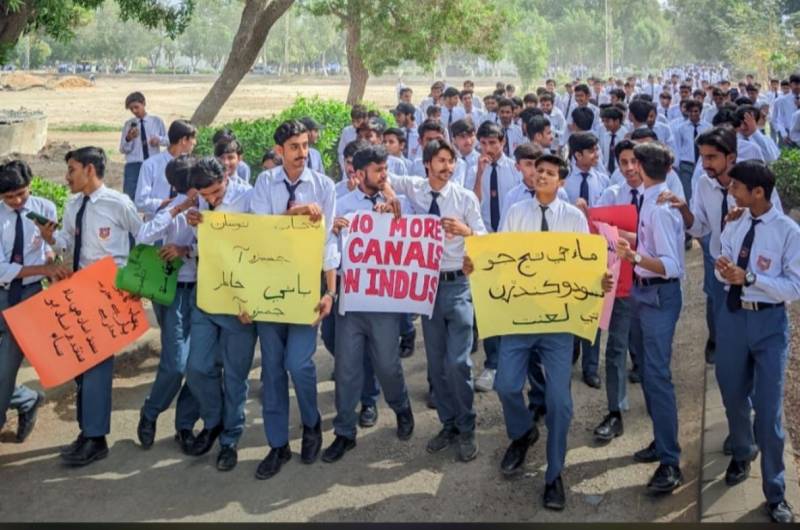
Leaders of nationalist parties, social activists, writers, and analysts in Sindh are upset with President Asif Ali Zardari's stance on the six canals scheme. During his address to parliament, Zardari opposed the Cholistan project, but Sindhi leaders call this a mere "Lolly Pop" to appease them. They vow to continue their struggle until the federal government and IRSA reverse their decision to build canals on the Indus River.
Riaz Chandio of JSM-Jeay Sindh Mahaz announced a protest on 14 March, International Rivers Day, at Katri Barrage. Ayaz Latif Palijo called it a trick of the PPP government and the President to defuse the massive movement against the canals. Noor Ahmed Katiyar urged elected MPAs and MNAs of Sindh to move a resolution against the project of six canals on the Indus River in the provincial and national assembly.
Poet and writer Jami Chandio called it an issue of life and death for the people of Sindh. The President of the District Bar Association Hyderabad, through a notification on Tuesday, announced a rally on 14 March to mark International Rivers Day and pay homage to the Indus River.
On the one hand, resistance across Sindh continues against the scheme, while on the other hand, water scarcity continues to deepen the coastline of Sindh.
Protests Continue Across Sindh
People from various walks of life, including nationalist party workers, religious groups, students, and civil society representatives, gathered at Shaheed Fazil Rahu Chowk in Jati town, Sujawal district. They protested against the six canals scheme, IRSA, and the federal government, accusing them of trying to deprive Sindh of its rightful water share and turning the region barren.
The protesters, carrying banners and placards, marched through the city's main streets and staged a sit-in at Jati town's main entrance, blocking traffic on the Jati-Sujawal road. Several leaders addressed the protesters, including Ashraf Thaheem of the Sindh Tarqi Pasand Party, Adil Laghari, Wafa Shah, Khalid Hussain Jat, Syed Mahetab Shah, and Nawaz Sheikh.
The speakers condemned the six canals scheme as a conspiracy against Sindh and the Indus River. They argued that neither national nor international law allows the exploitation of small provinces' resources. The federal government, they claimed, has no right to make unilateral decisions without the consent of the Sindhi people.
The protesters emphasised that the people of Sindh had overwhelmingly rejected the six canal scheme, which they saw as an attack on Sindh's riparian rights. Adil Laghari noted that water scarcity had forced residents of tail-end areas to buy water at exorbitant prices, putting human life and the survival of aquatic creatures at stake in Sindh's coastal areas.
Mahtab Shah vowed that the people of Sindh would continue to resist the scheme until it was scrapped. He expressed concern about the Indus River and the fertility of Sindh's lands, which would be threatened if the six canals scheme was implemented. Ashraf Thaheem of STP urged the people of Sindh to draw international attention to this issue.
Similar protests were held in Daro, Bathoro, and Sujawal city, condemning the construction of canals on the Indus River and the inadequate water supply at the Kotri downstream. Students of public sector schools in Hyderabad, Ghotki, Daro, and Badin staged protests against the ongoing water crisis and the wrongful scheme bound to worsen water shortage in the province.
Artists of Sindh, including singer Shaman Ali Mirali, Ghulam Shabbir Samon, actor Sattar Larr, and others, joined protests against the canals project in their respective cities and created mass awareness by singing nationalist songs.