

Hospitals are places of healing. Every day, they save lives, ease pain, and support families in their most vulnerable moments. But alongside this vital work, hospitals also generate a less visible by-product: waste. Used syringes, blood-soaked bandages, discarded medicines, laboratory chemicals, and general refuse all leave hospital wards daily. If not handled properly, this waste can quietly turn into a serious threat to human health and the environment.
In Sindh, hospital waste management has long been an under-discussed issue, even though the province hosts thousands of public and private healthcare facilities. The good news is that awareness is growing, systems are improving, and institutions are stepping forward to support hospitals in doing the right thing.
Hospital waste is not all the same. A large portion is general waste similar to household rubbish, but a significant share is hazardous. This includes infectious waste that can spread diseases, sharp objects that can cause injuries, pharmaceutical waste that can contaminate water, and chemical waste that can harm ecosystems.
When such waste is mixed, dumped openly, or burned improperly, it exposes hospital staff, waste handlers, scavengers, and nearby communities to infections such as hepatitis B, hepatitis C, and HIV. It can pollute groundwater, clog drainage systems, and release toxic fumes into the air. In short, poor hospital waste management turns a healthcare service into a public health risk.
Sindh has made steady progress in expanding healthcare access, but waste management practices have not always kept pace. In many facilities, waste segregation at source is weak. Colour-coded bins are either missing or not used correctly. Temporary storage areas are poorly designed. In some cases, waste is handed over to informal collectors who lack protective equipment or training.
These gaps are not always due to negligence. Often, they result from limited resources, high patient loads, lack of technical understanding, and the absence of structured training for doctors, nurses, paramedical staff, and sanitary workers. Hospital administrators are expected to comply with environmental regulations, but many struggle to translate rules into day-to-day practice.
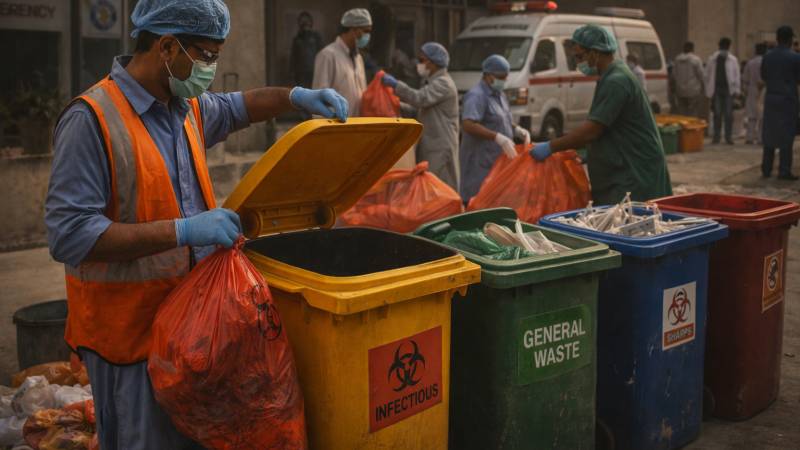
One of the simplest yet most powerful steps in hospital waste management is segregation at the point of generation. When infectious waste, sharps, recyclable materials, and general waste are separated correctly, the entire system becomes safer and cheaper.
Recognising that hospitals need practical support, SEPA has started imparting structured training on Hospital Waste Management (HWM) across healthcare facilities
Proper segregation reduces the volume of hazardous waste that needs special treatment. It lowers the risk of needle-stick injuries. It protects cleaning staff, who are often the most vulnerable link in the chain. Most importantly, it creates a culture of responsibility inside healthcare facilities, where everyone understands that waste is not “someone else’s problem.”
After segregation, waste must be treated and disposed of through safe and approved methods. Incineration, autoclaving, chemical disinfection, and secure landfilling all have a role, depending on the type of waste. Sindh has seen a gradual improvement in centralised treatment facilities, particularly in major cities, but coverage remains uneven.
Transporting waste safely, maintaining records, and ensuring final disposal are critical steps. Without monitoring, even well-designed systems can fail. This is why hospital waste management is not just a technical issue but a governance issue as well.
Compliance with hospital waste management rules should not be seen as a burden or a box-ticking exercise. At its heart, it is about protecting people. A nurse who avoids an infection because sharps were disposed of correctly. A sanitation worker who returns home safely because gloves and masks were provided. A child who does not fall sick because medical waste did not end up in a drain.
When hospital staff understand this human connection, compliance becomes meaningful rather than forced.
Quite recently, Sindh has witnessed a more constructive approach towards improving hospital waste management. Instead of focusing only on penalties, the emphasis is increasingly on capacity building, guidance, and partnership.
The Sindh Environmental Protection Agency (SEPA) has been playing a key role in this shift. Recognising that hospitals need practical support, SEPA has started imparting structured training on Hospital Waste Management (HWM) across healthcare facilities. These trainings are designed not just for administrators but also for doctors, nurses, paramedical staff, and waste handlers.
The sessions cover waste segregation, colour-coding, safe handling of sharps, temporary storage, internal transportation, use of personal protective equipment, and legal responsibilities under environmental laws. Importantly, the technical concepts are explained in simple, workable language, making it easier for hospital teams to apply them on the ground.
By offering hands-on HWM training, SEPA is helping hospitals ease their compliance burden. Instead of guessing what the rules mean, hospital staff now have clarity. Instead of fearing inspections, administrators can prepare systems with confidence. Training also creates ownership within hospitals, turning compliance into a shared institutional goal rather than an external pressure.
This approach sends a strong message: environmental protection and healthcare delivery can go hand in hand. With the right knowledge and support, hospitals can protect patients, staff, and the environment at the same time.
Hospital waste management in Sindh is still a work in progress, but the direction is encouraging. With growing awareness, improved infrastructure, and continuous training, the province has the potential to build a safer and more responsible healthcare system.
When hospitals manage their waste responsibly, they do more than follow the law. They uphold the very purpose of healthcare: to do no harm. And with SEPA’s ongoing efforts to train and guide healthcare facilities, compliance is no longer a hurdle. It is becoming a pathway towards safer hospitals and a healthier Sindh.