

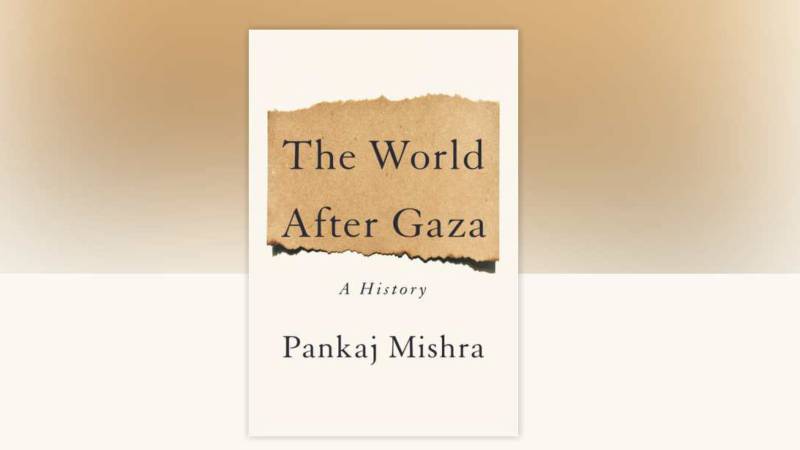
This book is a multifaceted critique of the metanarrative built and sustained by the victorious West after the Second World War. It is more of a discourse analysis of epoch-making events of the 20th century than a traditional chronological narration. A counternarrative that exposed the flaws of 19th-century ‘Orientalism’ is taken a step forward here. Also, it is not a deconstruction of the dominant narrative; it is rather an attempt to hold the mirror up to the powers to help them see their own faces in the context of colonialism and slavery.
This kaleidoscopic narration interprets Zionism, colonialism, slavery, and apartheid as a Western enterprise that, in the second half of the 20th century, led to the creation of Israel, decolonisation, and emancipation. By insisting that Zionism is the extension of colonialism and slavery, the author tries to undermine the moral high ground taken by the Zionists as victims.
Pankaj Mishra plants his feet in the ruins of Gaza, from where he makes a dispassionate analysis of the Holocaust (he prefers to call it Shoa, the Hebrew word for the Holocaust). How the tragedy unfolded while the West looked the other way; how the Jewish refugees were turned away from America and Europe, before they decided to champion the cause of Zionism as a solution to Europe’s Jewish Problem, at the expense of the people of Palestine. How the Zionist state, and its intellectuals, changed their approach to Shoa—from a sense of shame and humiliation to a marketable narrative of victimhood, living under perpetual threat of annihilation. The book calls it the weaponisation of the Holocaust, whereby the West provides unquestioned support for Israel’s security policies: the Nakba of 1948, the Arab–Israeli wars of 1967 and 1973, repeated incursions and occupation of southern Lebanon, and the Gaza tragedy today.
The book takes the argument further to show how the discourse of victimhood is being exploited by nationalist authoritarian leaders in the name of Hindutva in India
The discourse analysis proceeds at two levels. One, the triumph of the liberal democratic capitalist West over fascist totalitarian regimes. In this narrative, the Holocaust served as the face of human evil that must “never happen again”. Second, colonisation, slavery, apartheid, and the struggle against them. Here the colonial powers committed atrocities against the non-white people in Asia, Africa, Native Americans, and the Aborigines.
The book lays bare the de-historicisation of the “native brute”, who does not exist except as a “negative value” to the imperialist forces. The Gaza of today, and the Nakba of yesterday, are the continuation of the same narrative that sees Palestinians not as people, with a history and culture of their own, but as a nuisance to the superior chosen people who have a God-given right to their land. Thus, Israel is seen as “settler colonialism”.
The tragedy of Gaza has utterly exposed the fault lines of the Western narrative of moral superiority, and the Zionist narrative of victimhood.
The book takes the argument further to show how the discourse of victimhood is being exploited by nationalist authoritarian leaders in the name of Hindutva in India.
It is claimed that, fearing the loss of power and influence in the face of the rising East, the West has developed a sort of “siege mentality” and portrays itself as a victim.
The Gaza tragedy has seriously damaged the Western moral authority, paraded for too long in the name of democracy and human rights.
The book is heavily sourced from many authoritative references, but in the absence of footnotes it becomes difficult to dig deeper into the quoted sources or to verify the context of the quote. The index is also missing, making it difficult to go back to the book once you have read it.