


Reunions and anniversaries are reflective of bonds of comradeship and affection. The 16th Entry (1965-71) of PAF College Sargodha recently celebrated their 60th anniversary of joining the College. It was to be an occasion to renew our long-lasting friendship and to commemorate our affection for the mother institution. We gathered for the three-day festivities from 10 to 12 October in Islamabad, with alumni arriving from US, Canada, UK, Germany, UAE and Australia, as well as from Peshawar, Karachi, Lahore and Rawalpindi. However, the activities actually continued from the 7th, with the first arrival from the US, to the 26th, with the last departure to the UAE. It was a much cherished gathering whose images shall stay with us for the rest of our lives, whatever little of it is left.
16th Entry joined the Sargodha College, then called School, on the 6th of September 1965 in class 8. That was also the day when war broke out between India and Pakistan. The School was closed for a month and a half, with most of the boys being sent to the sister school at Lower Topa.
Our entry consisted of 63 boys between the ages of 12-and-a-half and 13-and-a-half years of age. The selection for the School has been based on merit without any quota of any kind. 23 of us joined the Pakistan Air Force (PAF), 8 the Pakistan Army, and two each Bangladesh Army and Air Force. 28 pursued their careers away from armed forces. One rose to the status of four-star general (in the Bangladesh Army), four have achieved degrees of PhD, many hold MS and two pursued banking. Some have become authors of books or magazine-columns. Sadly, one-fourth of the Entry, 16 of us, have met their Creator, including three who died in the line of duty as a result of air crashes; as is said, ‘with their boots on.’
The primary role of Sargodha College has been to produce soldier material. It is conducive for producing strict adherents of laws, traditions and commands, but not for free thinking
The Entry has stayed very close since leaving the College. They feel exuberant and jubilant in mutual company. There is not a day when this author doesn’t speak to one of his Entry mates. This is besides the regular exchanges on WhatsApp, which are always friendly. Religion and politics, two of the most divisive subjects polluting most online groups, are avoided studiously. During college years, our issues of contention were performance in studies or resilience on playing fields. Ultimately, after 60 years of comradeship, we realise that friendships forged on sports fields and classrooms supersede all other divergences. This reunion was one of many that we have celebrated.
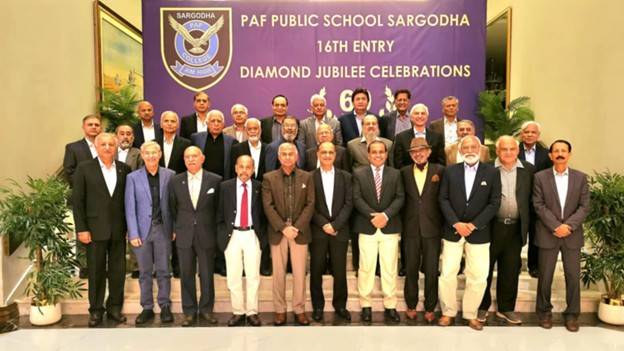
In 2015, we held the 50th golden jubilee, when with extensive support from PAF, we visited our Alma Mater for two days, including a night’s stay in one of the pre-cadet dormitories. We also gathered for two days for the 55th anniversary in 2020, when Covid was beginning to wane. As is evident, the College has instilled a bond that has endured time and distance.
With the success and fond memories of earlier get togethers, there was keen interest in the entry to hold the diamond jubilee anniversary. A Core Committee was established to devise a program, get security clearances, facilitate visas for oversea participants, arrange reception and see-off for foreign and outstation arrivals, reserve adequate accommodation, coordinate with PAF and have the souvenirs manufactured. As can be seen, it was a large task for which the Committee put in a lot of much appreciated work.
The six years that we spent in the School were a significant period for the nation. We joined the day the Indo-Pak war broke out in 1965, observed from behind closed gates the riots that ousted Ayub Khan regime in 1969, went through the turmoil of Yahya regime and graduated when a full-blown civil war was at its peak in 1971. Despite the unrest and bloody carnage in East Pakistan, our friendship with our Bengali school mates remained unaffected. None of our Bengali comrades, however, joined us when we entered PAF Academy in October of that year – it became the first GD (P) course of PAF without any Bengalis.
The School environment was absolutely secular, with the first mosque established in 1969, around 16 years after the school opened. We neither knew nor cared for anyone’s religious, sectarian or lingual affiliation, nor of their economic or social background. Friendships developed on the basis of common habits and likings, without any role played by religion or nationality. Some of the best friends of this scribe include Pashtuns and Bengalis, and these friendships have endured over the decades, transforming them into family affiliations. Secularism continues to be the guiding trait of our character.
The highlight of this anniversary, as in 2015, was a visit to the College. Most of us from Pakistan, especially those who served in PAF, have visited the place a number of times since we left but those who have settled abroad find few occasions to do so, especially the ones from erstwhile East Pakistan, who visited the College for the first time in 2015 for the Golden Jubilee gathering.
Naturally, these visits to one’s alma mater are emotional and nostalgic. This author, along with housemates of yesteryears, all in their mid-70s, visited our House as did the others to their houses. We looked at the dorms, that became our home for six long years at a very tender age. I recalled that our first dorm in-charge, a boy senior to us by three years, had lost his life during 1971 war over Badin airfield. We went to the indoor games room where we spent our spare time playing table tennis and learning the intricacies of chess, to the radio room where we entertained with music, to the prep room where we spent hours studying and to the wide front lawn, the largest of any other house, where we strolled with friends, or sat studying under tree shades during summer months.
I also sneaked to the back of house to the football field where, in the dark of a night a long time ago, I along with three other friends, smoked my first cigarette. It was heartening to see that the dormitories now had desert coolers to mitigate the scorching summer heat. The best development was the new toilet block, which is beautifully laid out with excellent furnishings. PAF and the College deserve to be highly commended for this. This author also spent a few lingering minutes in the house-library, where he was the in-charge during his final year.
The Academic block, to a large extent, is the same as before, with three significant exceptions. We pleasantly noted that the main hall had been tastefully remodelled, and the library had been extended, contrary to the trend in Pakistan where libraries are being folded up. The third pleasant surprise was the extension of the Archive Gallery into a double story building. This author remembers visiting the place a few years ago when the artefacts were housed in two cramped rooms. Now, it gives a magnificent look where stored memorabilia are displayed in a nice manner with good lighting. The gallery is now worthy of this great institution. We all were thrilled to see in the Gallery, the picture and uniform of our entry mate, Moeen Ahmad, who rose to be the Bangladesh Army Chief. The one day visit to the College by our entry shall always constitute a source of pleasant memories.
Over the years, the alumni of the College have done well in whatever field of profession they pursued. Many of them have risen to four stars in Air Force and Army, with innumerable having attained high positions in the three armed-forces, police and civil services. Three have commanded Bangladesh Air Force (BAF) and some became ministers in that nation. There have been countless PhDs and many who rose to the level of federal secretaries in civil services, ministers in federal government, head of financial and business organisations, bankers, successful entrepreneurs, airline executives, medical doctors and engineers.
While our alumni have done well in all spheres of life, some of us feel that there have been neither any scientists, innovators, discoverers or inventors, nor any social thinkers, philosophers or political pioneers. However, the Cadet Colleges, established on the model of Spartan and Janissary Schools, are not meant to do so. The primary role of Sargodha College has been to produce soldier material to run the air force. According to PAF College website, the Air Chief and Dir of Personnel in early 1951, AVM Atcherley and Air Cdre Janjua (later an accused in Rawalpindi Conspiracy Case), were concerned about the training aspect of the newly formed air force and decided to set up two 'feeder schools'; one in Sargodha and the other in Lower Topa. The selected boys are potential PAF Officers who are put through strict regimentation, to the extent that even teenage pranks invite strict disciplinary action. That environment has endured over the years and is, therefore, conducive for producing strict adherents of laws, traditions and commands, but not for free thinking.
They are also groomed to be brave and many have made these institutions proud. Saif-ul-Azam (class of 1954), whose one cousin, also from Sargodha College, later became the BAF Chief and the other, a PhD, was this author’s entry-mate, shot down one Indian fighter in 1965 and three Israeli fighters while serving with the Jordan and Iraq Air Forces in 1967. He still holds the record for most kills against the Israeli Air Force; by no means a small feat.
Then there was Flt Lt Matiur Rehman (class of 1956), who tried hijacking a PAF aircraft piloted by his student Flt Off Rashid Minhas in August 1971. Mati left behind his wife and two young daughters in the PAF Mess when he went on his one-way mission, betraying the Air Force that nourished him, but true to the nation that had been declared independent in March of that year. Both brave souls, ready to offer the ultimate sacrifice, typically emblematic of PAF, lost their lives and were awarded the highest gallantry awards by their respective nations. BAF Academy is named after Matiur Rehman, while a Base in Pakistan is named after Rashid Minhas.
Samin Jan Baber, incidentally from the same house as this author, from the initial entries of Sargodha School, joined the Pak Army and was awarded the Sitara Jurat in 1965 as well as in 1971. There are many from both schools who proved their mettle and training in the wars on the eastern as well the western front, and many others who lost their lives in the service of their nation. A few others served with honour in PAF and Army in engineering and allied branches of three services. The investment made by the nation in operating these schools has been richly amortised.
The reunion provided an excellent opportunity to interact with the young generation studying in the College. Their love for the Air Force and the nation was evident. It was satisfying to note that the future of the Air Force is secure with bright young boys opting to serve. They were also pleasantly amazed to see that even after leaving the premises, their seniors still rejoiced in the time spent in the College, and cherished the camaraderie developed more than a half century ago.