

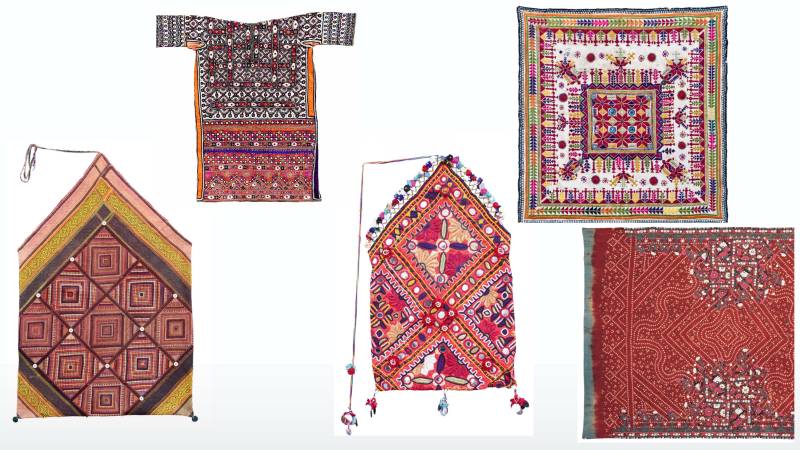
Nasreen and Hasan Askari, have quietly been taking Pakistani craft global and compiling an archive of textiles. The result is an impressive collection consisting of nearly 1,000 pieces on display in their home as Pakistan’s first textile museum, The Haveli, in Karachi. “Fifty years from now, unless this work is conserved, it will all be gone,” says Hasan Askari.
Their collection cannot just be described as a visual exhibit. It encompasses all that needs to be considered in today’s world in the context of history, human rights, climate change and sustainability.
The Askaris’ relationship with the arts can be considered a transcendental one. They are no strangers to this world made of artisans and artisanship. Nasreen Askari is the founder-director of the Mohatta Palace Museum in Karachi and co-author of the seminal book on the textiles of Pakistan, Colours of the Indus and on ceramics, Tale of the Tile. Hasan Askari, an investment banker by profession, is a former trustee of the British Museum in London. They are co-authors of the lavish The Flowering Desert documenting the tradition and heritage of handcrafted textiles in Sindh (now into its third reprint).
Nasreen began collecting textiles across Pakistan as a medical student in Jamshoro, focusing more on Sindh. Fifty years on she has built a collection that is considered to be one of the largest of its kind. “This is a self contained collection stretching over Pakistan and honing in on its inaugural exhibition on the textiles of Sindh. I felt it required to be seen,” she says.
Cultural documentation for the Askaris is an act of recognising and paying homage to the mosaic that is Pakistan and essentially, what it means to be a Pakistani, celebrating the identity with all its diversity.
The collection is displayed across five galleries in their home. In an era where art has become Yet Another Item For Sale, any element of value packaged as ‘an investment’, one could be forgiven for wondering what this museum will achieve. After all, the general criticism thrown at craft is that there has been no innovation and has no relevance in modern life.
However, what makes this criticism of the lack of innovation hollow is that it comes from the privileged (who have benefited the most from it) and it is made worse when one realises that craft itself has been nurtured and protected by the underprivileged, deprived of all opportunities and for whom craft reflects how they live.
“It is the age old dynamic of, is craft, art? Well certainly it is in our eyes. There are people who think there is too much ado about these textiles. The work is seen primarily rural and from settlements in Sindh and they are not from the ateliers of the fine designers of Karachi. But they are beautiful, relevant and representative of the people from whom they are drawn. They are not considered fine art. They are applied art and I thought because I had the makings of a consolidated collection I could possibly put it together and it could make sense,” says Nasreen.
The intellectualisation of textiles is a constructive means of communicating the techniques adopted in their production and understanding their patterns through a rational lens. But there is an entire dimension that often falls through gaps in the intellectual - unintentionally and perhaps due to lack of linguistic capture when it comes to explanation - which is, realising the human connection to fibre culminating in production of craft.
“We will actually create a platform for somebody to talk to the artisans and try and see if they are receptive to modern variations. That is up to the artisans,” says Hasan. “Our objective is to first and foremost conserve and document. We are not trying to monetise anything. It is reverse monetisation, we funded this museum entirely. It is our house, our collection, our funding. Of course one ought to take this forward, to innovate, to create and design, new patterns and new markets. We are just there to provide a platform for others to take it to the next level.”
Over the years, there has been a steady, growing awareness of the power of craft for female economic empowerment but also, as a method of communicating the real impact of climate change and what sustainable living looks like. In a world where sustainability is thrown around reducing it to a ‘trend’, this museum stands iconic as a form of decolonisation by encouraging ownership in Pakistan and also as a cradle nurturing ideas of exploration of the human relationship with nature in a Pakistani context.
“Clothes or garments are constantly being recycled into rallis (patchwork quilts). There is a great deal of sustainability in rural areas that escapes our attention in an urban setting,” observes Nasreen.
Recognising the rich quantities of varying craftwork across Pakistan, there is an acute awareness that access to regions is difficult. While KP and Punjab are comparatively easier than Sindh and Balochistan (Punjab being the easiest), the Askaris are willing to step in and address this.
“It is facile to talk about textiles but it is difficult to get to rural Sindh. I am hoping we will be able to inspire and encourage students to take the time and trouble to travel and we are quite happy to assist. I am very much hoping there will be a design intervention, students of design and textile arts will come forward and help us to innovate, explore and possibly put together patterns, colours and designs,” says Nasreen.
The Askaris have opened dimensions of exploration based in diversity, acknowledging that life cannot be lived in one homogenous way but in fact can essentially consist of coexistence, within Pakistan and beyond. A better opportunity for a better future could not be crafted by anyone else, anywhere else. The Haveli awaits.