

The Pakistan Democracy Act was recently introduced in the United States Congress. On the face of it, the bill appears to be a human rights measure. In substance, it is a political document. It attempts to single out Pakistan on the pretext of democratic backsliding and human rights violations. Such bills are not uncommon in U.S. foreign policy practice. But this one comes at a very sensitive time in Pakistan’s constitutional history.
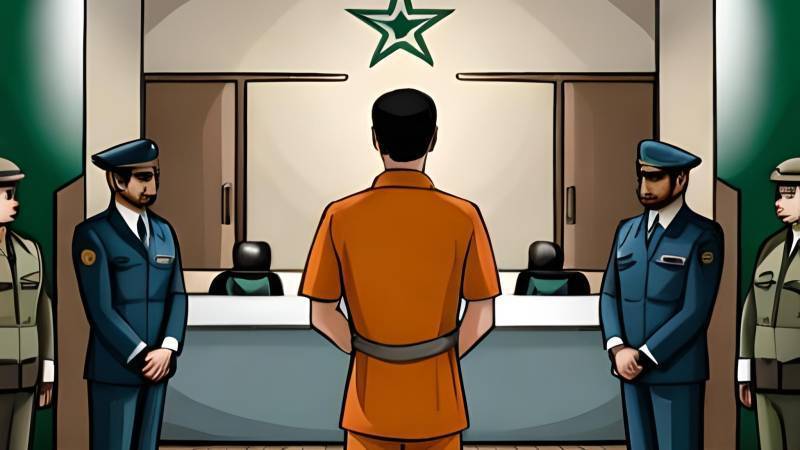
The Supreme Court of Pakistan is currently hearing a set of petitions challenging the trial of civilians through court-martial under the Pakistan Army Act, 1952. This issue has emerged in the aftermath of the events of May 9, 2023, when political protests turned violent. Some protesters stormed and damaged properties associated with the Pakistan Army, including the residence of the Corps Commander in Lahore. The federal government and military authorities have sought to try these civilians by way of court-martial.
The matter before the Supreme Court is of foundational importance. It is not about whether the country is in a state of war or peace. Nor is it about the general legality of the court-martial system. The real question is whether, under the Constitution of Pakistan, civilians involved in acts of political protest—even if violent—can be deprived of their right to a fair and public trial before the ordinary courts of law.
There is no ambiguity in the facts. The individuals being prosecuted are not armed militants or enemy combatants. They are political workers and supporters of an opposition political party. The demonstration, even if it turned disorderly, was political in nature. The attack on the Corps Commander’s residence, though unjustifiable, was not an act against a military installation in the operational or strategic sense. It was not an act of sabotage against a functioning military base. The locations targeted were symbolic representations of military power, not military targets in the conventional legal sense.
A ruling that authorises court-martial of civilians who participated in a political protest will seriously undermine Pakistan’s democratic order and its obligations under international law
The idea that such actions justify court-martial is deeply problematic. International human rights law imposes clear restrictions on the use of military justice systems against civilians. Article 14 of the International Covenant on Civil and Political Rights (ICCPR), to which Pakistan is a signatory, guarantees the right to a fair trial before a competent, independent, and impartial tribunal established by law. The UN Human Rights Committee has repeatedly held that court-martial of civilians is not permissible unless strictly required and narrowly limited, such as in situations of armed conflict or direct military engagement.
The European Union has already raised concerns about this issue. In its official statement in May 2023, the EU’s External Action Service emphasised that civilians must be tried by civilian courts, not through court-martial proceedings. Pakistan’s GSP+ status under the EU’s preferential trade scheme is linked to compliance with 27 international conventions, including the ICCPR. A judicial decision that legitimises the court-martial of civilians involved in political protests may trigger serious questions about Pakistan’s adherence to these commitments and could jeopardise its trade status.
The Pakistan Democracy Act, in this context, must be read as more than symbolic posturing. If enacted, it would compel the U.S. executive to reassess Pakistan’s human rights record with greater scrutiny. This could lead to travel restrictions, aid conditionality, and formal censure at international forums. While Pakistan is right to assert its sovereignty and judicial independence, it cannot afford to ignore the global legal and political consequences of constitutional interpretations that deviate from established norms.
The Supreme Court’s decision will have long-lasting impact. A ruling that authorises court-martial of civilians who participated in a political protest will seriously undermine Pakistan’s democratic order and its obligations under international law. It will also raise doubts about the ability of civilian courts to uphold the rule of law in politically sensitive matters.
This case is not just about May 9. It is about whether the Constitution of Pakistan can withstand the pressures of exceptionalism. A democratic society cannot normalise the court-martial of its citizens on the grounds that they protested at the wrong place. The judiciary must ensure that constitutional rights are not subordinated to the imperatives of political control.