

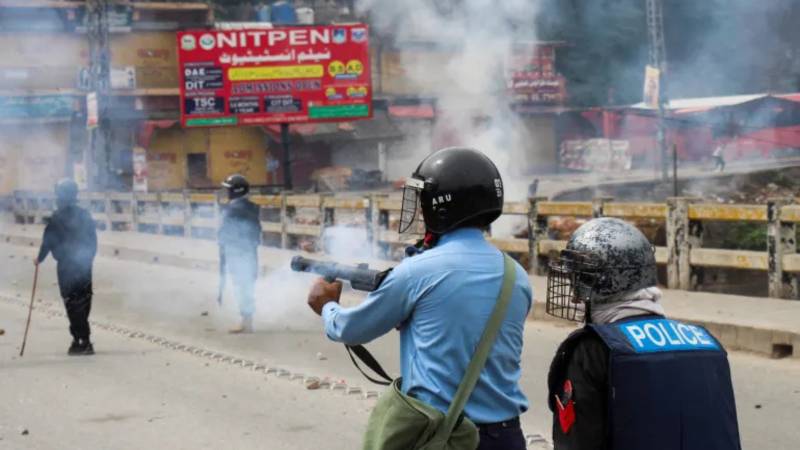
The streets of Pakistani-administered Jammu and Kashmir are alive with defiance. What began as a peaceful mobilisation around a 38-point charter of demands has grown into a people’s uprising against decades of exploitation, humiliation, and internal colonialism. The uprising has already cost lives, with at least a dozen people killed since 28 September, but its heartbeat grows stronger every day, sustained by the conviction of ordinary workers, students, traders, and women who refuse to remain silent.
This movement did not emerge overnight. Kashmir’s history has always been one of struggle. From the Poonch peasant revolts of the 1940s to the student and labour agitations of the 1970s and 80s, the people of this land have long resisted both their local elites and the suffocating control of Islamabad. In recent years, daily survival itself became the sharpest battlefield. Flour subsidies slashed, electricity bills inflated, taxes imposed while judges, ministers, and bureaucrats enjoy lavish perks — these injustices hardened into a single collective voice under the Awami Action Committee (AAC). Their 38 demands are not radical dreams; they are the most basic rights of any society: affordable bread, free education and healthcare, representation without manipulation, and sovereignty over their own resources.
The betrayal, however, deepens the wound. Two years ago, when Kashmiris had again taken to the streets, the government formally agreed to implement the AAC’s charter. Yet in the years that followed, no implementation came. The promises evaporated into silence, as if the agreement had only been a tactic to diffuse public anger. That broken promise now haunts the state, for when people see their demands ignored time and again, their resistance only strengthens.
Instead of dialogue, the state has responded with brute force. On 29 September, a complete wheel-jam and shutdown strike showed the will of the people. The following day, long marches began across the valleys and towns. Instead of listening, the government unleashed tear gas, live fire, and mass arrests. By 2 October, the cruelty reached its most shameful expression when police descended on peaceful demonstrators, including women and young female students, beating them, tearing their clothes, and keeping them in custody late into the night. What law, what morality, can justify this? Articles 16 and 17 of Pakistan’s own Constitution guarantee the right of peaceful protest and association. To trample these rights is not just a violation of law; it is an assault on the very idea of democracy itself.
What burns in the valleys of Kashmir is not only the cry for flour or electricity; it is the cry for dignity and self-determination
The state, in its desperation, showed its insecurity on another front as well. Not content with attacking protestors in Kashmir and Islamabad, the police even stormed the Press Club of the capital and attacked journalists, trying to silence those who bore witness to the truth. This is a mark of weakness, not strength. Only a deeply insecure and fearful government raises its hand against unarmed students, women, and the press. Such acts reveal not power, but fragility.
At its core, this uprising is about more than flour or electricity. It is about a system that robs Kashmir of its own resources while subjecting its people to colonial domination through constitutional tools like Act 74. It is about hydropower generated in Kashmir but sold back to Kashmiris at inflated rates. It is about the manipulation of refugee seats in the assembly to dilute genuine representation. It is about a comprador ruling elite living in privilege while the masses pay with hunger, unemployment, and humiliation.
But repression has only amplified the fire. The blackout imposed since 28 September was meant to suffocate the truth, yet the truth is escaping the blackout’s walls. Already, people across Pakistan and around the world are standing in solidarity. Diaspora communities in Europe, North America, and the Middle East have begun organising demonstrations outside Pakistani embassies. Inside Pakistan, progressive voices, labour unions, and students are waking to the fact that the Kashmiri struggle is inseparable from their own. The humiliation of women on 2 October has only deepened outrage. And the attack on journalists in Islamabad is a reminder that this is not merely Kashmir’s fight, but the fight of all who believe in dignity, democracy, and freedom of expression.
The government has already lost legitimacy in the eyes of the masses. It can oscillate between failed negotiations and violence, but neither will extinguish a fire rooted in truth and justice. History has shown, from colonial uprisings across the world, that brutality cannot kill an idea whose time has come. What burns in the valleys of Kashmir is not only the cry for flour or electricity; it is the cry for dignity and self-determination.
The arrests, the killings, the assault on women and journalists, all of these will be remembered as the shameful signatures of a state that chose violence over dialogue. But they will also be remembered as the sparks that fanned a larger fire. Today, in every city and country, people are beginning to raise their voices in solidarity with Kashmiris. This is not a local struggle; it is a universal demand for justice. Silence in the face of such repression is complicity. To stand with the Kashmiri people today is to stand with the principle of human freedom itself.