

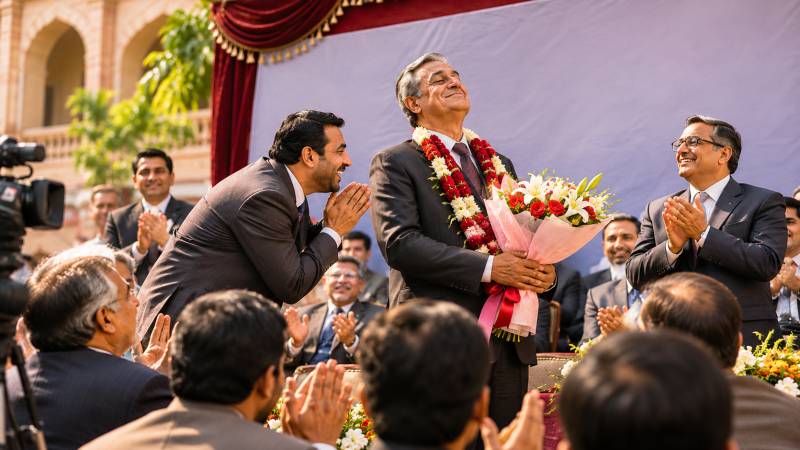
These days, if you scroll down social media for a few minutes, you will find the same scene repeated again and again. A guest arrives at a college, school or any other organization. A stage has been decorated, flowers have been arranged, a large banner has been printed, and a long list of speakers waits to welcome him. Each speaker tries to outdo the previous one in praise. One calls him visionary. Another calls him a gift to the nation. A third says history will remember this day.
The guest has come to inaugurate a single computer lab. He smiles, thanks everyone, and leaves. The computer lab remains. The videos remain longer. I watched one such video and left with a simple question in mind. Why do we praise so much, and why do we praise for such ordinary things? This is not a question about manners. In our society, praise has slowly stopped being gratitude and started becoming currency. It is a currency that everyone accepts, no one questions, and no one ever has to return.
Think of the ordinary transactions of daily life. A shopkeeper sells you bread. You pay him and never call him an angel. A driver drives the bus. You pay the fare and do not garland him for reaching the destination. These are duties performed for payment, and we understand them as such. But, when the same logic enters public life, it changes. A public servant performs his duty, for which the state pays him from public money, and we treat it as a personal favour. A road is built, a school is opened, a file is signed, and suddenly the language changes. It is no longer work. It is acknowledged as kindness, generosity or/and greatness.
This is where the praise economy begins. Not with a bribe in an envelope, but with a bouquet at the gate. The difference between the two is important. A cash bribe is illegal, risky and shameful. A praise bribe is legal, photographed and celebrated. Yet both buy the same things: access, attention and silence. No one is prosecuted for accepting a bouquet. No one is suspended for enjoying a speech in his honour and no one is blamed for favoring the person who called him great. It is influence without a receipt.
Why does this system survive? Because praise is safe. If a citizen demands his right in plain language, he is often called impatient. If he files a complaint, he is called ungrateful. If he asks a question, he is called difficult. But if he praises, doors open. Files move. Calls are returned. The same office that was inaccessible in the morning becomes generous in the afternoon, not because the law changed, but because the ego was satisfied.
Officers begin to compete not for performance but for applause. They learn that a good photograph is often more rewarding than a good decision. Slowly, institutions stop measuring work and start measuring welcome.
Over time, this teaches everyone the wrong lesson. Officers begin to compete not for performance but for applause. They learn that a good photograph is often more rewarding than a good decision. They learn that a loyal crowd is more useful than a competent staff. They learn that criticism is dangerous and flattery is profitable. Slowly, institutions stop measuring work and start measuring welcome. That is why our public functions have become so theatrical. The longer the praise, the weaker the performance it often conceals. A hospital with limited facilities can still arrange a grand reception. A university with little research can still arrange a grand seminar. A department with slow delivery can still arrange a grand dinner. The stage becomes a substitute for the substance. As long as the chief guest is happy, no one asks why the public is not.
The burden of this system does not fall equally. Those who have connections do not need to praise. They have a phone call. They have a name that opens doors. Those who have nothing have only their patience, their time and their praise. A father seeking admission for his child, a widow seeking a pension, a farmer seeking a connection, each must first perform humility. Each must wait, salute, smile and thank. The praise economy thus becomes a tax on the powerless, paid daily in dignity.
There is also a deeper moral cost. When a society praises power excessively, it teaches its young that success comes not from competence but from closeness to power. Students learn to praise the teacher rather than questioning him. Junior officers learn to praise the senior rather than correcting him. Journalists learn to praise the minister rather than investigating him. The entire ladder of advancement begins to reward obedience rather than excellence. We then complain that we have no independent thinkers, forgetting that we discouraged independence at every stage.
This pattern did not appear overnight. We have inherited a long culture of durbar and dera, where authority was displayed rather than questioned. Democracy was supposed to change that culture. In many places, it has adopted its language instead. In this quiet transformation, we have turned the journey from servants to Sultan and from chair to throne. The office remained the same. The manner of occupying it changed. The answer is not rudeness. Civility is a virtue. Respect for office is necessary. The problem is not respect. The problem is worship.
A healthy society knows the difference between courtesy and flattery. Courtesy says, welcome, we are glad you came. Flattery says, without you, we are nothing. Courtesy thanks a person for his time. Flattery thanks him for his existence. Courtesy asks a question. Flattery fears one. Pakistan needs to recover that distinction. An officer should be thanked for courtesy, not canonized for duty. A public figure should be judged by performance, not celebrated for presence. A public function should be judged by what it delivered, not by how loudly it praised. This change must begin not only with leaders but with citizens. We must stop offering praise as payment. We must learn to say, with calm and without fear, this is your duty, this is our right, and this is the record. That sentence is more patriotic than a thousand slogans. A nation that completes the journey from servants to Sultan and from chair to throne will soon have no servants left, only Sultans. A nation that learns to question with respect will discover something far more valuable than applause: accountability. Pakistan does not need more garlands. Pakistan needs more questions.