

Sonoko Machida is an award-winning Japanese author, born in 1980 in Fukuoka Prefecture. In 2016, she won the By Women for Women R-18 Literature Prize for Blue Fish of Cameroon. Her novel The 52-Hertz Whales won the Japanese Booksellers’ Award and became an bestseller with over half a million copies sold in Japan. Her following two novels, Scooping Up the Stars and Sora’s Recipes, were both nominated for the award in consecutive years. The Convenience Store by the Sea has sold over half a million copies between Japan and South Korea.
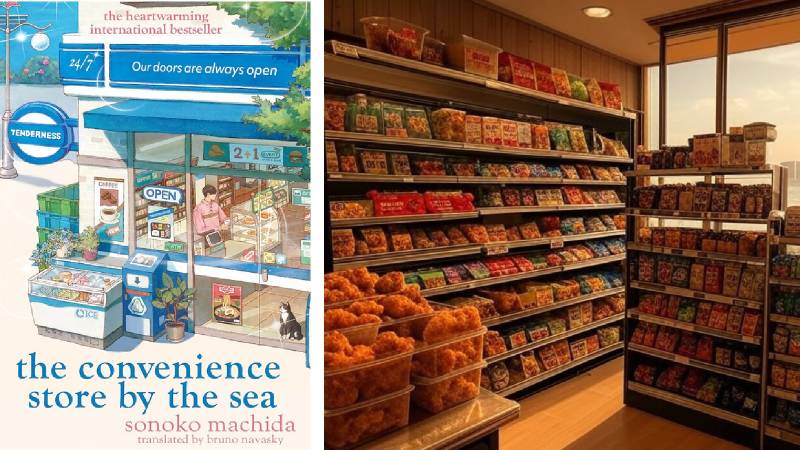
The Convenience Store by the Sea is about the quaint seaside town in Kitakyushu, Mojiko, which is full of hidden delights. And one unexpected treasure is the 24/7 operational convenience store called Tenderness. Its motto is “Caring for People, Caring for You.”
It’s odd that the store’s manager has his own fan club and is a bit of a small-town celebrity. The customers are all somewhat eccentric. But there is a warmth about Tenderness that draws you into the store. The employees all know you by name, the lights are always on. And the shelves are shocked with treats from ramen to crispy fried chicken to sweet parfaits. Customers get the feeling that whatever they need will be available at the store.
Title: The Convenience Store by the Sea
Author: Sonoko Machida
Translated by: Bruno Navasky
Machida writes the book by intertwining short stories about customers at the store and their personal lives and dreams. There is Mitsuri who works part-time at the store, loves drawing manga, and calls Shiba, the store manager by the name of Phero-manager, the author writes, “‘Phero-manager’ was Mitsuri’s private nickname for Shiba. He had a sort of mysterious magnetism that made him intensely attractive, so much so that she imagined invisible pheromones – love hormones – pouring out of him like water out of a fountain.” All the old ladies of the area love him and everyone who seems to come into contact with Shiba seems to fall for his charm.
The store had a special program of food for old people especially the residents of the building in which the store is housed. We are also introduced to Shiba’s brother, Tsugi, the “Whatever Guy” who does anything and everything that you tell him to: he finds lost people, cleans out houses for the old, etc. He is a real handyman for the town and is needed and in high demand by everyone. We are also introduced to the art to manga as both Mitsuri and another character, Yoshiro are fond of the comics. Mitsuri even has a blog on the Phero-manager and has made a fictional account of his life online that has many followers.
Machida writes the book by intertwining short stories about customers at the store and their personal lives and dreams
But that’s not all the book is about, it’s about lessons in learning, a story about Yoshiro’s search for his purpose and how he likes the coffee at the store and it keeps him going, a story about two young teenage girls who bond over strawberry parfaits and both are facing personal challenges and how they overcome them, a story about an aging man who finds hope in pretending to be grandparent to a young boy on his field day, and finally a story about a young boy who doesn’t believe in love but then falls in love himself.
The book is essentially a book of love, friendship and hope and the convenience store is the central point that seems to bring all these elements together. It is littered with wise quotes. For example, at one place in the book, Tsugi says: “The more we suffer, the more we should eat. If you don’t get enough nutrition, it distorts your thinking.” At another place the author comments on marriage by writing that: “Just as I raised you to be that way, there are parts of me somewhere that were created by you. Husbands and wives raise each other.” In this way, Machida comments on marriage and how husbands and wives grow together and due to each other – and their characteristics grow due to how each is treated by the other.
The book is one that highlights the importance of community in a world that is increasingly becoming individualistic, for example when Shiba’s sister becomes ill, people from all over the city send food and flowers and that is a heart-warming thing to read. Often, in today’s world, where we are focused on the me, myself, and I, this book’s stories gives you a look into what it’s like to live in a small-town and be surrounded by people who care about your well-being when you’re down.
Without giving any endings away, each short story has a lesson, and the book was an easy and absorbing read as I enjoyed my time learning about Tenderness and the goods that were sold there, and its clients lives. This book is one I would recommend to everyone for it will add value to your life and grow your personality, as only some books can do. It is exceptionally well-written and I’m not surprised that it is selling like hot cakes all over the world. For me, it was a pleasure to read and review.