

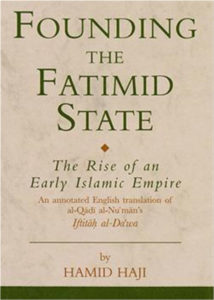
Founding the Fatimid State: The Rise of an Early Islamic Empire
Hamid Haji
I.B. Tauris (2006)
Rs5,404
The author of Iftitah al-da‘wa (Commencement of the Mission), Abu Hanifa al-Nu‘man b. Muhammad b. Mansur b. Ahmad b. Hayyun al-Tamimi, generally called al-Qadi al-Nu‘man (d. 363AH/ 974CE), was the most eminent exponent of Fatimid jurisprudence and an official historian of the Fatimids. He entered the service of the first Fatimid caliph-imam al-Mahdi billah (r. 297-322 AH/ 909-934 CE) in Ifriqiya (present-day Tunisia and eastern Algeria), and served the first four Fatimid caliph-imams in various capacities for almost fifty years until his death. He reached the height of his career during the reign of the caliph-imam al-Mu‘izz li-din Allah (r. 341-365 AH/ 953-975 CE) under whose close supervision he composed his Da‘a’im al-Islam (The Pillars of Islam) which represents a culmination of more than thirty years of his effort to codify Fatimid jurisprudence. It was proclaimed as the official code of the Fatimid state, and continues to be one of the primary sources of Ismaili law to the present day for some Muste‘alvi Ismaili communities. When caliph-imam al-Mu‘izz moved to Egypt in 362 AH/ 973 CE, after the Fatimid conquest of that country, al-Nu‘man accompanied him and continued to serve caliph-imam al- Mu‘izz until his death in Cairo at the end of Jumada II 363 AH/ 27 March 974 CE.
Al-Nu‘man is also regarded as the founder of Fatimid historiography. His major historical work, Iftitah al-da‘wa, completed during the reign of caliph-imam al-Mu‘izz is the most important primary source containing a detailed narrative account of the establishment of Fatimid rule in North Africa. It relates the successive phases of the Ismaili da‘wa: its rise in the Yemen under the direction of the da‘i Ibn Hawshab, the da‘i Abu ‘Abd Allah al-Shi‘i’s initial training under him, his mission among the Kutama Berbers, his military campaigns, the fall of the Aghlabids, and the advent of caliph-imam al-Mahdi in Ifriqiya. The author relates these events using biographical and archival sources and his work has become a reference for subsequent narratives of the rise of the Fatimids in Ifriqiya. The Iftitah devotes a few pages to Imam al-Mahdi’s emigration to the Maghrib and his captivity in Sijilmasa. The author retraces briefly successive stops of caliph-imam al-Mahdi’s journey, which allows us to verify the account of another early Ismaili text, Sirat al-Hajib Ja‘far, whose version of Imam al-Mahdi’s emigration is more detailed. The Iftitah specifies the historical context of his emigration and elucidates the choice of his destination which was determined especially by the rising fortunes of Abu ‘Abd Allah.
The Iftitah provides valuable information on some Aghlabid emirs, particularly the last of them, Ziyadat Allah (r. 290-296 AH/ 903-909 CE), as well as officials who exercised military and civil functions in the Aghlabid state, complementing information found in other sources. More significantly, it highlights the activity of some supporters of Abu ‘Abd Allah who played a major role in his mission, but about whom only sketchy information has been preserved in the sources. They were Kutama tribesmen who adhered to the da‘wa very early and became pillars of his administration.
The Iftitah is equally important for the social and political history of Ifriqiya at the advent of the Fatimids. It relates in detail the conditions among the Kutama where the da‘wa was established. Their territory was a remote, mountainous region where the Aghlabids exercised only nominal authority. The Kutama represented several clans which did not recognise any authority other than their chiefs. Their situation afforded a favourable terrain to Abu ‘Abd Allah’s mission. However, Abu ‘Abd Allah was not able at first to rally all the Kutama to his cause. Some tribes offered him their strong and immediate support while others, led by chiefs jealous of their authority, rose against him. About this turbulent phase of the da‘wa among the Kutama, the Iftitah presents details of Abu ‘Abd Allah’s struggles against a hostile tribal coalition which eventually turned in his favour, allowing him to establish his authority over all the Kutama, who then became instrumental in his military campaigns which led to the establishment of Fatimid dominion in North Africa.
Hamid Haji is a specialist in Fatimid literature. He studied at the Sorbonne and is currently Research Associate with The Department of Academic Research and Publications at The Institute of Ismaili Studies. His publications include: A Distinguished Da’i under the Shade of the Fatimids : Hamid al-Din al-Kirmani and His Epistles (1998) and Founding the Fatimid State: The Rise of an Early Islamic Empire (2006).
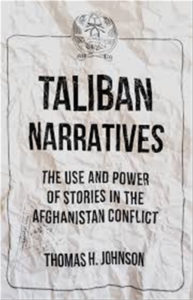
Taliban Narratives: The Use and Power of Stories in the Afghanistan Conflict
Thomas H. Johnson
Hurst (2017)
Rs5,496
Why has the Taliban been so much more effective in presenting messages that resonate with the Afghan population than the United States, the Afghan Government and their allies? This book, based on years of field research and the assessment of hundreds of original source materials, examines the information operations and related narratives of Afghan insurgents, especially the Afghan Taliban, and investigates how the Taliban has won the information war. Taliban messaging, wrapped in the narrative of jihad, is both to the point and in tune with the target audiences it wishes to influence. On the other hand, the United States and its Kabul allies committed a basic messaging blunder, failing to present narratives that spoke to or, often, were even understood by their target audiences. Thomas Johnson systematically explains why the United States lost this “battle of the story” in Afghanistan, and argues that this defeat may have lost the U.S. the entire war, despite its conventional and technological superiority.
Thomas H. Johnson is a research professor of National Security Affairs at the Naval Postgraduate School (Monterey, California). He has conducted research and published widely on Afghanistan and South Asia for three decades. In 2009, he served as the Senior Political and Counterinsurgency Advisor to Gen Jonathan Vance, Commander of Canadian Forces in Afghanistan (Task Force Kandahar).
Islamist Rhetoric: Language and Culture in Contemporary Egypt
Jacob Høigilt
Routledge (2011)
Rs14,657
Islamism in Egypt is more diversified in terms of its sociology and ideology than is usually assumed. Through linguistic analysis of Islamist rhetoric, this book sheds light upon attitudes towards other Muslims, religious authority and secular society.
Examining the rhetoric of three central Islamist figures in Egypt today - Yusuf al-Qaradawi, Amr Khalid and Muhammad Imara - the author investigates the connection between Islamist rhetoric and the social and political structures of the Islamic field in Egypt. Highlighting the diversity of Islamist rhetoric, the author argues that differences of form disclose sociological and ideological tensions. Grounded in Systemic Functional Grammar, the book explores three linguistic areas in detail: pronoun use, mood choices and configurations of processes and participants. The author explores how the writers relate to their readers and how they construe concepts that are central in the current Islamic revival.
Introducing an alternative divide in Egyptian public debate - between text cultures rather than ideologies - this book approaches the topic of Islamism from a unique analytical perspective, offering an important addition to the existing literature in the areas of Middle Eastern society and politics, Arabic language and religious studies.
Jacob Høigilt is a Middle East researcher at Fafo Institute for Applied International Studies in Oslo, Norway. His main research interests include Islamism, Arabic sociolinguistics and politics in the Arab world.

The Barbarisation of Warfare
George Kassimeris
Hurst (2006)
Rs2,922
Images from Baghdad’s now notorious Abu Ghraib prison have come to define the ill-starred occupation of Iraq, but they also remind us of war’s undiminished brutality and indiscriminate excess. Yet, what happened in Abu Ghraib took place, sometimes on a huge scale, during World War II and later in Kenya, Algeria, Vietnam, Bosnia, Rwanda, Sierra Leone and Chechnya, bearing witness to our capacity to act in barbarous ways if circumstances permit. What drives people to mistreat, humiliate and torment each other? In an age when violence and torture are becoming addictive media spectacles, now more than ever should we investigate brutality and inhumanity in times of war. With original contributions from world-class scholars, this book raises disturbing questions: Can warfare be anything other than barbaric? Are we all human, or are some of us less human than others in wartime? Can torture ever be justified? “The Barbarisation of Warfare” is a provocative and hard-hitting analysis of the human misery and complex moral dimensions of modern warfare.
George Kassimeris is Reader in Terrorism Studies at Wolverhampton University.
Transnational Muslim Politics: Reimagining the Umma
Peter G. Mandaville
Routledge (2002)
Rs3,662
This book analyses Islam as a form of ‘travelling theory’ in the context of contemporary global transformations such as diasporic communities, transnational social movements, global cities and information technologies. Peter Mandaville examines how ‘globalization’ is manifested as lived experience through a discussion of debates over the meaning of Muslim identity, political community and the emergence of a ‘critical Islam’.
This radical book argues that translocal forces are leading the emergence of a wider Muslim public sphere. Now available in paperback, it contains a new preface setting the debates in the context of September 11th.
Peter Mandavilleis is an assistant professor of Government and Politics at George Mason University in Fairfax, Virginia. He was formerly Lecturer in International Relations at the University of Kent at Canterbury in the UK, and has also held a visiting appointment at the American University in Washington DC. Previous publications include two co-edited books, The Zen of International Relationsand Meaning and International Relations.