

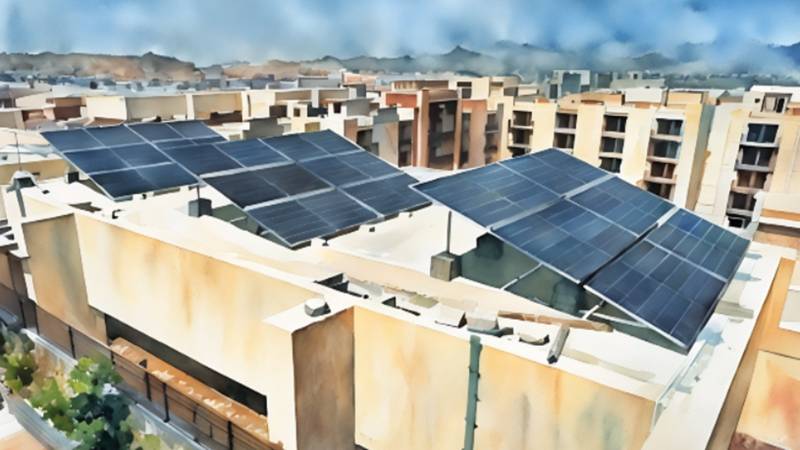
This is big news, and not just in the Pakistani media. It has even made it to The Economist, probably the most prestigious newsmagazine in the world.
It was just a question of time before solar panels made it to the roofs of Pakistani houses. There are three reasons for this. First, when customers get fed up with rising electric bills, they begin looking for solutions. Using less by investing in energy efficiency only goes so far. They begin to search for alternatives when they see their people’s electric bills doubling in less than a decade, sometime in just five years. Second, when frequent power outages or blackouts begin to occur, households become frustrated with the power coming from the grid. And, third, when solar panels become affordable, mass adoption takes place.
And that is just what happened in Pakistan. In the last five years, electric bills have crossed a red line. They are now higher in Pakistan than in many American states. Since average household income in Pakistan is a lot lower than that in the US, the energy burden, which is the share of spending on energy as a percent of income, is way higher in Pakistan than in the US.
Many Pakistanis are now paying more for electricity than for their rent. The average price of electricity is estimated to be $0.23 per kWh, which is higher than the average price in the US.
This has created a crisis of affordability. That’s why customers are installing solar panels on their roofs. They can lower a household’s electric bill by 80%, or even 100%, depending on the rules of the game.
A key element is the price consumers are paid for their exports to the electric grid, which often happens in the middle of the day when the sun is shining, and the solar panels are producing more energy than can be consumed at home. Of course, the sun does not shine at night, and it does not shine much on cloudy days. It is during those times that the household must import power from the grid.
Under net energy metering, the price a household pays for importing power is the same as the price they are paid for exporting power. When solar adoption by households begins to accelerate, as it is Pakistan, the electric utilities panic. Their revenue base shrinks, and since they are regulated monopolies, they begin to come up with excuses for turning off the ‘solar tap.’
They argue that customers who install solar panels are wealthier than the average customer and since utilities must recover their fixed revenue regardless of how electricity is being consumed, they will have to raise electric rates, and that will penalise low-income customers who can’t afford to install solar panels.
The first thing they want to do is to kill ‘net energy metering.’ Since exports account for roughly half of the household’s bill savings, that can severely lower the incentive for installing solar panels. By killing net energy metering, utilities want to end the solar revolution.
China is now a global leader in the production of electric vehicles, with BYD being the leading brand. It is just a question of time before Pakistan will start importing electric vehicles from China and reduce its dependence on imported oil
But, to paraphrase Victor Hugo, "No one, not even all the armies of the world, can stop an idea whose time has come." Solar panels are such an idea. They are being adopted rapidly across the globe where electricity is expensive. Examples include Australia, California and Hawaii. They are also being adopted in England and in many European countries and in Canada.
By lowering their electric bills, solar panels lower the energy burden, making life affordable. In addition, they are the gateway to the adoption of electric vehicles, which many governments want to make the dominant form of transportation. Why? Because they emit no carbon emissions and help mitigate climate change which looms over the globe as an existential challenge. Witness the floods, wildfires and droughts that are taking place much more frequently than they did a few decades ago.
Electric vehicles will be adopted if their driving costs are lower than traditional vehicles which run on petrol. Their driving costs will not be lower if electricity is expensive. Solar panels lower electricity bills and encourage household adoption of electric vehicles.
Pakistan has long had close ties with China, political as well as economic. It is importing solar panels from China at an affordable price. China is now a global leader in the production of electric vehicles, with BYD being the leading brand. It is just a question of time before Pakistan will start importing electric vehicles from China and reduce its dependence on imported oil.
And, of course, there is another benefit. When a household generates ‘clean’ power from solar panels on its roof, it reduces the need to buy ‘dirty’ power from the grid, which is often coming from fossil fuels such as coal and natural gas.
What will happen next? More and more solar installations will be paired with batteries. This would take place for two reasons. One, to keep the lights on when the electric grid goes down. Without a battery, the solar panels cannot power the house. Second, when net energy metering is replaced with a net billing tariff, where the export price is a lot lower than the import price, batteries will be needed to promote self-consumption. This has been happening in Hawaii since 2015 when net energy metering ended and is now happening in California, which ended net energy metering in 2023.
At the government level, Pakistan needs to embrace the solar revolution. Instead of harping on an inequitable cost shift from wealthy to poor customers due to the former installing solar panels, it should find a way to make solar affordable to all customers.
Worldwide, the energy paradigm is shifting from large-scale generation that is sited far away from the point of consumption to small-scale generation that is locally sited. That also minimises the need to build transmission lines, and will help realise the philosophy that E F Schumacher codified in his classic, Small is Beautiful.