

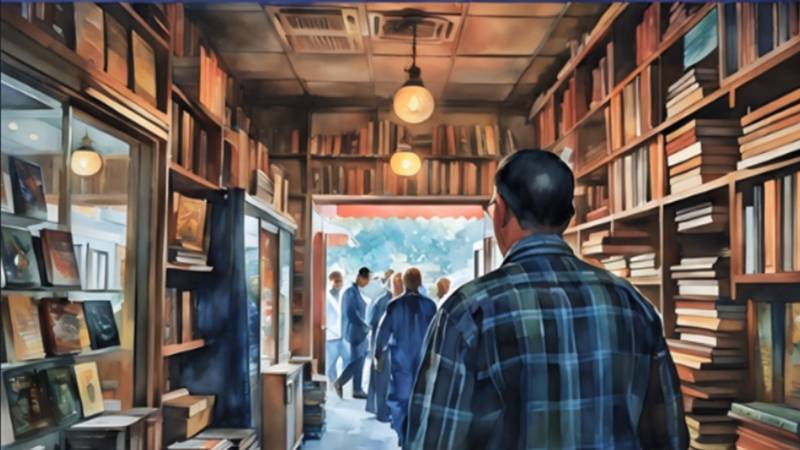
Ejaz Books is located in Jinnah Super Market, F-7. It is a small shop, not visible from the distance. As soon as I get near, my sight first falls on the rack of discount novels displayed outside the store. Inside, the space seems limited: it can get crowded easily. But the moment I start looking at the books in the shop. I forget all of it – everything now seems spacious. I find a few books on the poet William Butler Yeats and I’m surprised. There are rows and rows of books one might not find anywhere else in the city. “This is an area of interest of ours,” Mr Fareed who works there tells when I ask him about the books. He says many customers tell him that.
Behind Ejaz Books is The Book Searcher. It, too, is not a huge shop, but rather well stocked. Unlike Ejaz Books, The Book Searcher deals in newer books – albeit still stocking some old ones. They have rows of fiction and non-fiction, including books of philosophy and history. One can often find books by authors such as Freud, Foucault, Nietzsche and Fanon there. The shop is owned by Mr Khalid Mehmood, who tells me that he’s been working here for more than 40 years, perhaps indicating the book store started somewhere in the 1990s (perhaps earlier). Ejaz Books, too, is very old, having first started in the 1970s.
Ironically, when I ask Mr Mehmood about the current situation of the book business, he tells me “Book stores ka business aesa hi chlrha hai jese Pakistan k halaat chlrhy hain” (“The book store business is running similar to the current condition of Pakistan”). Yet later, while talking about the nature of books in the digital world, he says triumphantly that books shall win once again in the face of technology. Mr Fareed, too, is confident that “itna koi doom and gloom nahi hai” (“there isn’t such doom and gloom”) while talking about the book business.
When it comes to the genres being read, according to Mr Fareed of Ejaz Books, in the past, long series of novels used to be popular. But these days, teenagers or the youth are mostly reading fiction and self-help, while adults are reading philosophy and history
It would be easy to conclude from this that bookstores are thriving. Yet that would be too hasty a conclusion. In the past few years, many bookstores in the city have closed their doors. Mr Mehmood points to this factor too. He says that one reason for the few existing bookstores to have gained business is that many stores have closed, thus there are only a few options left for customers. According to statistics, about 75% of Pakistanis do not read, and only 9% are avid readers. This complicates things: indeed it would perhaps be better, then, to look at bookstores as more of a niche business. As Mr Fareed tells me, there is a certain circle of people who still read and encourage their peers to read as well.
Yet, at the very least, it would be right to conclude that the popular impression about bookstores heaving their final breaths as missing the mark. Bookstore owners and workers seem to disagree with this notion – at least as per my conversations with them. I think this discourse about the ‘doom and gloom’ – in the words of Mr Fareed – reflects the popular yet reductive analysis of Pakistan as a so-called ‘backward society.’ It is true that only a fraction of the population reads, yet one must remember the larger socio-economic factors as well. One major factor is the limited access to education for many. If there is limited access to education, it is understandable that only a few people might be reading. This certainly does not mean that people are deliberately keeping themselves uneducated – rather it is a systemic issue. There is also the lack of critical attitudes within educational institutions – the decades-long ban on student unions being one example of it.
When it comes to the genres being read, according to Mr Fareed of Ejaz Books, in the past, long series of novels used to be popular. But these days, teenagers or the youth are mostly reading fiction and self-help, while adults are reading philosophy and history. Mr Fareed gave a rather brilliant analysis of the role of media in changing how we interact with books. He pointed out that these days, although many people read novels, many yet prefer to watch the movies or shows based on them. He also points towards the decline in magazines as relating to the popularisation of digital press and magazines. “People read articles online now,” he says.
These insights are important. They reveal how we interact with books and how our relationship with books change over time. If the digitisation of fiction in the form of popular films and shows points towards a decrease of popularity in the reading of fiction, it poses some further questions perhaps. For instance: would the popularity of podcasts eventually decrease the sales of non-fiction literature as well? Perhaps.
Yet before we ask these questions, why even bother? Do books matter? Do bookstores matter? I think they do. Literature matters because it serves as an evidence of our humanity – a testament to what we can be, what we are. Books give us knowledge but also hope, in the words of James Baldwin: “You think your pain and your heartbreak are unprecedented in the history of the world, but then you read.” And bookstores are very intimate spaces, they too represent something about us.
The Polish poet Csezlaw Milosz once wrote that history is important only when “we can relate it to ourselves personally” for otherwise it “will always be more or less an abstraction.” Bookstores perhaps, are those concrete monuments of history through which we can relate to ourselves. Spaces within the confines of which are contained our cultures, histories, politics – quite literally. Thus to talks about the bookstores of Islamabad is to talk also about the concrete history of the city and its people.
When Mr Fareed says that there isn’t such ‘doom and gloom’ or when Mr Mehmood says that books shall win in their war with technology, it is a discourse of hope. Both of them, in their bookstores – and through them as pieces of history – looked forward and hoped. Perhaps, that is why our bookstores are important. They are our history, and they let us hope.