

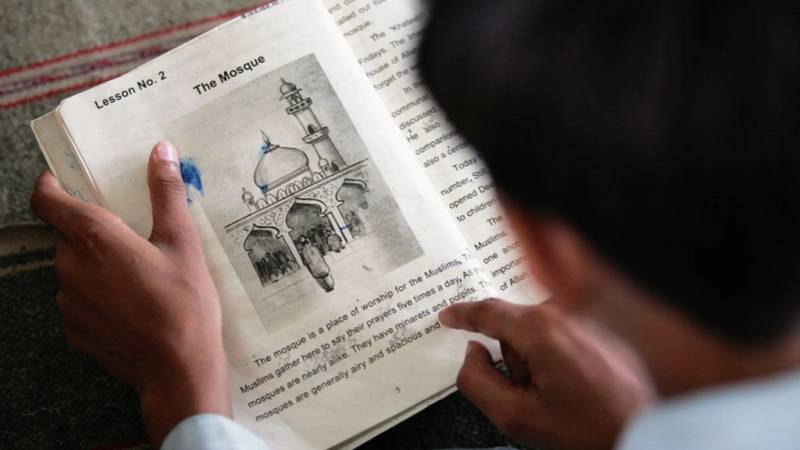
Pakistani minorities have long complained that key school textbooks reflect a decline in religious diversity and contain systemic bias. A recent study once again highlights discriminatory content against minorities in school textbooks in Punjab, the country’s most populous province.
Launched on March 30 in Islamabad, the study found that textbooks used across Punjab are heavily influenced by one religious perspectives and often marginalize other religions. It further suggests that incidents such as the Jaranwala attacks on Christian communities three years ago reflect the intolerance embedded within the educational curriculum.
The report recommends revising school syllabi to emphasize universal human values, including equality, respect, and tolerance. Titled “Inclusive Education for a United and Harmonious Pakistan,” the study was launched by the Weaving People to Grow Foundation (WPTGF) in collaboration with Action for Impact (AFI).
Conducted between 2023 and 2025, the study analyses discriminatory content in Punjab’s textbooks and identifies systemic issues contributing to intolerance against minority communities. It argues that such content hinders critical thinking among students. To explore the issue in depth, education experts, teachers, youth, and development professionals were interviewed, alongside a comprehensive content analysis of Punjab’s textbooks.
One of the researchers, Kiran Peter from Islamabad, noted that in subjects such as Urdu, English, and social studies, nearly 51 percent of the material represents a single religion. She argued that this contradicts Article 22 of the Constitution of Pakistan, which safeguards freedom of religious education. The article ensures that no individual is forced to receive religious instruction or participate in worship of another faith, prohibits discrimination in educational institutions, and protects the rights of institutions to provide their own religious instruction.
However, minority students are often required to study these textbooks against their will. While there is an option to study ethics as an alternative subject, many institutions do not offer it to minority students. Although policy states that non-Muslim students should study ethics, the necessary books and resources are often unavailable.
An inclusive curriculum, the report argues, will not only protect minority rights but also strengthen Pakistan’s future as a tolerant, peaceful, and united society.
So far, even the national curriculum has failed to address key gaps, including religious representation, critical thinking, and inclusion. Although the Constitution of Pakistan guarantees equality, equity, and inclusion in education, these principles are still not fully implemented in schools.
Ashiknaz Khokhar, a human rights activist from Lahore, responded to the report by emphasizing that education is not merely about literacy but about shaping mindsets and building a peaceful society. “I urge the government, education authorities, and policymakers to ensure that textbooks promote inclusivity, interfaith harmony, and human dignity. Representation of minority heroes, accurate history, and teachings of universal values such as empathy and coexistence must be incorporated,” he said.
According to the report, Punjab has approximately 35.5 million children aged 5 to 16, of whom 24.2 million are enrolled from pre-primary to higher secondary levels. Enrollment drops significantly at higher levels of education. Data from the Pakistan Social and Living Standards Measurement Survey 2023 shows that the national literacy rate stands at 60.7 percent. However, literacy rates among minorities are considerably lower: Christians and upper-caste Hindus each have a literacy rate of 34 percent, while scheduled caste Hindus stand at 19 percent. Statistics for Sikhs, Baháʼís, and other religious groups are not officially recorded.
The report links these disparities to discrimination and exclusion, both in textbooks and in teachers’ attitudes. It notes that many subjects contain content and imagery that minority students may find exclusionary, potentially violating Article 25-A of the Constitution, which guarantees the right to education.
The study concludes with several recommendations. It calls for the elimination of biased and harmful content, urging authorities to review and remove material that promotes hate, discrimination, extremism, or religious bias.
It also recommends adopting a balanced and inclusive approach to discussing religion across all subjects. Curriculum development committees should include representatives from all religious communities in Pakistan to ensure diverse perspectives and promote inclusivity in education.