

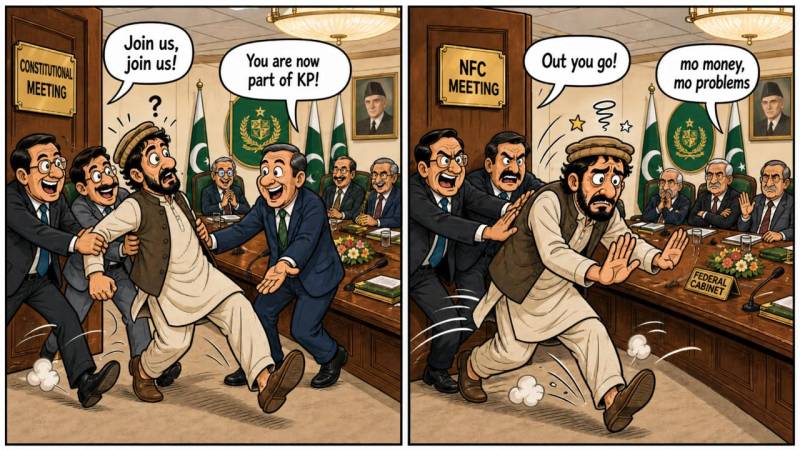
Some disputes in Pakistan are lazily filed away as “provincial demands”. The assumption is familiar: one province is asking for more money, the federation is short of cash, and everyone will eventually settle for less than what was promised.
But the National Finance Commission issue raised by Khyber Pakhtunkhwa after the merger of FATA is not just another provincial quarrel over funds. It is a test of whether Pakistan takes its constitutional promises seriously, believes in fiscal federalism, and upholds the equality of all citizens before the law. And because the issue is of national finance, not enough people know enough about the issue to care. But they should.
When FATA was merged into KP through the 25th Constitutional Amendment, it was not presented as a favour to one province. It was sold, rightly, as a national act of integration. Parliament, the state, political parties and security institutions all endorsed the principle that millions of citizens who had lived for decades under an exceptional legal regime would finally be brought into the constitutional mainstream.
That phrase, “constitutional mainstream”, sounds noble. But it cannot mean only new police stations, new administrative titles and new slogans. It must also mean money. Development money. Governance money. Security money. Schools, hospitals, roads, courts, local governments, jobs and services. A merger without fiscal integration is not mainstreaming. It is paperwork.
This is where the NFC comes in. Under Article 160 of the Constitution, the NFC is the mechanism through which federal divisible pool resources are shared between the federation and the provinces, and then among the provinces.
The Constitution expects this arrangement to be reviewed every five years because countries change, populations change, needs change, and federal bargains must be kept alive. Yet Pakistan is still operating under the 7th NFC Award, which expired in 2015. That alone should worry anyone interested in democratic federalism.
The KP case goes further. After FATA became part of KP in 2018, the province’s population, area and administrative responsibilities changed. If the Constitution redefined the province, the fiscal formula should have followed. The argument from KP is simple: an Amendment and Modification Order under Article 160(6), read with Article 160(7), should have been issued to incorporate the former FATA’s population and area into KP’s NFC share from 2018-19 onwards. This did not happen. It was not allowed to happen.
The merged districts are not just a local development challenge; they are tied to national security, border management, counterterrorism, migration, political trust and the credibility of the state
While FATA was underdeveloped and overcontrolled under federal administration for almost seventy-one years, in the past eight years KP has been expected to pay with money it doesn’t have to right historical wrongs.
The result, according to KP’s calculations, is not merely delay but exclusion. Around 6.5 million citizens of the former FATA have, in effect, remained outside the horizontal sharing formula for eight years. KP estimates that roughly Rs 964 billion that should have been reflected in its NFC share has instead flowed to other provinces because the formula was not updated.
Separately, the merger-related federal grant, based on the Sartaj Aziz Committee's recommendation, has also fallen far short: KP says it received about Rs 1 trillion in 2024-25 prices against a calculated entitlement of Rs 2.2 trillion, leaving a shortfall of around Rs 1.2 trillion. Together, KP describes this as a double jeopardy of approximately Rs 2.177 trillion.
These numbers are large enough to sound abstract. So let us translate them.
It could build hundreds of kilometres of roads, dozens of major hospitals, hundreds of mother and child facilities, thousands of schools, and upgrade health units across some of the most underserved parts of the country. In security terms, it could fund police stations, posts, vehicles, judicial complexes and the administrative architecture needed to make the writ of the state something more than a phrase used in press conferences.
This is why the issue should matter in Lahore, Karachi, Quetta and Islamabad, not only in Peshawar, Bajaur or Waziristan. Money owed to the former FATA under the constitution is being used for vanity projects in the other provinces – money that isn’t theirs to spend.
Money that comes from a region with some of the worst health, education and development indicators. Effectively, the poor are paying for the motorways, jets and new daala’s and bulletproof vehicles in other provinces that are already running budget surpluses.
What makes this situation particularly egregious is that the other provinces are all running budget surpluses; they do not need to keep the share of the former FATA.
Pakistan has already paid a terrible price for treating its peripheries as afterthoughts. The merged districts are not just a local development challenge; they are tied to national security, border management, counterterrorism, migration, political trust and the credibility of the state.
When the federation promises integration but does not finance it, it creates a dangerous gap between constitutional language and lived reality. Into that gap enter resentment, alienation and the familiar complaint that Pakistan remembers some citizens only when it needs sacrifice from them.
There is also an uncomfortable question for the other provinces. If Balochistan’s protected share could be extended in 2015 through a Presidential Order under Article 160(6), why can a similar constitutional mechanism not be used to account for the former FATA’s merger into KP?
The point is not to pit KP against Balochistan. Quite the opposite. The Balochistan precedent shows that the Constitution has tools for adjustment when federal realities demand it. The issue is whether those tools are applied consistently, or only when politically convenient.
Nor should this be framed as KP asking for charity. That is precisely the wrong lens. A constitutional share is not a grant, and a grant is not a substitute for a constitutional share. The merger-related development commitment and the NFC formula update are two separate obligations. One was meant to help rebuild and develop the merged districts; the other was meant to recognise that KP itself had changed.
This distinction matters because Pakistan’s federation cannot survive on discretionary generosity. It requires rules. When rules are followed, disputes remain manageable. When rules are avoided, every budget becomes a bargaining table, every province becomes suspicious, and every delay becomes political.
This is not just about balancing accounts. It is about an underrepresented people being made invisible.