

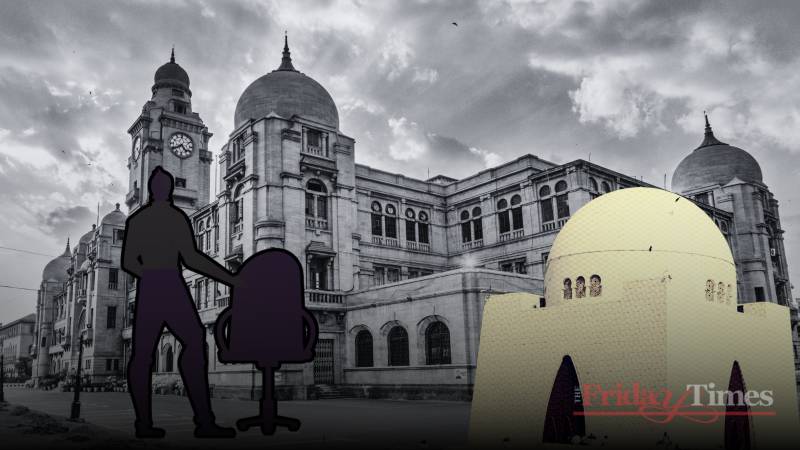
Picture this: a city of 30 million souls, Pakistan’s economic heartbeat, where the mayor—Karachi’s so-called “hot seat”—is a household name, unlike the mayors of Lahore, Islamabad, Peshawar, or Quetta, whose names most people don’t even recall. Everyone looks to Karachi’s mayor to fix broken streets, clogged drains, and crumbling infrastructure. Although Arif Hasan’s book The Land Issue claims the Karachi Metropolitan Corporation (KMC) controls 30.9 percent of the city, Mayor Murtaza Wahab himself stated in 2023 that he controls just 27.4 percent—highlighting the “hot seat’s” limited reach. A mayor for barely a quarter of the city? It feels like a cruel joke for Karachi’s people—and for Pakistan. This broken system, with no city-wide master plan and no constitutional protection for local government, leaves residents lost in a maze of blame. Can Karachi’s mayor ever rise above being a scapegoat? Only if we give them real power.
Karachi is different. In Punjab, the PML-N mostly gets the mandate; in Khyber Pakhtunkhwa, PTI dominates. So even without active local government setups, these parties invest in their cities. In Sindh, the PPP relies on rural votes. Karachi rarely gives them a clear mandate, with support split between the PPP, MQM, PTI, and JI. After 17 years of PPP rule in the province, Karachi is now the fourth least liveable city in the world, so public distrust is understandable. In the 2023 Local Government Elections (LG), MQM’s non-participation and fervent hope that a PPP mayor—backed by the PPP’s provincial government—would secure funds and spark development, led to Murtaza Wahab’s win. This refocused attention on LG, with KMC, 25 Town Municipal Corporations (TMCs), and 246 Union Councils (UCs), yet residents’ hopes for progress remain unfulfilled.
Rewind to the City District Government Karachi (CDGK) era under Pervez Musharraf, when mayors like Naimatullah Khan (JI, 2001–2005) and Mustafa Kamal (MQM, 2005–2010) wielded direct federal funds to transform the city. In the 1990s, KMC built Karachi Medical and Dental College (1991) and Abbasi Shaheed Hospital (1974). Today’s LG system—which ended Musharraf’s CDGK and was cemented by the Sindh Local Government Act (SLGA) 2013—has neutered the mayor.
Karachi needs a mayor with city-wide authority, fixed funds through the Provincial Finance Commission (PFC), and a unified Karachi Plan to sync KMC, TMCs, cantonments, and agencies
If KMC controls just 27.4% of Karachi’s land, then who controls the remaining 72.6%—the remaining 2,561 km² of the city? A large chunk falls under federal enclaves like six cantonment boards (with separate LG elections), the Karachi Port Trust (KPT), and Pakistan Railways, which act like untouchable fiefdoms with no elections. Provincial land—where areas fall under the Malir Development Authority (MDA), Lyari Development Authority (LDA), Karachi Development Authority (KDA), and the Sindh Building Control Authority (SBCA)—joins LG polls but chains the mayor to menial municipal tasks, while the Sindh Solid Waste Management Board (SSWMB) hogs waste control. No coordination, just chaos, as Arif Hasan’s The Land Issue exposes.
In Saddar Town, UCs sweep some streets, but Karachi Cantonment and railway land near Cantt Station are federal no-go zones. In Malir, KMC handles basics, but MDA runs housing schemes like Malir Town Residency, and Malir Cantonment—with 12 km² and 10 wards—operates independently. The mayor can’t touch gas pipeline repairs or construction schedules, as SBCA and SSWMB hold control. Even within KMC’s 27.4%, TMC chairmen, not the mayor, fix streets. After the 2025 monsoon’s destruction, Wahab said the lanes are TMC territory, not his, leaving residents further perplexed.
Not just this—Karachi has no city-wide master plan, unlike London’s which unites 32 boroughs. TMCs, UCs, cantonments, and agencies work in silos, digging up roads without coordination. Monsoons wash away these half-baked repairs, flushing money down the drain. Federal enclaves like KPT and bodies like MDA don’t coordinate with KMC, leaving residents clueless about who’s responsible for a flickering streetlight or a clogged sewer.
Parties like PPP, MQM, PTI, and JI promise a superhero mayor, but it’s a hollow pitch. MQM’s Wasim Akhtar (2016–2020) admitted he had no power. Wahab, despite PPP ruling Sindh, now sings the same tune. The SLGA 2021, crafted by PPP, gutted mayoral authority—a far cry from the CDGK era. In the 1990s, mayors built hospitals, universities, and ran 450 schools. Today, they can’t touch health or education. But this isn’t just Sindh’s game—across Pakistan, provincial governments strip local bodies of power to hoard development credit. Ironically, Sindh is the only province with a working LG system, yet just Rs. 165 billion—5% of its Rs. 3.25 trillion budget—goes to local governments across the entire province, including Karachi. This deliberate underfunding turns local leaders into blame magnets for provincial failures.
Having control over the beautification of parks, fire departments, bridges, underpasses, main roads, and rain drainage sounds important, but it’s nowhere close to real city governance. Unlike NYC, where the mayor runs all 781 km² and oversees schools, police, and subways—and London, where Sadiq Khan commands 1,572 km² with a unified plan—Karachi’s mayor has no control over policing, transportation, education, health, or core infrastructure. KMC scrapes by on parking fees and municipal utility charges collected through K-Electric bills, which are peanuts for a metropolis. It once collected property tax, entertainment tax, land use fees, tolls, and BTS tower tax, but Sindh’s Excise Department and SBCA took over those. They also retained the Rs. 61 billion Octroi Zilla Tax and cess. KMC is left scrounging for crumbs.
The 18th Amendment in 2010 gave provinces power and renamed NWFP as Khyber Pakhtunkhwa. Yet even then, no one talked about constitutional protection for local governments. And even after LG empowerment bills from Senator Faisal Sabzwari (MQM-P), former Senator Sania Nishtar (PTI), and MQM-P—who now hold all 22 National Assembly seats from Karachi and had pledged this reform before the 2024 elections—the party couldn’t push Islamabad to include it in the 26th Amendment which occurred in October 2024.
It’s obvious that nobody seems eager to devolve powers to the grass-root level. Every four years, a powerless mayor steps in, begs for funds, and leaves. Is it so hard to copy London’s Greater London Authority, NYC’s strong mayor model, or Singapore’s centralised system—tweaked for Karachi? A powerful mayor would attract serious candidates, not symbolic ones. Karachi needs a mayor with city-wide authority, fixed funds through the Provincial Finance Commission (PFC), and a unified Karachi Plan to sync KMC, TMCs, cantonments, and agencies. Above all, constitutional protection by amending Article 140A to define mayoral and UC powers—for planning, policing, land, infrastructure, health, and education—is critical, just like the Constitution outlines the Prime Minister’s powers (Articles 90–91) and the Chief Minister’s non-negotiable authority (Articles 129–130).
Without it, the mayor remains a glorified bystander, unable to fix Karachi’s streets or drains, no matter how hard they try. A city that powers 60% of Pakistan’s economy deserves more than symbolic leadership. It deserves a mayor with the muscle to rebuild what’s been ignored.