

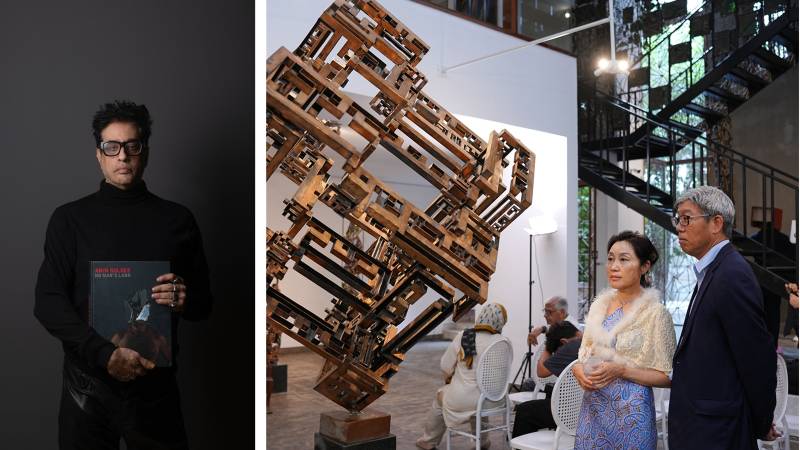
Amin Gulgee’s monograph, No Man’s Land, was launched on 11 May 2025. A comprehensive survey of the artist’s more than thirty-year-long career as a sculptor, performance artist and curator, this 414-page book was released by Skira, a Milan-based publisher of art books, earlier this year. The event occurred at the eponymous Amin Gulgee Gallery in Karachi, a non-commercial art space that he established in 2000.
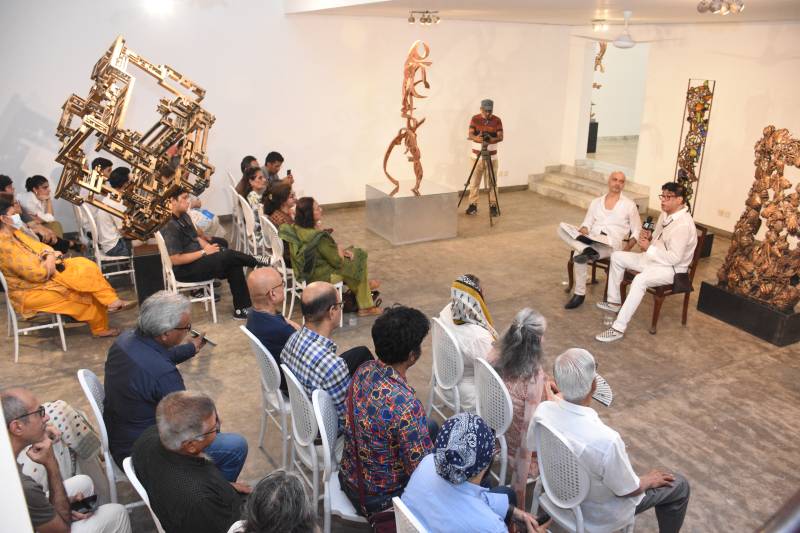
It was hot that late afternoon, reflecting the political climate between Pakistan and India, who, it had just been reported, had agreed to a ceasefire after a four-day conflict. Asked why he chose to have this event at such a stressful time, Amin replied, “This launch was scheduled a while ago; one hopes that sanity prevails.” In spite of the heat—both literal and figurative—the people of Karachi crowded into the Amin Gulgee Gallery, helping themselves to chaat and other South Asian snacks as they waited for the presentation to begin. The audience comprised students, intellectuals, publishers, writers and artists. After a half an hour of mingling, the audience settled down on chairs amidst Amin’s sculptures in copper and bronze to listen to a conversation between the artist and HM Naqvi, both dressed in white.
“Do you enjoy the smell of copper smelting in the morning?” Amin responded with his thunderclap of a laugh and cried out, “Yes!”
A critically acclaimed novelist based in Karachi, Naqvi had penned an essay for No Man’s Land titled “Amin Gulgee Demands Attention.” He has known the artist for a number of years and has attended many of his shows and performances. Amin began the proceedings by thanking John McCarry, who edited the book, and Kiran Ahmad, who designed it, as well as the 12 writers, including Naqvi, who contributed to the monograph. Amin explained that he had asked the contributors to comment on any part of his trajectory that engaged them; the length of their respective essays was entirely up to them. He compared this process of commission to a party where “everyone can do what they want.” Introducing Naqvi, Amin noted how much his two novels, Home Boy and The Selected Works of Abdullah the Cossack, had affected him. Naqvi then did what he described as “an impressionistic reading” of his essay for the monograph. His delivery was eloquent, his voice stentorian. The author stopped to ask Amin a question about his use of calligraphy in his sculptures and installations.
Amin replied, “My father was a great calligrapher. I don’t claim to be a calligrapher. What I do in my trajectory is I use one line…from the Iqra Ayat. I use the same line in the Naskh script and I repeat it again and again and again. Some of the sculptures you see around you with cursive script have that same line. Now you can’t read anything. So, when I travel [abroad for exhibitions], people ask, ‘What is written?’ I say, ‘Nothing is written.’ But the essence for me remains that same line.”
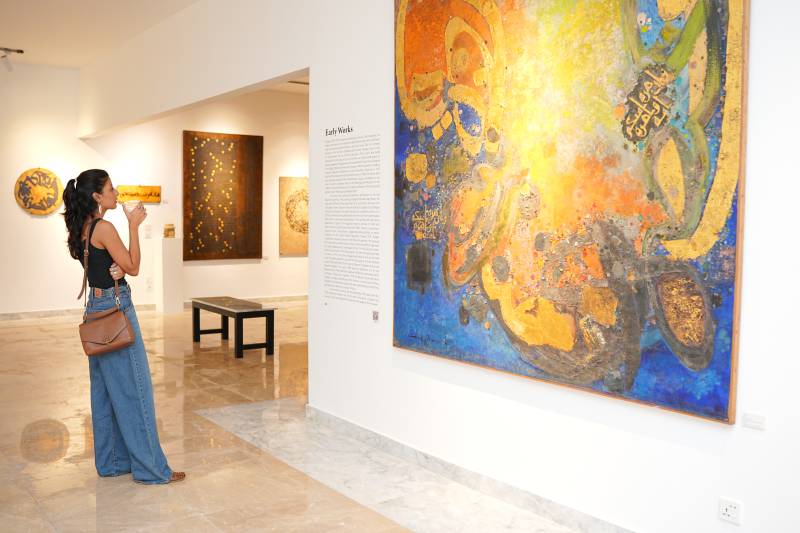
The author continued reading from his essay, at moments pausing to ask the artist more questions. At one point, he asked, “Do you enjoy the smell of copper smelting in the morning?” Amin responded with his thunderclap of a laugh and cried out, “Yes!” He then elaborated, “You’re a writer and I’m sure the spirits must speak to you. They tell you their tales, their stories. You’re just a conduit to put it onto paper. It’s the same thing for us object makers. We try to listen to the spirits.”
This back and forth lasted a brisk but insightful twenty minutes, touching on Amin’s sculpture and installation, his longstanding interest in performance art, as well as his role as Chief Curator of the first Karachi Biennale in 2017. The chemistry between the novelist and the artist was apparent. Their spontaneous exchange was not only informative, but also at times quite amusing. It ended with Amin laughing once more and thanking the novelist by exclaiming, “You are the sweetest boy one can chat with!” After the talk, Amin’s copper and steel gates to the adjoining Gulgee Museum were opened and the assembled crowd explored the two-story museum dedicated to the work of Amin’s father, Ismail Gulgee, which Amin curated and opened to the public on the 18th of February this year.
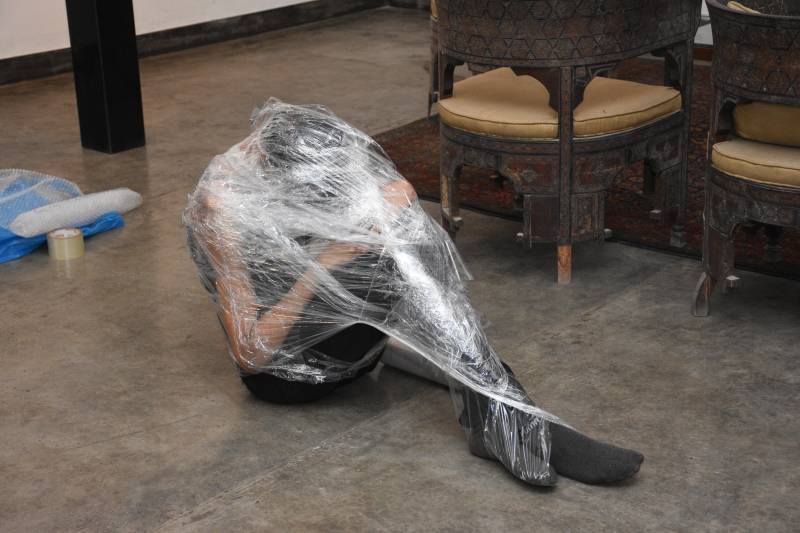
The surreal timing of this event was accentuated by a series of performance works that unfolded throughout the gallery the evening of the book launch. Amin has consistently engaged with performance over the past two decades, both as a performer and a curator, often opening his gallery to exhibitions of the art form. (An entire section of his monograph is dedicated to performance art.) For this event, Amin had collaborated with Sara Vaqar Pagganwala, who had introduced him to her students at the Indus Valley School of Art and Architecture in Karachi where she has taught a course on performance art for about a decade. According to Sara, it is the only course in a Pakistani art school dedicated to performance art, an emerging field in the country. After meeting with the students and discussing their proposals, Amin selected a few of them to perform at the launch. Most notable was “Cling,” in which Amar Shah lay on the floor of a side gallery with his body wrapped in transparent plastic.
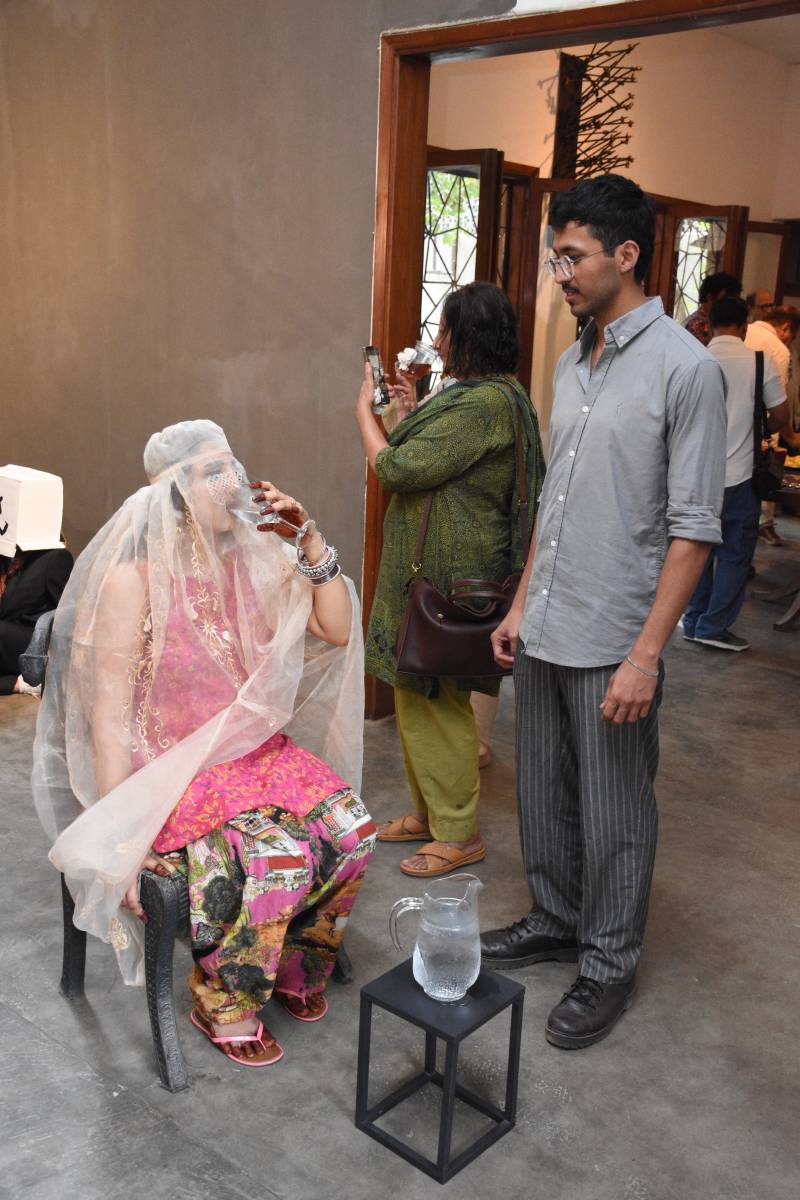
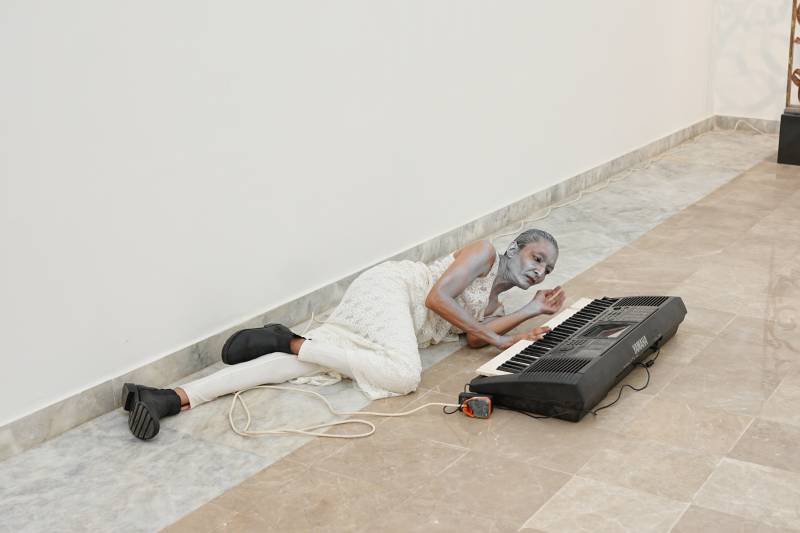
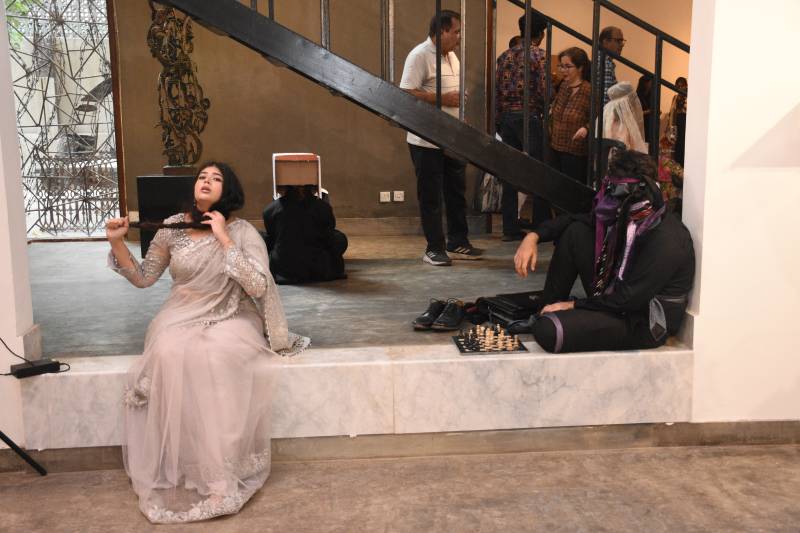
In the main gallery space where the talk took place, Alishba Shafaqat and Hamza Mubarak sat facing each other on a ledge underneath the staircase. Dressed in a white sari, Alishba attempted to strangle herself using her long black braid. Facing her, Hamza silently played chess, at times stopping to knot ties around his head and neck. Umaina Khan and Jamal Ashiqain, two established artists, also performed. Sitting regally on a chair and wearing a diaphanous burqa the she had created, painter Umaina Khan ceremoniously poured water into a glass and attempted to drink it though the mesh of her veil. Lying prone on the floor of an adjacent gallery with Amin’s towering sculptures that leads to the Gulgee Museum, photographer Jamal Ashiqain played atonal sounds from a synthesiser. Attired in a white summer dress, his slim frame was in sharp contrast to the harsh composition he was intuitively creating.
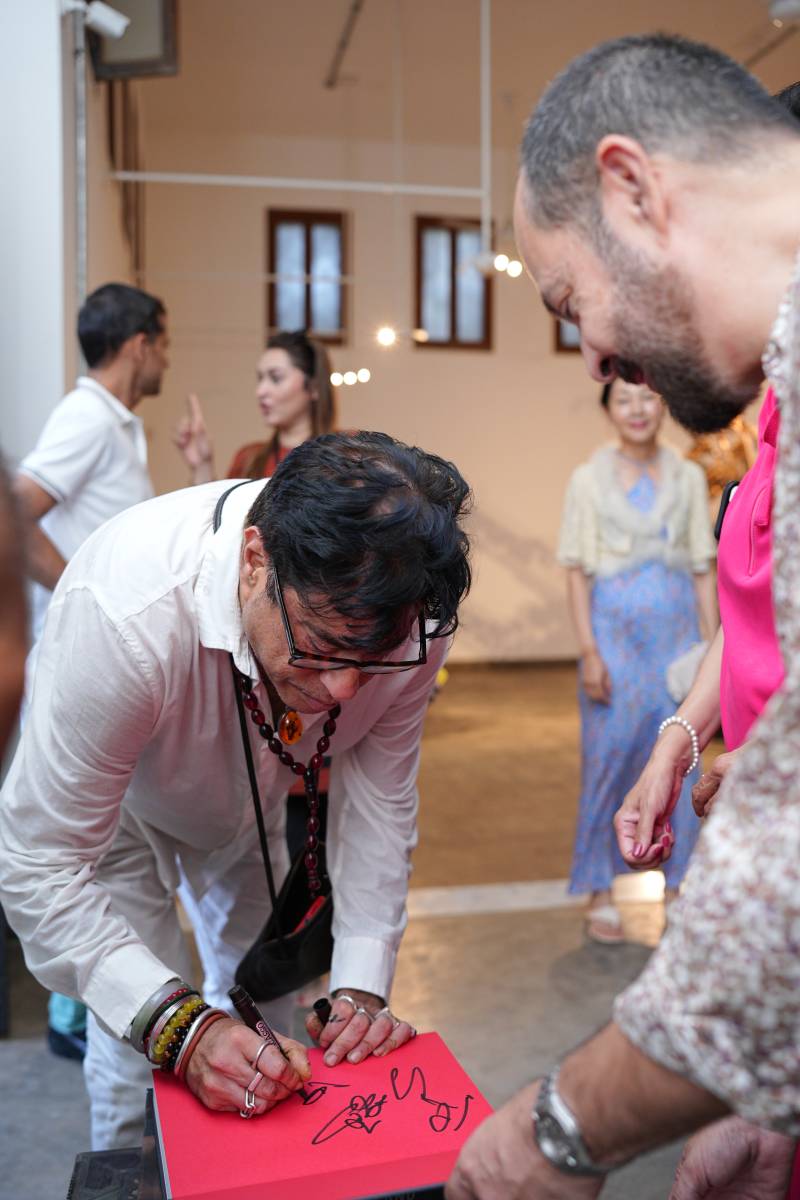
As the launch wrapped up, Amin autographed copies of his monograph. Wiping sweat from his brow, he exclaimed, “I am very grateful to HM for being so easy to talk to, and to all the artists who have performed at the launch. Most of all, I am grateful to all the Karachi-wallahs who braved the heat to be here today.”