

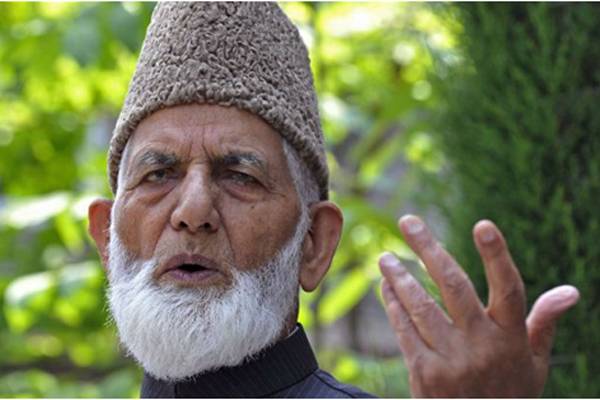
Kashmir’s most prominent and influential resistance leader, Syed Ali Geelani, has created a furor with his statement that the people of Kashmir have failed their leadership in the “movement for freedom” and not vice versa. He explained his reasons in an interview published in the Rising Kashmir on November 28. Geelani said people “forced” the leadership to change the direction of mass agitation in 2010, and defied the call for boycotting the elections. Perhaps for the first time, he spoke openly about issues, without mixing them with political strategy.
Geelani is the first leader from the separatist camp to admit that people have not been following separatist leaders or have been wavering in their response. This is critical for a movement that has continued for more than 25 years, consuming thousands of lives and bringing tremendous changes to the Kashmiri social fabric. One can understand that such struggles are not time bound, but to take stock of what is going on is unavoidable. I will come to the merits of the statement a little later, but the debate that it has kick-started on social media – where people are questioning their leaders – is a healthy trend that has never been encouraged.
For over two decades, the leaders in the resistance camp have never allowed such questions. In some cases, newspaper offices were attacked and people were threatened for asking questions about the movement, its direction and role of its leaders. Unfortunately, in our society, leaders think that they are above everyone else and cannot be challenged or asked to be transparent. Such double standards have shaped the personalities of most of them. For example, engagement with Delhi at individual or organizational level has been seen as akin to collaboration. Although some of these leaders formally engaged with Delhi in the period between 2003 and 2007, behind-the-scenes engagement has continued. There is no harm in engaging with the power that you are challenging. But it is legitimate to ask why it is permissible for the leaders to engage behind the scenes – without even making their motives public – but not for other individuals. Once a reporter asked a leader, “Why don’t you all unite?” He shot back saying, “What does it matter to you?” The leader was bereft of basic etiquettes.
There are some valid questions that people have raised about Geelani’s statement. One of them is why we can’t call it “collective failure”. It may be unfair to blame only the people for the movement losing direction. If Geelani cites being pressured by traders and parents to end the agitation because the economy and education were suffering, we need to ask if a strike is the only tool of agitation. Surely, if the Valley was locked down for three months, there were valid concerns about where we were heading. What is the point of plans that are not sustainable? There is no denying the fact that the killing spree that continued in 2010 led to spontaneous protests as well, but why didn’t the leadership sit together and formulate a strategy that would not become a liability at the end?
Geelani says people should have boycotted the elections, and thought of ending the occupation first. The response is simple: is there a time frame for ending the occupation? If not, why should people suffer for even the basic amenities? The argument that the Government of India uses voter turnout as evidence at the international level to argue that the people of Kashmir have faith in India does not hold much substance. In today’s world, such hoodwinking is not possible. Kashmiris distinguish between the two processes. Even after the elections, tens of thousands of people attended the funeral of a foreign national. That shows that the elections have not changed the course of the movement.
The people of Kashmir have always adapted to the situation, and after the way Delhi has managed Kashmir for 68 years, they have devised a method for counter-managing Delhi. Looking back at the political upheavals of the past and taking Geelani’s assertions as the basis of how people behave, one can easily absolve Sheikh Mohammad Abdullah. It was the people who failed him after 1953, when they fell prey to Bakhshi Ghulam Mohammad’s sops of subsidies. When Sheikh Mohammad Abdullah signed an accord with Indira Gandhi in 1975, Pakistani Prime Minister Zulfikar Ali Bhutto called a strike to denounce it, and received an overwhelming response. But when Sheikh Mohammad Abdullah returned to Srinagar days later, taking over as chief minister, he was given a joyous reception. Which way were they leaning then?
Since Kashmir is at a critical juncture, the leadership will have to face the questions and even respond to them. People have given enormous sacrifices and continue to do so. They have made them leaders, without any real test of popularity. The leaders ride on the popular sentiment. But have they not failed the people by not controlling their egos? Why can’t the leaders unite for the sake of the people who have suffered? If the leaders have the right to ask questions about people and their ability to follow a dignified path, the people also have a right to ask what their leaders have done.
It is significant that Geelani has shown the courage to raise critical questions that could shape a healthy discourse. He should now take the criticism as positive feedback and allow a debate on the subject. Others can follow suit.
The author is a veteran journalist from Srinagar and the editor-in-chief of Rising Kashmir
Email: shujaat7867@gmail.com
Geelani is the first leader from the separatist camp to admit that people have not been following separatist leaders or have been wavering in their response. This is critical for a movement that has continued for more than 25 years, consuming thousands of lives and bringing tremendous changes to the Kashmiri social fabric. One can understand that such struggles are not time bound, but to take stock of what is going on is unavoidable. I will come to the merits of the statement a little later, but the debate that it has kick-started on social media – where people are questioning their leaders – is a healthy trend that has never been encouraged.
For over two decades, the leaders in the resistance camp have never allowed such questions. In some cases, newspaper offices were attacked and people were threatened for asking questions about the movement, its direction and role of its leaders. Unfortunately, in our society, leaders think that they are above everyone else and cannot be challenged or asked to be transparent. Such double standards have shaped the personalities of most of them. For example, engagement with Delhi at individual or organizational level has been seen as akin to collaboration. Although some of these leaders formally engaged with Delhi in the period between 2003 and 2007, behind-the-scenes engagement has continued. There is no harm in engaging with the power that you are challenging. But it is legitimate to ask why it is permissible for the leaders to engage behind the scenes – without even making their motives public – but not for other individuals. Once a reporter asked a leader, “Why don’t you all unite?” He shot back saying, “What does it matter to you?” The leader was bereft of basic etiquettes.
There are some valid questions that people have raised about Geelani’s statement. One of them is why we can’t call it “collective failure”. It may be unfair to blame only the people for the movement losing direction. If Geelani cites being pressured by traders and parents to end the agitation because the economy and education were suffering, we need to ask if a strike is the only tool of agitation. Surely, if the Valley was locked down for three months, there were valid concerns about where we were heading. What is the point of plans that are not sustainable? There is no denying the fact that the killing spree that continued in 2010 led to spontaneous protests as well, but why didn’t the leadership sit together and formulate a strategy that would not become a liability at the end?
Geelani says people should have boycotted the elections, and thought of ending the occupation first. The response is simple: is there a time frame for ending the occupation? If not, why should people suffer for even the basic amenities? The argument that the Government of India uses voter turnout as evidence at the international level to argue that the people of Kashmir have faith in India does not hold much substance. In today’s world, such hoodwinking is not possible. Kashmiris distinguish between the two processes. Even after the elections, tens of thousands of people attended the funeral of a foreign national. That shows that the elections have not changed the course of the movement.
They have devised a method of counter-managing Delhi
The people of Kashmir have always adapted to the situation, and after the way Delhi has managed Kashmir for 68 years, they have devised a method for counter-managing Delhi. Looking back at the political upheavals of the past and taking Geelani’s assertions as the basis of how people behave, one can easily absolve Sheikh Mohammad Abdullah. It was the people who failed him after 1953, when they fell prey to Bakhshi Ghulam Mohammad’s sops of subsidies. When Sheikh Mohammad Abdullah signed an accord with Indira Gandhi in 1975, Pakistani Prime Minister Zulfikar Ali Bhutto called a strike to denounce it, and received an overwhelming response. But when Sheikh Mohammad Abdullah returned to Srinagar days later, taking over as chief minister, he was given a joyous reception. Which way were they leaning then?
Since Kashmir is at a critical juncture, the leadership will have to face the questions and even respond to them. People have given enormous sacrifices and continue to do so. They have made them leaders, without any real test of popularity. The leaders ride on the popular sentiment. But have they not failed the people by not controlling their egos? Why can’t the leaders unite for the sake of the people who have suffered? If the leaders have the right to ask questions about people and their ability to follow a dignified path, the people also have a right to ask what their leaders have done.
It is significant that Geelani has shown the courage to raise critical questions that could shape a healthy discourse. He should now take the criticism as positive feedback and allow a debate on the subject. Others can follow suit.
The author is a veteran journalist from Srinagar and the editor-in-chief of Rising Kashmir
Email: shujaat7867@gmail.com