

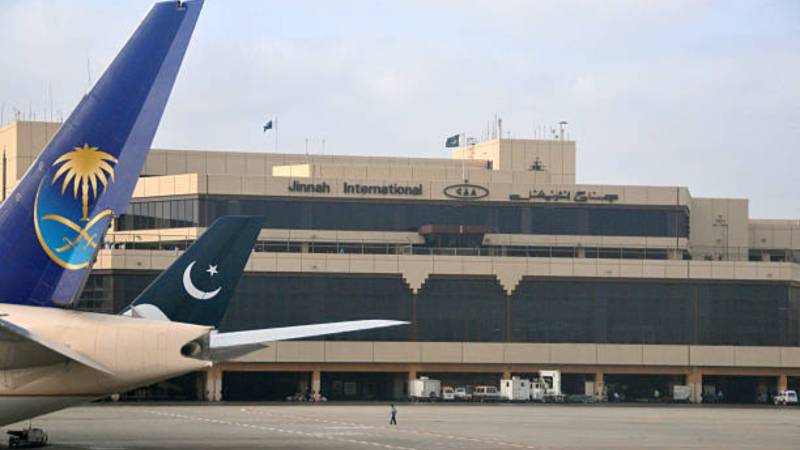
The other day, I went to drop off a relative at 1 a.m.
Most international flights out of Karachi — and Pakistan in general — unfortunately tend to depart in the middle of the night.
The moment we turned left from Shahrah-e-Faisal onto the link road leading to Jinnah Terminal, there was a massive traffic bottleneck.
I had not seen anything like this before.
Slowly, the car crawled forward — the last thing anyone travelling to the airport to catch a flight would need.
I wondered whose bright idea this was.
There were no warning signs of a police checkpost to alert motorists, who suddenly found themselves caught in a bottleneck just minutes away from the airport terminal.
Eventually, it turned out to be a police checkpost, manned by two or three officers. The policemen, for their part, were mostly occupied with flashing torches in the faces of passing motorists and passengers.
I wondered: do they really think they will catch a would-be terrorist like this? Surely there must be a better way than inconveniencing the thousands of travellers who use Karachi airport every day.
Three lanes were merging into one. It was complete madness.
Cars honked incessantly, as one would expect — nearly everyone had someone to see off for a flight.
Finally, after losing 20 minutes of my life that I will never get back, we moved past the checkpost. Then we reached the ASF (Airport Security Force) checkpost, Karachi Airport's actual security checkpoint. There, it was smooth sailing; we crossed quickly and moved towards the main airport building.
At Karachi Airport, where one can pay even to enter the departures lounge without delay or to proceed past immigration without waiting, it isn’t difficult to guess who benefits from the airport’s ‘fast-track system’
We reached the terminal building and headed for International Departures, located at its far end. The rush was immense, and there wasn’t a single parking spot available — legally, at least, though many cars were double-parked.
Goodbyes were said and hugs exchanged.
The passenger moved towards the entrance of the departures area and found that the line to enter snaked all the way around to the refreshments stand. At least 60–70 passengers were waiting, as many flights were leaving around the same time.
Just then, a porter approached the passenger and offered to take them through a separate entrance, set aside for VIPs and senior government officials. Of course, this was for a price, and the passenger went in immediately.
Check-in was smooth.
Then came the dreaded immigration check, where delays are often inordinate. Here too, someone approached the passenger and offered to take them through an unused counter — again, for a price.
This is Karachi Airport’s version of a fast-track system.
Airports around the world have a fast-track system for passengers willing to pay a bit extra to skip the lines.
But there, the system is advertised to the general public, and payments are official, not under the table. Companies bid for managing the system under a third-party contract, and the government receives a fixed amount. In this case, however, the government receives nothing.
At Karachi Airport, where one can pay even to enter the departures lounge without delay or to proceed past immigration without waiting, it isn’t difficult to guess who benefits from the airport’s ‘fast-track system’.
Imagine the impression this would make on a first-time foreign visitor to Pakistan.
This is unlikely to change because, in this part of the world, governments generally do not prioritise making life easier for citizens or providing efficient and reliable services — such as a user-friendly travel experience. The mindset of treating citizens like cattle and assuming they will accept any level of bad governance and corruption must change.
The question is: who will make that happen?