

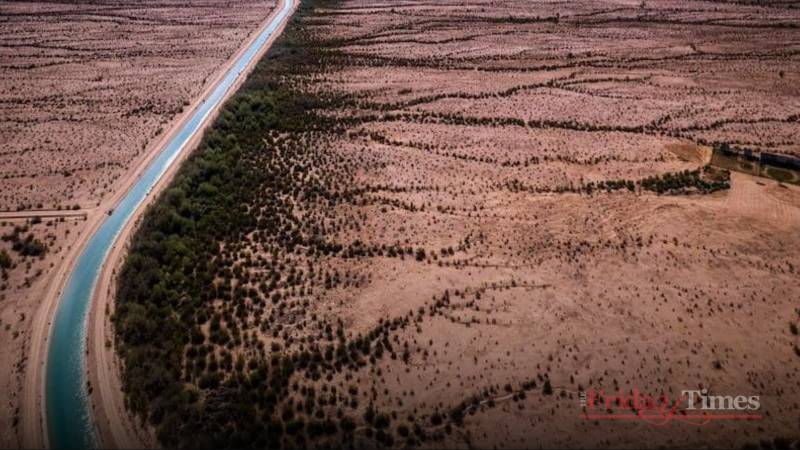
Pakistan’s decision to shelve the Cholistan canal project has been welcomed by experts, civil society, and environmentalists. The move should, many argue, reflect the need to prioritize improving existing irrigation infrastructure over politically contentious and environmentally risky expansion.
Initially envisioned as one of six major canals under the Green Pakistan Initiative, the Cholistan canal was to draw water from the Indus River to irrigate arid lands in the desert. However, critics had long questioned the project’s viability, pointing to its high environmental costs and concerns over water equity.
The GPI, backed by the military and presented as a strategic response to modernize agri and irrigation systems, says that "revitalizing agriculture is essential for the economy, and farmers need access to modern techniques and equipment for effective crop growth. Fundamental issues include a lack of knowledge about modern farming methods, financial constraints for farmers, and the need for scientific and modern agriculture practices." This aim could be achieved without constructing a new canal, especially in the water scarce areas, keeping in mind that other canals in the network are either fully or partially operating but need dire attention.
The Cholistan canal project became a flashpoint for wider concerns about corporate agriculture, land grabs, and what some activists describe as "extractive development" cloaked in the language of national progress.
“They call it ‘development.’ We know it for what it is: extraction, displacement, and deepening cycles of patriarchal violence — fueled by corporate farming and protected by state repression,” said Mushtaq Rajpar, former president of the Sindhi Association of North America (SANA).
Concerns were also raised over the impact of diverting water from the Indus — a lifeline already stretching thin — to arid zones with limited natural fertility, at a time when not just Sindh or southern Punjab but the whole of the country are facing acute water shortages and ecological degradation.
Experts who have worked on Pakistan's water related issues say the government should shift its focus to already underutilized lands within the available canal command, where yields remain half of regional and international averages due to outdated policies and practices, water mismanagement, and lack of farmer support. They believe that millions of acres of irrigated land are being inefficiently. The absence of a proper regulatory framework, inefficient canal systems, leakages, illegal extractions lead to wastage of waters.
If Pakistan invests in improving those areas — through canal rehabilitation, precision irrigation, better farmer training and adopting drip and sprinkler techniques — the returns would be far greater than opening up barren desert.
The country's major reservoirs, Tarbela, Chashma, and Mangla, have also been losing storage capacity due to siltation and weak implementation of policies along with rapid population growth.
Pakistan's irrigation system, one of the largest in the world, is now increasingly vulnerable due to climate change, groundwater depletion, and poor maintenance. While Diamir-Bhasha and Mohmand are incomplete, experts believe that authorities should invest and improve existing infrastructure and aggressively work on the hydrological and hydro-climatological related policies. They argue that the government should support small farmers, research and align water policies with ecological realities, and recommend improving water governance, water security by managing available resources.