

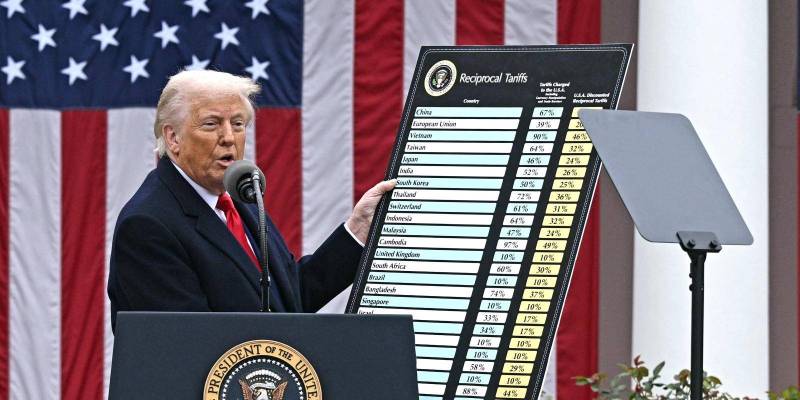
If Donald Trump were to adopt a personal motto, one that encapsulates his approach to international relations, negotiation, and governance itself, it might read thus: Have carrots ready, but always begin with sticks. In the recent adjudication of Learning Resources v. Trump, a six-to-three majority of the United States Supreme Court struck down the largest ensemble of tariffs ever imposed by the former president, disarming one of his most prized instruments of executive coercion.
Mr Trump will surely find others, but the Court’s decision stands as a decisive affirmation of the constitutional principle of separation of powers. Presidents who assume the mantle of independent lawmakers render themselves lawbreakers. That message is unmistakable, even amid the justices’ nuanced and sometimes divergent reasoning.
In his second administration, the president’s preferred stick was the unbridled authority to impose tariffs at will, without procedural encumbrance beyond the perfunctory approval of counsel via an emergency declaration. This power, he claimed, flowed from a novel reading of the International Emergency Economic Powers Act of 1977, a statute enacted to limit presidential emergency powers relative to its predecessor, the Trading With the Enemy Act.
It had never before been used as a source for tariffs. Yet the absence of precedent rendered IEEPA tariffs particularly attractive, a blank canvas awaiting a visionary. Such was the lens through which the president viewed his prerogatives.
Trump’s affinity for tariffs is not a passing fancy. Regardless of economic orthodoxy, he has consistently asserted that international trade benefits sellers at the expense of buyers, and that tariffs deployed energetically protect the nation from exploitation. In his first administration, he exercised this belief within the limits of statutory authority. In his second administration, he sought to replicate the strategy with novel tools. The IEEPA tariffs were sui generis, and Trump’s enthusiasm for their apparent lack of constraints matched his fervour for trade barriers themselves.
Consider Brazil, upon which he imposed substantial tariffs despite a U.S. trade surplus. The rationale was that the nation’s prosecution of a former leader, a declared Trump supporter, allegedly threatened American national security.
In negotiations, he wielded the threat of punitive tariffs as leverage. When partners resisted, as Ontario’s government did when it cited Ronald Reagan against trade barriers, the prescription was to escalate the tariff. Yet his bark often exceeded his bite, and follow-through was inconsistent.
Once a high baseline tariff was in place, the proverbial carrot could be offered. Perhaps a kilogram of gold for his library, perhaps promises of investment, perhaps concessions favourable to American exports. His lawyers were prepared to defend every IEEPA tariff as a necessity dictated by the president’s judgment of national emergency.
The Supreme Court has reaffirmed a simple truth: the president is bound by law, and only Congress can make substantive law
The tariffs challenged in Learning Resources stemmed from Trump’s declaration of an extraordinary threat posed by illegal aliens and drugs at the southern and northern borders. The northern component strained credulity, given that more narcotics flow outward from the United States than inward.
Declarations of emergency are difficult to contest, as courts are reluctant to second-guess the Commander-in-Chief. The proliferation of spurious emergencies is a bipartisan issue, not addressed in this case. On 11 February, the House of Representatives, including all Democrats and six Republicans, voted to disapprove of Trump’s Canada emergency.
The delay shows the limited appetite among Republican legislators to scrutinise the president. Many focused on the dangers of fentanyl without questioning causality. Without an effective legislative veto, the president could simply override such disapprovals with a signature veto.
The litigation in Learning Resources focused not on the emergency declaration itself but on whether IEEPA’s language justified the claimed tariff powers. This represents the latest chapter in the ongoing judicial question: when can one teach an old statute new tricks? Recent years have provided the Supreme Court ample practice, as presidents of both parties have sought to circumvent Congress when cooperation proved inconvenient.
During the Biden administration, conservative justices invoked the Major Questions Doctrine, arguing that matters of vast political and economic importance require explicit congressional authorisation. Liberal justices maintained that statutes granting broad powers should be interpreted according to their literal scope.
Learning Resources v. Trump disrupted these alignments. Even conservative justices sympathetic to the Major Questions Doctrine diverged on its meaning. Three conservative justices found that IEEPA’s grant to regulate trade could plausibly include imposing tariffs. This is similar to the liberal Court’s broad reading of statutes underlying Biden’s student loan forgiveness programme.
While textual fidelity can justify executive deference, a wider view exposes the extraordinary ambition of the administration’s claim. It sought to expand presidential authority almost boundlessly, beyond what Congress could have intended. The Court’s majority agreed that IEEPA could not replace decades of tariff legislation.
Chief Justice Roberts observed that interpreting “regulate” to include taxation would result in a transformative expansion of executive power. Justice Kagan preferred a statute-specific approach. All members of the majority, however, recognised that aggressive executive readings can distort the policymaking process.
Justice Neil Gorsuch’s concurrence provides a compelling defence of institutional prudence. He warned that IEEPA tariffs could be exploited by any future president declaring a climate emergency, imposing tariffs on gas-powered automobiles at arbitrary rates from one per cent to one million per cent. Congress, he emphasised, is the proper forum, where deliberation tempers impulse and compromise shapes disagreement into law.
Could Congress grant a president the expansive tariff authority Trump claimed? Only in a polity with extraordinary trust between the branches, where legislators value executive dexterity without fear of abuse. That polity does not exist. Limitless presidential discretion, as envisioned under the defunct IEEPA regime, is constitutionally impossible.
Americans continue to live under the rule of law, even in the face of executive overreach. The Supreme Court has reaffirmed a simple truth: the president is bound by law, and only Congress can make substantive law. Trump may say, “They do not need anything more from Congress,” refusing to accept the Court’s decision. But the ruling sends a clear message: in a constitutional republic, no one, no matter how powerful or popular, stands above the law. As A Few Good Men reminds us, “You can’t handle the truth!” The truth is that justice is not optional. It is what sustains democracy.