

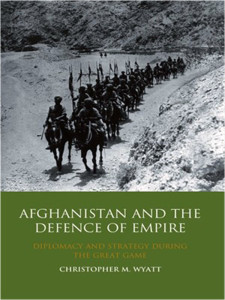
Afghanistan and the Defence of Empire
Christopher M. Wyatt
I.B. Tauris (hardcover), 2016
PRs 10700
At the height of the Great Game in Central Asia, in the run up to World War I and the aftermath of the second Afghan War, the region of Afghanistan became particularly significant for both Great Britain and Russia. Afghanistan and the Defence of Empire explores the relationship between British and Afghan rulers, during the crucial period of the reign of Amir Habibullah Khan, as the British sought to safeguard their Indian Empire from the threat of Imperial Russia. With Russia’s defeat at the hands of the Japanese in 1905 and the rise of Germany as a superpower, the need to end the rivalry took on the utmost importance: efforts which culminated in the singing of the Anglo-Russian Convention in 1907. As the history of Afghanistan becomes ever more crucial for the understanding of its present military and political situation, this book will be of vital interest for students of History, Central Asian Studies, Military History and International Relations.
Review
‘Anyone who is engaged in British empire studies needs to understand British India; with it, the fear of its loss; and with that, the centrality of the Great Game. Christopher M. Wyatt’s book powerfully explains the dynamics of that Game at a most crucial time in Imperial, and world, history. The tale is told with precision and clarity; it covers a vital moment in the life (and death) of the British and Russian empires; and it speaks to a moment that is still important today, as contemporary struggles in Afghanistan again have a global prominence, and are understood locally in the context of narratives about Afghan struggles. It is also important to have a volume that looks at the national/international politics of the country at a very important moment in world history, yet one that has been relatively little covered in the literature. It is particularly powerful on the various interests and interplays within the British Empire - and plays well to the importance of particular individuals in particular places, at particular times. The way that Wyatt draws the lessons of history for the contemporary struggles in Afghanistan should be required reading for all those working in that country.’ - Stuart Croft, Professor of International Security, University of Warwick
The Origins of Visual Culture in the Islamic World
Mohammad Hamdouni Alami
I.B. Tauris (hardcover), 2016
PRs 11500
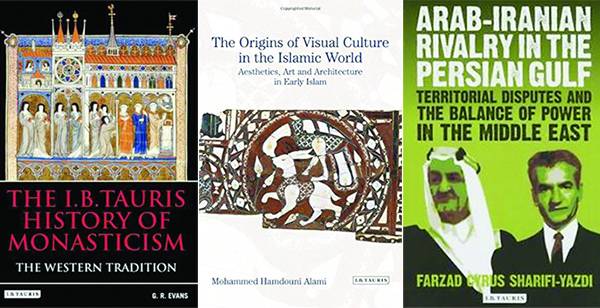
In tenth-century Iraq, a group of Arab intellectuals and scholars known as the Ikhwan al-Safa began to make their intellectual mark on the society around them. A mysterious organisation, the identities of its members have never been clear. But its contribution to the intellectual thought, philosophy, art and culture of the era – and indeed subsequent ones – is evident. In the visual arts, for example, Hamdouni Alami argues that the theory of human proportions which the Ikwan al-Safa propounded (something very similar to those of da Vinci), helped shape the evolution of the philosophy of aesthetics, art and architecture in the tenth and eleventh centuries CE, in particular in Egypt under the Fatimid rulers.
With its roots in Pythagorean and Neoplatonic views on the role of art and architecture, the impact of this theory of specific and precise proportion was widespread. One of the results of this extensive influence is a historic shift in the appreciation of art and architecture and their perceived role in the cultural sphere. The development of the understanding of the interplay between ethics and aesthetics resulted in a movement which emphasised more abstract and pious contemplation of art, as opposed to previous views which concentrated on the enjoyment of artistic works (such as music, song and poetry). And it is with this shift that we see the change in art forms from those devoted to supporting the Umayyad caliphs and the opulence of the Abbasids, to an art which places more emphasis on the internal concepts of ‘reason’ and ‘spirituality’.
Using the example of Fatimid art and views of architecture (including the first Fatimid mosque in al-Mahdiyya, Tunisia), Hamdouni Alami offers analysis of the debates surrounding the ethics and aesthetics of the appreciation of Islamic art and architecture from a vital time in medieval Middle Eastern history, and shows their similarity with aesthetic debates of Italian Renaissance.
The I.B. Tauris History of Monasticism
G.R. Evans
I.B. Tauris (hardcover), 2016
PRs 7200
From the earliest centuries of the church, asceticism and the contemplative life have been profoundly important aspects not just of western Christianity but of western civilization as a whole. For even as monasteries withdrew from the main currents of their societies they provided fertile soil and sanctuary to the liberal arts and sciences as well as those who wanted to spend their lives focused upon God. They became the driving cultural forces of Europe, nurturing education, music, manuscript illumination, art and history, agriculture and animal husbandry – all in addition to spiritual guidance. In this first general history of monasticism in the West since 1900, G R Evans explores the cloistered communities and individuals that have aspired to the ascetic ideal, assessing the huge impact they have made on the wider church and its practices. Including many of the best known names in Christian history – such as Cuthbert, Columba, Hilda of Whitby, Peter Abelard and Thomas Merton – this authoritative survey traces the monastic impulse, in all its rich complexity, from its beginnings in the Egyptian desert up to the present-day ecumenical Taizé community.
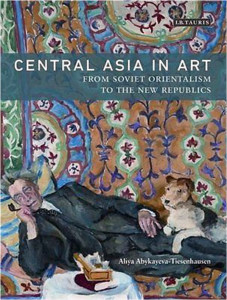
Central Asia in Art: From Soviet Orientalism to the New Republics
Aliya Abykayeva-Tiesenhausen
I.B. Tauris (hardcover), 2016
PRs 6290
In the midst of the space race and nuclear age, Soviet Realist artists were producing figurative oil paintings. Why? How was art produced to control and co-opt the peripheries of the Soviet Union, particularly Central Asia? Presenting the ‘untold story’ of Soviet Orientalism, Aliya Abykayeva-Tiesenhausen re-evaluates the imperial project of the Soviet state, placing the Orientalist undercurrent found within art and propaganda production in the USSR alongside the creation of new art forms in Kazakhstan, Kyrgyzstan and Uzbekistan. From the turmoil of the 1930s through to the post-Stalinist era, the author draws on meticulous new research and rich illustrations to examine the political and social structures in the Soviet Union?and particularly Soviet Central Asia?to establish vital connections between Socialist Realist visual art, the creation of Soviet identity and later nationalist sentiments.
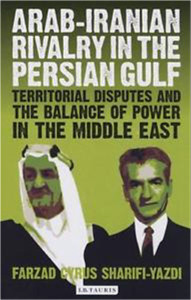
Arab-Iranian Rivalry in the Persian Gulf
Farzad Cyrus Sharifi-Yazdi
I.B. Tauris (hardcover), 2016
PRs 13480
Iranian ambitions in the Persian Gulf and rivalries with Arab neighbors are subject to intense - and heated - speculation, controversy and debate. Here, Farzad Cyrus Sharifi scrutinizes the rival Arab-Iranian claims to Bahrain, the Shatt al-Arab waterway, and the Abu Musa and Tunbs islands in the years after World War II and before the Iranian revolution. Through investigation of previously unexamined primary materials and interviews with leading players, this book sheds new light on the evolution and dynamics of hegemonic and nationalistic Arab-Iranian rivalries and how these rivalries began to find symbolic expression through territorial disputes. Sharifi illustrates that these ongoing disputes - and the deep-seated tensions still prevalent in Arab-Iranian relations - are largely rooted in how they were constructed in the post-World War II period, making this book vital reading for researchers of the politics, history, international relations and diplomacy of the Middle East.