

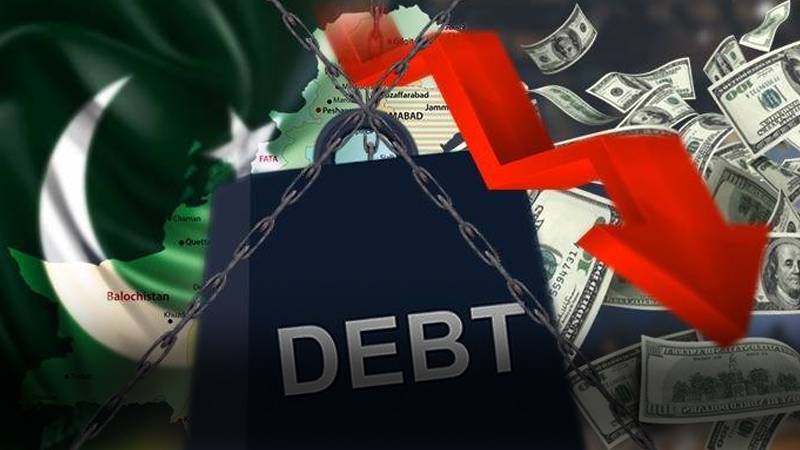
During the last few days, while state-dominated media in Pakistan saturated the airwaves with tales of diplomatic glory—from the downing of Indian jets to coverage of President Trump’s praise for Pakistan and his meeting with the army chief, from a seat on a UN Security Council body to a starring role at the Shanghai Cooperation Organisation (SCO) summit—Islamabad was quietly doing something far more telling: rushing back to Beijing for yet another bailout.
The government secured $3.7 billion in new commercial loans, stacked on top of $4 billion in cash deposits, $5.4 billion in rolling credit lines, and a $4.3 billion trade-financing facility. China is already Pakistan’s largest bilateral creditor, with nearly $29 billion owed—over a fifth of Pakistan’s total external debt. For all the flag-waving and rhetorical bravado, this latest infusion of Chinese money underscores a cold truth: Pakistan’s global posturing cannot hide the economic frailty that keeps it tethered to Beijing’s goodwill for survival.
From the outside, these infusions soothe jittery currency markets and prop up dwindling reserves—now around $9 billion, barely two months’ import cover. But the spectacle of each Beijing bailout masks the rot beneath: a stagnant economy, starved of productivity and export competitiveness. Compare Pakistan’s projected $33 billion in exports this year with India’s $450 billion, Vietnam’s $400 billion, and Bangladesh’s $60 billion, and the gulf is self-evident. Yet even these paltry figures hide the deeper malaise: an export-to-GDP ratio stuck at 10%, down from 16% two decades ago, while neighbours boast ratios two to ten times higher. Pakistan is not just trailing its peers; it has surrendered the race.
Why has this happened? The answer lies in the country’s fixation on its geostrategic location and nuclear power status—prioritising borrowed cash over structural reform. Every rollover of Chinese deposits feels like vindication—that surely, if Beijing keeps lending, Pakistan must be on the mend. In reality, this financial merry-go-round rewards inertia. With $13.7 billion of Chinese debt (excluding infrastructure and energy-related liabilities) already on the books, each new loan is merely a swap: maturing credit lines are extended or repackaged, keeping Islamabad technically liquid while liabilities mount. Meanwhile, Pakistan’s $22 billion in external debt repayments due in 2025 loom ever closer. Without real growth, each tranche from China only delays the reckoning.
If Islamabad cannot summon the courage to overhaul its education system, lower energy costs, and modernise trade and infrastructure, each fresh loan from Beijing will merely prop up a fragile status quo
At the heart of Pakistan’s stagnation is a workforce ill-equipped for today’s global market. Between 2000 and 2019, labour productivity rose a mere 32%—a fraction of India’s 177%, Bangladesh’s 109%, and Vietnam’s 137%. Cheap wages—around $0.64 per hour—may seem like a competitive advantage until one realises that inefficiency wipes out any cost benefit. Literacy hovers around 60%, average schooling stands at just 5.1 years, and vocational training is almost non-existent. As a result, Pakistan’s factories churn out low-margin textiles, rice, and leather goods, while high-value sectors pass it by. Between 2003 and 2018, the range of exported products grew by just 21%, compared to explosive diversification in neighbouring economies.
That failure to diversify has made Pakistan’s export earnings hostage to a handful of markets and products. Over 90% of its apparel is exported to just the EU and the United States, leaving the economy highly exposed to Western policy shifts and demand cycles. Foreign direct investment tells the same story: Pakistan attracts roughly $2 billion a year, while Vietnam pulls in $20 billion, thanks to its integration into electronics and machinery supply chains. Every time policymakers trumpet a new Chinese rollover as evidence of fiscal health, they obscure the reality: Pakistan remains on China’s hook for its very survival.
Meanwhile, public debate remains frustratingly shallow. Newspapers and talk shows parrot discussions on IMF conditionality, rupee devaluation, and interest-rate tweaks—as if these alone could remedy the disease. No one talks seriously about industrial power costs—15–17 cents per kWh, two to three times higher than in Bangladesh or Vietnam—which suffocate manufacturers. No one demands an end to protectionist import duties that preserve obsolete industries at the expense of competition. No one insists on slashing logistics costs inflated by 20–30% due to port congestion and customs delays. Certainly, no one proposes replacing dependency on Chinese credit lines with dependency on homegrown competitiveness.
Yet the ingredients for revival are within reach—if only Pakistan dares to break the cycle. Redirect just a fraction of China’s bailout funds into education, and the country could overhaul curricula, train teachers, and launch digital-classroom initiatives in remote districts. A comprehensive energy strategy—anchored by solar and wind—could bring industrial power costs down to regional norms of 6–9 cents/kWh, revitalising manufacturing. A bold trade-policy agenda, featuring lower tariffs and aggressive free-trade negotiations, could open new markets and incentivise export diversification. Modernising ports, roads, and customs could cut logistics expenses by at least 15%, making Pakistani goods more competitive abroad.
Crucially, Pakistan must free itself from the illusion that endless Chinese loans are a sustainable strategy. Loans can temporarily smooth cash flows, but they cannot substitute for productivity. Indeed, each rollover entrenches dependence: Beijing, after all, will not continue extending credit indefinitely without strategic leverage in return. From infrastructure concessions to policy influence, China will demand collateral—economic and political—turning Pakistan’s short-term cash relief into long-term vulnerability.
In contrast, consider how India, Vietnam, and Bangladesh confronted their own crises. India embraced liberalisation and invested heavily in IT and pharmaceuticals, nurturing a skilled labour force. Vietnam built export-processing zones and invested in infrastructure, transforming itself into a manufacturing hub. Bangladesh reformed labour laws and courted global apparel brands, turning a low-tech industry into an export juggernaut. In each case, political will triumphed over the comfort of easy money. Herein lies Pakistan’s dilemma: it prefers the safety of a Chinese safety net to the discomfort of reform.
If Islamabad cannot summon the courage to overhaul its education system, lower energy costs, and modernise trade and infrastructure, each fresh loan from Beijing will merely prop up a fragile status quo. The day will come when China, facing its own fiscal or geopolitical constraints, stops rolling over deposits—when its willingness to absorb risk wanes. At that moment, Pakistan’s façade of stability will crumble, exposing an economy unfit to stand on its own.
The path is clear, though politically daunting. Education must become the cornerstone of policy, transforming a chronically under-skilled youth into a productive labour force. For instance, Sindh’s literacy rate has not improved since 2008, and female literacy remains below 50% in nearly all districts outside Karachi. Energy reforms must align costs with global standards. Trade liberalisation must dismantle monopolies and encourage competition. Infrastructure upgrades must be relentless. Innovation must be incentivised. Only then can Pakistan generate the self-sustaining growth required to repay its debts without begging for extensions. Only then can it replace dependency with autonomy, borrowing with building.
China’s latest $3.7 billion package may buy another quarter of calm, but it cannot purchase Pakistan’s future. For that, Islamabad must shift from treating loans as a lifeline to treating reform as non-negotiable. The day it abandons the borrowing binge for a building binge will mark the true beginning of Pakistan’s economic story—not as a perpetual debtor, but as a contender on the global stage.