

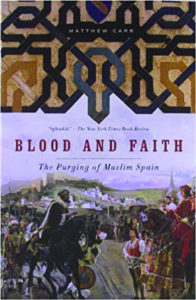
Blood and Faith: The Purging of Muslim Spain
Matthew Carr
Hurst & Co.
A centuries-old story with remarkable contemporary resonance, Blood and Faith is celebrated journalist Matthew Carr’s riveting and “richly detailed” (Choice) chronicle of what was, by 1614, the largest act of ethnic cleansing in European history.
Months after King Philip III of Spain signed an edict in 1609 denouncing the Muslim inhabitants of Spain as heretics, traitors, and apostates, the entire Muslim population of Spain was given three days to leave Spanish territory, on threat of death. In the brutal and traumatic exodus that followed, entire families and communities were forced to abandon homes and villages where they had lived for generations, leaving their property in the hands of their Christian neighbors. By 1613, an estimated 300,000 Muslims had been removed from Spanish territory.
Blood and Faith presents a remarkable window onto a little known period of modern Europe—a complex tale of competing faiths and beliefs, cultural oppression, and resistance against over-whelming odds that sheds new light on national identity and Islam.
Matthew Carr is a writer, broadcaster, and journalist and the author of The Infernal Machine: A History of Terrorism and the acclaimed memoir My Father’s House. He lives in Derbyshire, England.
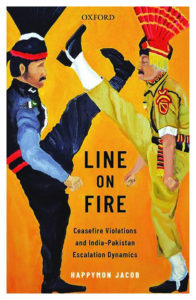
Line on Fire: Ceasefire Violations and India–Pakistan Escalation Dynamics
Happymon Jacob
Oxford University Press
The India–Pakistan border in Jammu & Kashmir has witnessed repeated ceasefire violations (CFVs) over the past decade. As relations between India and Pakistan have deteriorated, CFVs have increased exponentially. It is imperative to gain a deeper understanding of these violations owing to their potential to not only cause a crisis but also escalate an ongoing one. Line on Fire, part of the Oxford International Relations in South Asia series, postulates that the incorrect diagnosis of the reasons behind CFVs has led to wrong policies being adopted by both India and Pakistan to deal with the recurrent violations. Using fresh empirical data and first-hand accounts, the volume attempts to understand the reason why CFVs continue to take place between India and Pakistan despite consistent efforts to reduce the tension between the two nations. In doing so, it recontextualizes and enriches the prevailing arguments in contemporary literature on escalating dynamics and unenduring ceasefire agreements between the two South Asian nuclear rivals.
Happymon Jacob teaches disarmament studies at New Delhi’s Jawaharlal Nehru University.
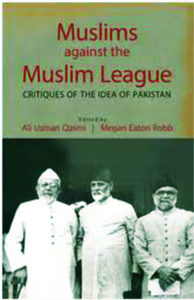
Muslims against the Muslim League
Ali Usman Qasmi, Megan Eaton Robb
Cambridge University Press
The popularity of the Muslim League and its idea of Pakistan has been measured in terms of its success in achieving the goal of a sovereign state in the Muslim majority regions of North West and North East India. It led to an oversight of Muslim leaders and organizations which were opposed to this demand, predicating their opposition to the League on its understanding of the history and ideological content of the Muslim nation. This volume takes stock of multiple narratives about Muslim identity formation in the context of debates about partition, historicizes those narratives, and reads them in the light of the larger political milieu of the period. Focusing on the critiques of the Muslim League, its concept of the Muslim nation, and the political settlement demanded on its behalf, it studies how the movement for Pakistan inspired a contentious, influential conversation on the definition of the Muslim nation.
Ali Usman Qasmi is Assistant Professor in the Department of History at the Lahore University of Management Sciences, Pakistan. He is the author of Questioning the Authority of the Past: The Ahl al-Qur’an Movements in the Punjab (2012) and The Ahmadis and the Politics of Religious Exclusion in Pakistan (2015).
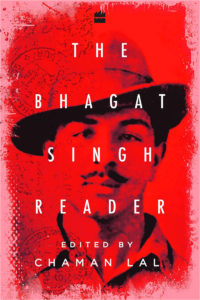
The Bhagat Singh Reader
Chaman Lal
HarperCollins Publishers India (2019)
Sporting a sharp handlebar moustache, his hat askew, Shaheed Bhagat Singh has been lionized in Indian imagination as one of the most influential revolutionaries of the Independence movement. Convicted and hanged by the British in 1931 for his role in killing a colonial police officer in the Lahore Conspiracy Case, he became a martyr at the young age of twenty-three, leaving behind an inspiring legacy. Tales of Bhagat Singh’s heroism and bravery are part of popular folklore, as it were – how he exploded bombs at the Central Legislative Assembly in Delhi and showered leaflets on the legislators before surrendering himself to the authorities, or how he led Indian political prisoners in a hunger strike demanding better conditions in jail. The Bhagat Singh Reader brings into prominence his less widely known intellectual output. It presents in a single volume a collection of his writings and thoughts: from his letters, telegrams and notices to articles that chalk out his subversive and progressive ideas, and his mails from prison to the colonial administration and judiciary. His forty-three sketches of Indian freedom fighters throw light on the larger picture of the independence struggle. This is a book that reveals Bhagat Singh the man and the thinker, the Marxist and the idealist.
Chaman Lal is professor (retired) and former chairperson of the Centre of Indian Languages at Jawaharlal Nehru University. He is honorary advisor, Bhagat Singh Archives & Resource Centre, Delhi Archives, and fellow of Panjab University, Chandigarh.
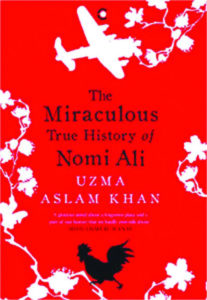
The Miraculous True History of Nomi Ali
Uzma Aslam Khan
Westland Books
Nomi and Zee are Local Borns—their father a convict condemned by the British to the Andaman Islands, their mother shipped off with him. The islands are an inhospitable place, despite their surreal beauty. In this unreliable world, the children have their friend Aye, the pet hen Priya and the distracted love of their parents to shore them up from one day to the next. Meanwhile, within the walls of the prison, Prisoner 218 D wages a war on her jailers with only her body and her memory.
When war descends upon this overlooked outpost of Empire, the British are forced out and the Japanese move in. Soon the first shot is fired and Zee is forced to flee, leaving Nomi and the other islanders to contend with a new malice. The islands—and the seas surrounding them—become a battlefield, resulting in tragedy for some and a brittle kind of freedom for others, who find themselves increasingly entangled in a mesh of alliances and betrayals.
Uzma Aslam Khan was born in Lahore and grew up in Karachi, Pakistan. She is the author of five novels, including Trespassing, The Geometry of God, Thinner than Skin, and, most recently, The Miraculous True History of Nomi Ali. Trespassing was shortlisted for the Commonwealth Prize Eurasia 2003. The Geometry of God was voted one of Kirkus Reviews’ Best Books of 2009 and won a bronze medal in the Independent Publisher Book Awards 2010. Thinner than Skin was longlisted for the Man Asian Literary Prize 2012 and the DSC Prize for South Asian Literature 2014. Her novels have been translated worldwide, including in Romania, Brazil, France, Spain, Italy, Serbia, Norway, and Sweden.