

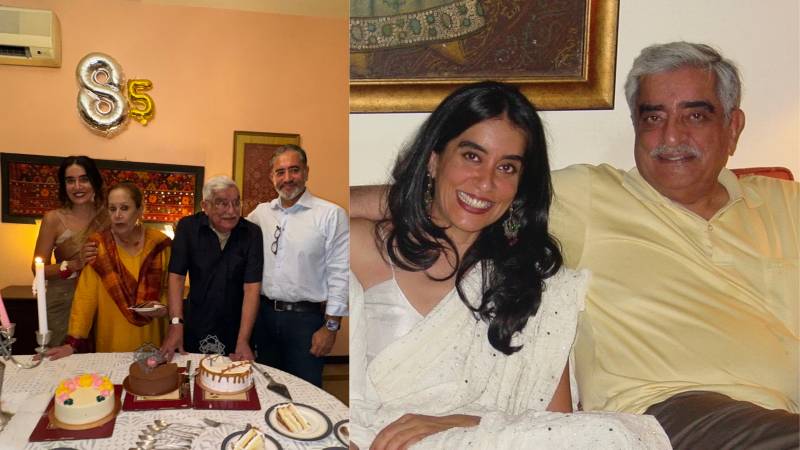
Najmuddin Shaikh
September 4, 1939 – March 28, 2025
My father left this world just over a month ago. It is difficult to characterise the time before and after. Taking care of the ill has a certain urgency; there is no time outside that time. But the time of mourning has a strange duration. There is an insistent sadness even as one believes, unconsciously but not only unconsciously, that all this is temporary: my father is abroad for work as he so often was throughout his life, and very soon, he will emerge from his study, his hair disheveled, his kurta sleeves rolled up, ready for tea and conversation as usual.
Even as mourning cannot and will not conform to reason or limits, there comes a moment when its call is unmistakable both within and outside that reason and those limits, when it is clear that something (a sense, a feeling) and someone (a presence, an aura) will no longer be among us. It is only then, that is now, in these early weeks, that I think about all the gifts my father gave as he was slowly leaving us, gifts he granted when he was least in a position to do so. He was unwell though the source of his illness was then a mystery. When I rang from New York, he made it clear, with the utmost lucidity and emotional clarity that he wanted simply to fade away having lived a rich and productive (this latter he qualified with “I hope”) life, a point he made more than once. He told me he knew it was hard for me as his daughter to hear him say this, but, even so, he said, one should know when it is time to move on to the next phase, and this was the stand he was taking to his own end.
My father repeated variations of these sentiments to each one of us, thereby freeing us from the terrible fate of those condemned to believing their loved ones were not prepared to die, were fearful of what awaited them, or were disappointed by the incompleteness of their lives. That he did so was a testament to his wisdom and judgment, and equally to his generosity. How much more unbearable would it have been if he were burdened by regret or frustration, clinging hopelessly to the life that was leaving him? Even as he became seriously ill when he was in the constant company and invariably asked how he was feeling, he would respond with characteristic understatement and equanimity, “Not too badly”.
It is indisputable that his life was remarkable. Still, it is uncommon even for the
most remarkable among us to recognise our lives as such. He grew up in a family of doctors in Hyderabad, Sindh, and against all expectations, made the decision early in life to pursue international relations, the one subject to which he had been especially drawn having read in many widely diverse disciplines, taking great pains to find serious books when they were not so easily available with the kind of determination and initiative that characterised his every endeavour.
His first ambassadorial post was to Canada, where he served as High Commissioner before being appointed Ambassador to Germany, just as the Berlin Wall came down
And so, at the relatively young age of 21, he took the civil service exam and the following year began a decades-long career in the Foreign Service of Pakistan. After completing graduate study at the Fletcher School of Law and Diplomacy at Tufts University in Boston and language training in Paris, he started his first posting in Moscow at the height of the Cold War. He rapidly became fluent in Russian and a keen member of the diplomatic community, befriending his contemporaries from other missions as well as his counterparts in the Soviet Ministry of Foreign Affairs. As a young bachelor, then only in his 20s, he was known as a bit of a bon vivant, developing a taste for caviar, a vibrant and active social life, and an irrepressible inquisitiveness about the world around him. From Moscow, he moved to Tehran in the mid-1960s, under Shah Reza Pahlavi, where he proved equally talented, learning Farsi, moving with ease in several circles, and becoming known for his warm hospitality and sharp wit as well as for his astute political and diplomatic skills.
He was too modest to ever speak of his own successes except with the greatest irony, but others over the course of our lives told us how unusual it was to have such a young foreign service officer so adept at both his social and professional responsibilities.
It was during this time, on a brief visit to Islamabad, that he met his life partner, Raana Sharwani, to whom he was married in 1971, just as the country was torn asunder during the liberation war of East Pakistan, now Bangladesh. In 1973, the family moved to Baghdad, returning to Islamabad for two years before moving to Washington, D.C. where he served for a time as Deputy Chief of Mission.
During the mid-1980s, as Additional Secretary for the Soviet Union, Afghanistan and Policy Planning in the Foreign Office, he was a key participant in the negotiations that led to the 1988 Geneva Accords calling for the Soviet withdrawal from Afghanistan during which his fluency in Russian served him especially well in talks with the last Foreign Minister of the Soviet Union, Eduard Shevardnadze. I still have vivid memories of seeing him on the nightly news, walking down gilded hallways during the talks looking dapper in a three-piece suit surrounded by his contemporaries from the Soviet Union, Afghanistan, and the United States. He travelled frequently not only to Geneva but also to Moscow and Washington over those years where his skill as a negotiator was shaped by his singular ability to listen to even that which was not spoken, giving equal importance to often conflicting and divergent points of view, and, as a master in the act of persuasion, enabling all parties to believe their interests had been achieved. I should add that all of us, his immediate and extended family, as well as his intimate friends, were many a time the collateral beneficiaries of this extraordinary ability!
His first ambassadorial post was to Canada, where he served as High Commissioner before being appointed Ambassador to Germany, just as the Berlin Wall came down. His next ambassadorial posting was to Washington, D.C., immediately after which he returned to Tehran, this time as Ambassador. He reached the pinnacle of his career as Foreign Secretary from 1994-97 where he served with distinction during the Prime Ministership of Benazir Bhutto.
He brought to the position his decades of diplomatic experience, his characteristic discipline, vitality, and efficacy, and, as ever, his great and abiding love of country. In the days after he passed away, we received countless messages from his Foreign Office colleagues commenting on his extraordinary skills as a diplomat, interlocutor, and mentor. His fellow diplomats knew him as a “thorough gentleman,” both principled and egalitarian. His seniors and subordinates equally attested to his academic vigor and commitment, suggesting he was among the most intellectually engaged and vibrant foreign secretaries in the country’s history.
A true cosmopolitan, equally at home in Tehran as in Moscow and New York, able to speak with equal ease to people of all ages and origins, conversant both literally and figuratively in several languages, my father remained throughout his life a consummate diplomat
I remember being amazed by his limitless energy myself. He would frequently arrive early in the morning from a brief trip to several countries and immediately leave for the Foreign Office, his initialed leather briefcase in hand. He was as diligent in fulfilling the social demands of his profession, attending receptions and formal dinners, and leaving when appropriate to return to his files at home. He would then change into his well-worn kurta shalwar and lie in bed on his right side with his head propped up, reading intently. As he read, he would write comments on hundreds of diplomatic briefs pulled from the trunk that accompanied him home from the office.
Following his retirement, he remained active, teaching at the National Defense University in Islamabad, and writing regular columns for English dailies including Dawn and The Daily Times. Among the positions he assumed at the time were Special Envoy to Yemen, Sudan, Kenya, and Bahrain, senior vice president of the Karachi Council of Foreign Relations, and head of global and regional studies at the Institute of Business Management in Karachi. He was also an active participant in several track-two diplomacy initiatives on Pakistan-India relations.
He played bridge regularly and hosted parties at home when he would pour himself a rather generous scotch on the rocks and light a cigarette, but only after preparing drinks for his friends. At the end of the evening, he always insisted on walking his guests out to their cars. He retained also his unique sense of style, moving seamlessly and gracefully from three-piece suits to raw silk kurtas and blazers, the latter always adorned by his signature cravats.
He demonstrated throughout his life astonishing discipline, an unquenchable thirst for knowledge, and a deep curiosity which he taught his children not so much by way of a command but rather by example. Even more importantly, perhaps, he evinced an unusual commitment to both traditional and contemporary ideals. A feminist avant la lettre, he insisted his daughter receive an education equal to his son, even if this meant compromising his son’s conventionally necessary priority of attention. As Foreign Secretary, he named two successive women as directors in his office, including Tehmina Janjua who went on to become the first woman Foreign Secretary in the country’s history. He supported his wife in her professional pursuits including those considered unbecoming at the time, as a television actress and director. He was equally supportive when she was appointed a senior government official in her own right, and after his retirement, had no hesitation in following her to Karachi when she began work at a private television network.
A true cosmopolitan, equally at home in Tehran as in Moscow and New York, able to speak with equal ease to people of all ages and origins, conversant both literally and figuratively in several languages, my father remained throughout his life a consummate diplomat. His heart, though remained in Pakistan, the country which he served with dedication and absolute faith all his life, believing to the very end in its promise and potential even as the faith of many others wavered.
We have been so touched by the devotion and commitment shown by his immensely loving and generous family, fellow diplomats, and friends from the many phases and places of his life who have come or called or written while he was ill and in the weeks that followed.
What a gift he gave as he left. How many gifts did he bestow in his life to so many.
Khudahafiz, my beloved Baba. And thank you.
Behind the door
you pull at the cord of longing
until tears come
in this well you are mirrored.
— Nelly Sachs