

With at least 615 fatalities and 388 injuries—among civilians, security personnel, and outlaws—in approximately 273 incidents of violence, including terror attacks and counter-terror operations, Pakistan witnessed a nearly 32% decline in overall violence and several other promising trends in its security landscape during the second quarter of 2025, according to the Centre for Research and Security Studies (CRSS). These include:
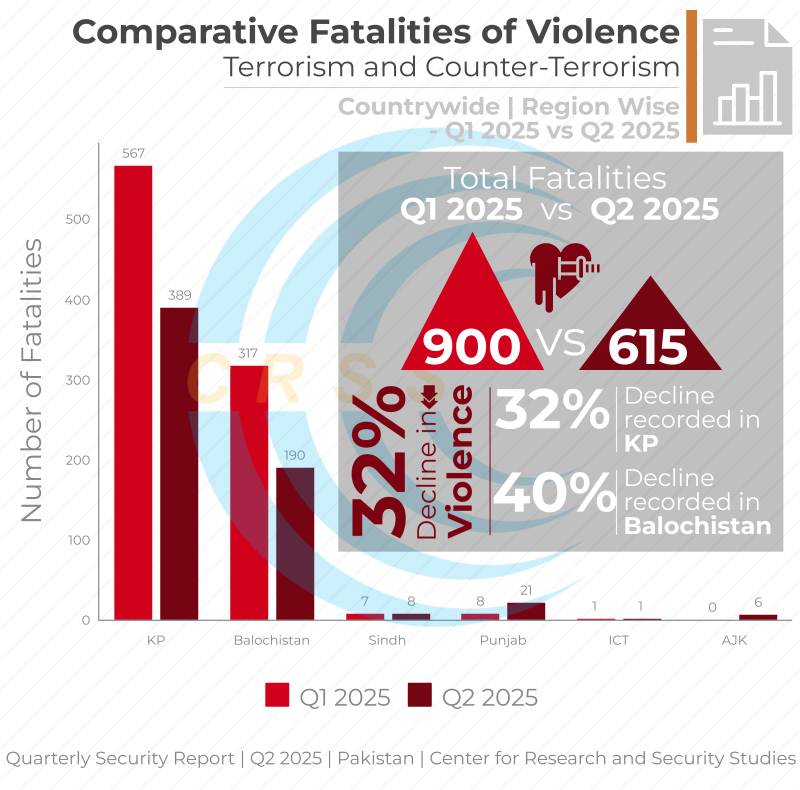
i) Fatalities dropping from 900 in Q1 to 615 in Q2, 2025, the key metric behind the reported 32% reduction in violence.
ii) The fatalities suffered by security personnel and civilians combined (282) remained lower than the total number of outlaw fatalities recorded (333)—amounting to over 15% fewer comparative losses among civilians and security officials.
iii) Approximately 32% and 40% less violence was recorded in Khyber Pakhtunkhwa (KP) and Balochistan provinces, respectively, compared to Q1. Violence-linked fatalities dropped from 567 to 389 in KP, and from 317 to 190 in Balochistan, indicating a possible strategic breakthrough as a result of a pro-active hunt-neutralise-capture campaign.
While terrorism and insurgency-induced violence receded in these conflict-hit provinces, both regions continued to bear the brunt, accounting for over 94% of total fatalities and 93% of violence-related incidents recorded this quarter.
The Tehrik-i-Taliban Pakistan (TTP) continued to lead the violence in KP, while Balochistan remained a parallel epicentre of unrest—marked by a deadly mix of separatist militancy and targeted attacks against state forces.
The spread of militancy into previously calmer areas is also a cause for concern. Pakistan’s largest province, Punjab, witnessed an alarming trend, recording a 162% surge in fatalities—though absolute numbers remain relatively low (from 8 in Q1 to 21 in Q2, 2025). Notably, Azad Jammu & Kashmir, which reported zero fatalities in Q1, recorded six deaths in Q2. Islamabad and Sindh remained largely unaffected with only minimal fluctuations.
While the intensity of violence has eased in traditional hotspots, its spread into newer or less-prepared regions will require continued attention and policy adjustments.
Analysis of overall fatalities and casualties recorded in Q2, 2025, by victims of violence reveals some important trends—both alarming and encouraging:
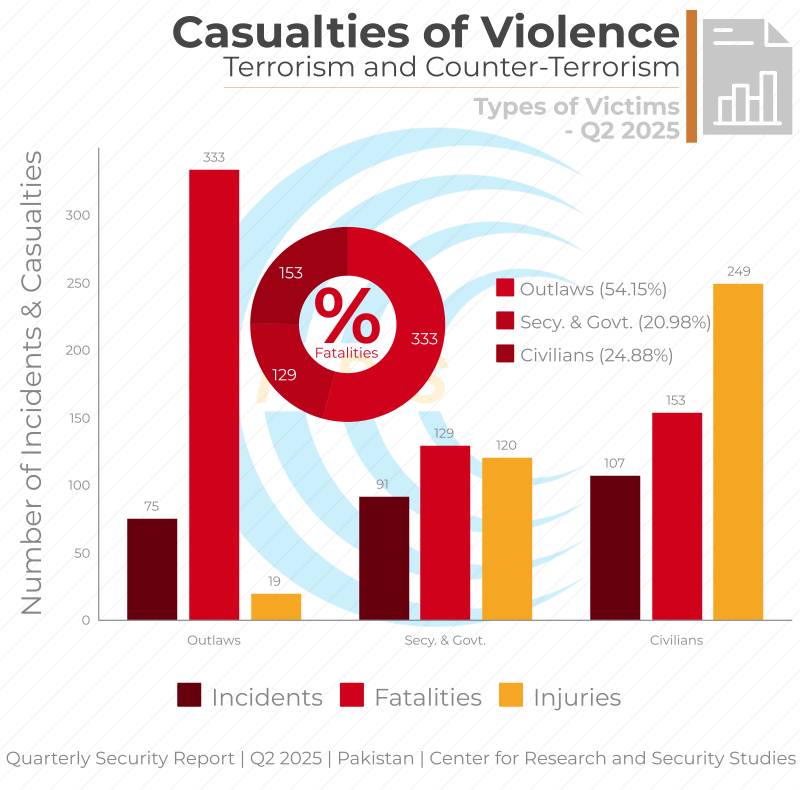
Outlaws suffered the majority of fatalities (over 54%, or 333 deaths), followed by civilians (25%, or 153 deaths), and security/government officials (21%, or 129 deaths).
Although outlaws accounted for the highest number of fatalities, civilians were the most frequently targeted group, suffering more attacks and injuries than either security personnel or militants.
Civilians were affected in 107 terror attacks, compared to 91 attacks on security personnel and 75 operations targeting outlaws.
Civilians also suffered 249 injuries, compared to 120 among security personnel and only 19 among outlaws.
This high number of attacks and injuries suffered by civilians indicates that terrorist groups aim to instil fear and cause disruption, rather than execute precision strikes.
Moreover, the disproportionately low injuries but high fatalities among outlaws—despite being involved in fewer incidents—suggests a high degree of lethal precision in state-led counter-terrorism operations.
As previously mentioned, even the combined fatalities of civilians and security personnel (282) remained lower than the 333 fatalities among outlaws—another positive indicator.
Meanwhile, deaths among outlawed groups—militants and insurgents—fluctuated around 35% between 2021 and 2024, but surged to around 55% in Q2, 2025, reflecting intensified and successful counter-terrorism campaigns.