

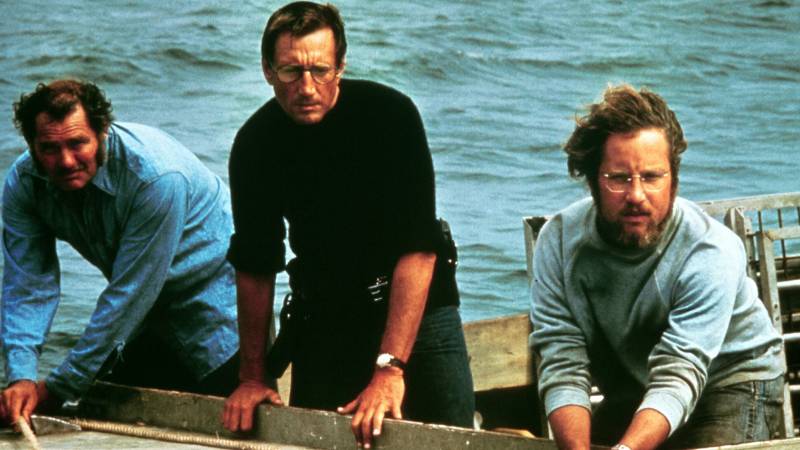
With the boom and bust of TikTok following the pandemic, ‘normcore’ was coined, and the film’s fashion suffered a full-circle moment when the blue-collar workwear and preppy Ivy League essentials were adopted to become a symbol of themselves. Interestingly enough, Spielberg’s version had no proper costume designer, although it did have three ‘wardrobe workers’: Robert Ellsworth and Irwin Rose working on the menswear, and Louise Clark on the womenswear. Acne Studios’ AW23 collection, modelled by Kylie Jenner and previous Nordstrom launches selling dirty denim, took fashion bros by storm with the capitalist promise of ‘showing you’re not afraid to get down and dirty’; it was when the jokes started to write themselves. Often credited as the forefather of denim, Levi’s originally came up with the jean to persevere against the thrash of working-class labour.
Jaws disproves stuck-up stereotypes, particularly with Hooper, regarding Ivy style and how it leans formal and stuffy. The laid-back approach to this style became the new trendy ‘anti-trend’, hashtagged ‘old money’, encouraging consumption of slacks and polos while throwing away ‘flashier’ items, like distressed skinny jeans or comfortable trainers. Toxic minimalism movements rooted in celebrity culture, dripping down to the ‘sad beige’ mums, have stripped away the very essence of the featured outfits in an unfortunately successful attempt at cosplaying the rich, all while being poor is only cool when you’re rich. Everyone is a self-proclaimed artist until it doesn’t sell, because this is often carried out without knowing art exists in a lineage of the artist’s work, not totally by itself.
Additionally, his style embraced a nautical element, namely his fisherman’s beanie, grey crew neck and deck/boat shoes. For a quick history lesson, the fisherman beanie is the phenomenally straightforward idea that you’d be able to regulate temperature easily when working the seas and docks. Hooper is seen switching it out with a distressed denim beanie, eerily similar to Japanese label Kapital, for which Americana is a recurring touchstone, in addition to deconstruction and traditional textile techniques like sashiko and boro.
Although utterly kitschy to have been inspired by Ernest Hemingway’s classic The Old Man and the Sea and to have been mechanically distressed to showcase the fisherman’s struggle (made from panels of 12oz denim featuring a buckle-fastening strap at the crown), it sort of plays into itself, because if it didn’t, Jaws in the fashion setting would likely have been forgotten about. Because things fade when they can’t be renewed to be resold in one way, shape, or form. His style explores fewer pastels, like Kelly green and baby pink, that would have been more historically accurate for the lively 80s to come, but this was likely intentional, given that the setting of ‘Amity Island’ was off-coast.
From utility to runway, the film’s fashion set the stage for the illusion of ‘normalcy’ available for purchase at J.Crew and Uniqlo
Ironically, the whole ‘old money’ fever was overcome in 1980 following Lisa Birnbach’s Official Preppy Handbook, a satirical ode to the East Coast Waspie Preppie culture that was emerging. The book, written in partnership with Jonathan Roberts, Carol McD. Wallace and Mason Wiley went from poking fun at the posh to a guidebook for a cult following in short, democratising preppy and adjacent styles, such as the ‘Sloane Rangers’ of West London. Since then, Americana has managed to trickle down to Japanese ‘City Boy’ culture since the 70s, namely in the lifestyle magazine Popeye and prep in W. David Marx’s book Ametora: How Japan Saved American Style.
Madman Fisher Quint is the stereotype he’s set out to be, rightfully so, combining military aspects and the blue-collar worker. His clothing shows real wear and tear, particularly in some variation of a B1 cap he wears for a solid chunk of the film. Other iterations of military wear are his M51 field jacket, Vietnam ‘USGI’ boonie hat and cargos. Keeping in with war heritage, he also layers Navy-issue blue chambray shirts under heavy-duty woollen CPO shirts, for that tough-guy feel. More casual looks feature raglan shirts, designed out of necessity for the ease of movement and dressing of British General Lord Baron Raglan, who’d lost his arm in battle.
The diagonal seam, often differentiated with another colour, went down from the collarbone to the underarms, helping achieve great comfort. When aboard the Orca, in Quintessential fashion (pun intended), he puts his thinking hat and penny loafers on. This term originates from somewhere in the 1930s, when teenagers began placing a coin in the slot of the laceless formal shoe for payphone change, akin to their Ivy-inspired school uniforms. His character meticulously avoids any sailor clichés like fisherman hats or silly ascots. The authenticity of his style is further amplified by the background actors, likely to be locals wearing their own personal clothing. In a way, it hints at the bad blood between the actual accessibility of fashion versus its masterfully created perception otherwise.
Brody is found at the intersection between Hooper and Quint, between two worlds he’s not really affiliated with, given that the sea is far from a man’s best friend. As the film progresses, he’s seen transitioning to darker colours, in rhythm with the unfolding of the plot. The turning point to note is the beach-turned-disaster scene, where he wears the stark contrast of a crisp navy tee and khaki shorts. Avoiding most any chance of being awkward on deck, he stays true to himself, although the life jacket did get the best of the police chief at some point.
A simple man wears simple clothing; he can be seen rocking some waist-adjustable, inclusivity-pushing trousers. Achieving a ‘lived-in’ look, done by clothing brands for you today, through rolled sleeves, popped collars and distressing at the hem, Brody silently passes comments on the performative denim-heads of today. To deal with the fluctuating weather at sea, he makes the smart choice of wearing a mock neck. From utility to runway, the film’s fashion set the stage for the illusion of ‘normalcy’ available for purchase at J.Crew and Uniqlo. Putting a price tag on the accessibility of fashion-forwardness for consumer culture to bite down on has had its turn with many, but Jaws has and will always stand the test of time, transcending season and trend.