

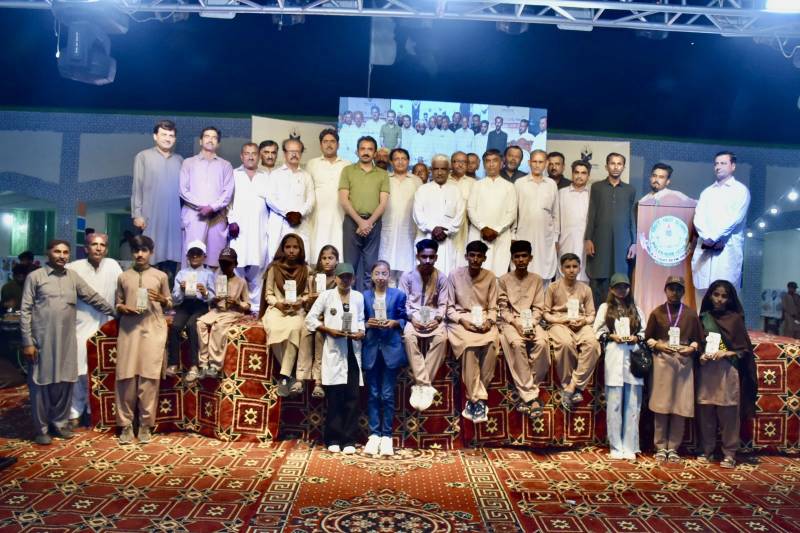
MITHI: As the Sindh government advances its School Specific Budget initiative, its early effects are beginning to emerge in places often left at the margins. In the desert of Tharparkar, Government Boys High School Malanhor Vena situated at the outskirts of Mithi town, adopted by the Thar Education Alliance (TEA) is quietly translating financial autonomy into a broader ambition to evolve into a model public school shaped by both institutional support and community ownership. This was evident during the school’s annual event, which was attended by the parliamentarians, education officials, local stakeholders, teachers, students and community members and it was a rare convergence in a region where public schooling often struggles for visibility.
The gathering carried less the air of ceremony and more that of a collective stocktaking. Among those in attendance were PPP MNA Dr Mahesh Kumar Malani, MPA Mohammad Qasim Siraj Soomro, Senator Gyanchand Tharani and Assistant Commissioner Mithi Umair Ashraf, alongside representatives from the education department and civil society. Their presence underscored a growing recognition that meaningful reform in education requires alignment across multiple tiers of governance. The students, however, remained at the centre of the occasion. Through a series of stage performances, they offered glimpses of both talent and confidence, while a group presentation on climate change advocacy stood out for its urgency.
Speaking with clarity and conviction, the students called for serious action, their voices reflecting a generation increasingly aware of the environmental vulnerabilities that define hard life in the desert of Thar.
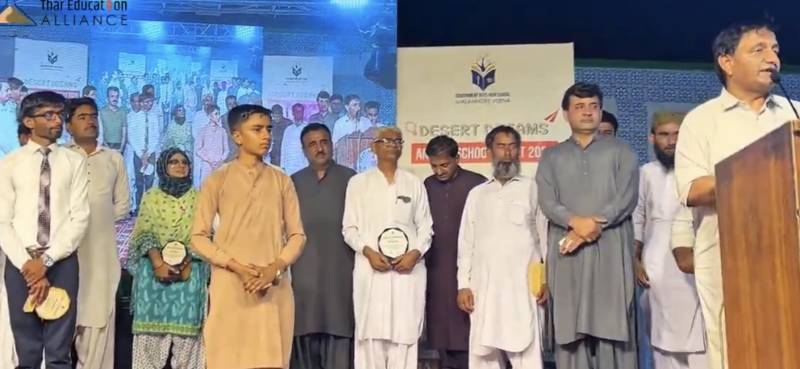
Welcoming the guests, Head Teacher Satram Das said the very presence of stakeholders gathered with a sense of confidence and commitment was itself a measure of progress. He noted that the school stands among the first in Sindh to utilise the School Specific Budget in alignment with its intended heads, resulting in visible improvements to the learning environment. “This is not only an example being set by the Sindh Government,” he said, “but a moment that signals a shift towards making history in public education.”
TEA’s Chief Executive Partab Shivani framed the initiative as both an opportunity and a responsibility. The school’s adoption, he said, was aimed at transforming it into a model for the province, an ambition contingent on shared ownership. He pointed to the community’s engagement as a critical strength, noting that despite resource gaps, there is a clear understanding among residents of the value of education.
At the same time, he highlighted persistent challenges: the presence of around 90 female students without a single female teacher, and the school’s role as a cluster hub serving more than 22 surrounding institutions. “The village presents a rare but encouraging reality: not a single child remains out of school a reflection, he suggested, of both community awareness and sustained local effort,.” he added.
The PPP MNA from Thar, Dr Muhesh Kumar Malani, addressing the gathering, described the village as distinctive in its commitment to education and community cohesion. He expressed confidence that TEA’s involvement would yield tangible improvements, assuring continued support at multiple levels. MPA Qasim Siraj Soomro echoed the need to prioritise quality in education, noting that the role of teachers remained central to shaping a meaningful learning environment. Strengthening faculty, he suggested, would be key to sustaining any progress made through financial or administrative reforms. The event also served as a moment of recognition. Former head teachers were awarded for their contributions in strengthening the school over the years, a gesture that acknowledged continuity alongside change. Mohan Singh, a matriculation student, was awarded a laptop in recognition of his integrity and refusal to engage in the prevailing culture of cheating and unfair means during board examinations. His commitment to honesty was acknowledged as both rare and exemplary. Building on this, the Thar Education Alliance (TEA) announced that it would support his educational expenses through to university level. The organisation also extended this commitment as an open encouragement to other students, signalling that those who uphold similar values of integrity and dedication would find institutional support for a better future.