

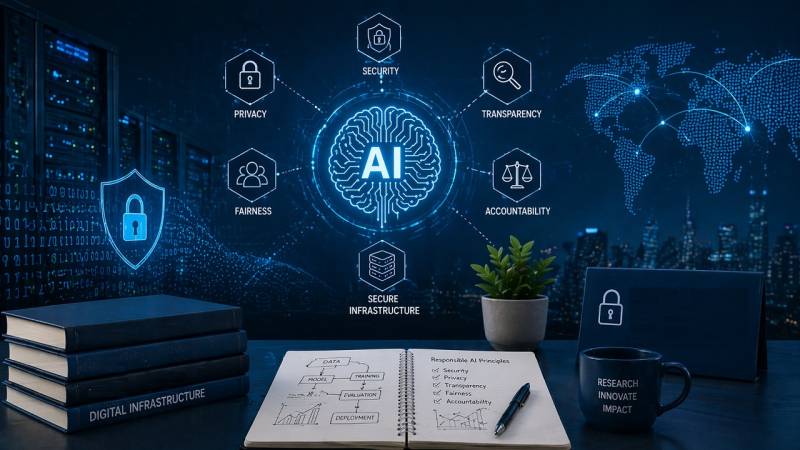
Artificial intelligence is becoming part of ordinary life much faster than most people expected. It is entering healthcare, education, offices, phones, and digital services, often before users fully understand what can go wrong. The promise is real, but so are the risks. If a system is trained badly, if data is not protected, or if safety is treated as an afterthought, the damage can spread quickly. That is why the public conversation around AI is no longer only about innovation. It is also about trust, reliability, and protection.
Dr. Shakil Ahmed, an AI & Information Security Expert, works in exactly that space where progress and caution have to move together. Based in Karachi and serving as Associate Professor at FAST–NUCES, Dr. Shakil has built his work around artificial intelligence, secure digital systems, and postgraduate research. His view is straightforward: “AI is only useful when people can trust how it is built and how it is used.” That line helps explain why his work feels timely. He is not only interested in what a model can achieve. He is equally concerned with whether it is safe, dependable, and strong enough for real use.
In simple terms, artificial intelligence helps machines detect patterns, classify information, and support decisions. Information security protects the data, devices, and systems behind that work. When those two fields are separated, problems begin. A tool may look advanced but still expose sensitive data, or it may automate an important task without being reliable enough for serious settings. Dr. Shakil has worked across both sides, and that gives his comments more balance. He appears to see AI not as a race to impress, but as a responsibility to build systems people can rely on. As he puts it, “Security cannot be added at the end. It has to be part of the system from the beginning.”
For Dr. Shakil Ahmed, the larger concern is not whether AI will spread, but how responsibly it will spread. He appears to favour systems that are tested carefully, used for a clear purpose, and built with room for human judgement instead of blind dependence. In his thinking, useful technology should reduce risk, not quietly multiply it, and it should help people make better decisions rather than push them aside.
That view comes from years of teaching, supervision, and applied research. With a PhD in Computer Engineering and more than two decades in academia, he has stayed close to both technical work and student development. He has taught and supervised work in artificial intelligence, machine learning, cryptography, deep learning, and intelligent systems, which gives his comments a steadier foundation than trend-based discussion.
That matters because the AI debate is often pulled in two extreme directions. On one side, every new tool is treated like a breakthrough. On the other, every risk is described like a reason to stop. The more serious question sits in the middle: how can digital systems be made accurate, secure, and useful enough for everyday settings where mistakes have real consequences. That is the part of the conversation where voices like Shakil’s become important, because they are shaped by actual work rather than noise.
The substance of his work also connects well with public concerns. Dr. Shakil has been involved in healthcare-focused AI research, including skin cancer classification through deep learning and GAN-based models. He has also contributed to climate-related analytics, including work on forecasting Karachi’s air temperature variation, and has worked on FPGA-based AES-XTS encryption for secure storage systems. Together, these areas show a consistent concern with how digital tools perform when the stakes are real.