

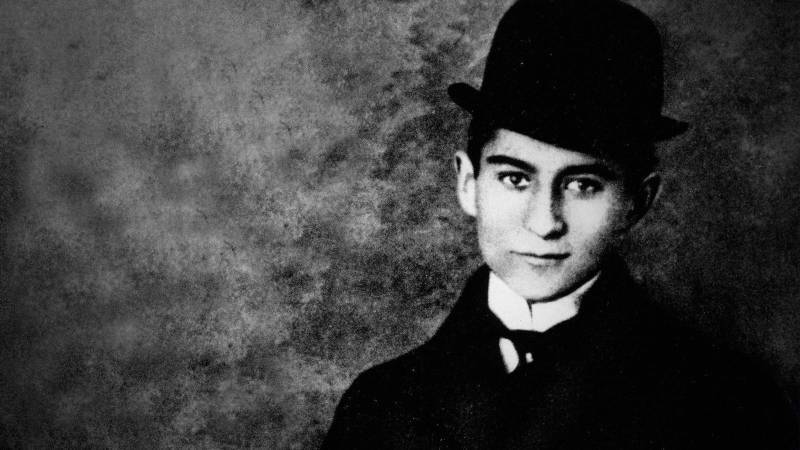
“I never wish to be easily defined. I’d rather float over other people’s minds as something strictly fluid and non-perceivable; more like a transparent, paradoxically iridescent creature rather than an actual person.” ~Franz Kafka
To pen anything about a great writer is such a cumbersome and uneasy task. And especially, when the writer is mainstreamed with such severity that not only the right themes but also the wrong thinking about him have been well established over the years of literature. But then, that is the beauty of literature. One can always shed a novel perspective on an otherwise hackneyed body of work, and that’s what I am trying to indulge in.
Kafka, perhaps one of the greatest German writers, whose life was a misery and he just let the grotesque spread on the paper. It is said that he burnt 90% of his work, and what is left is a flicker out of an inferno.
Anyway, I recently had the privilege to ponder upon his sine qua non scribbling– Metamorphosis. The infamous vermin transformation of a hard-working, tidy lad, who was responsible for looking after his worn-out father, mother, and younger sister. The family was ridden with debt and struggling to make ends meet. Whereas, Gregor was the only breadwinner of the family, and yet tragically metamorphosised into an ignominious shape and form.
A key insight about great writers is this: they offer latitude to different interpretations, or the lack thereof. For some, what happened after the transformation will be the reflection of the reality we live in, where the adage “essence transcends form” is nothing but a mythological epigram. The façade is what we sell, and ipso facto, as one becomes more palatable, the value of the person somehow inflates squarely.
Like an onion without end, this book offers a lot; and thus testifies to the greatness and vastness of the ideas and pen of the scribe
Maybe for some, this is not an ideological work at all. Rather, a nut-head frenzied story, with a lot of drama and a nonsensical plot. Or maybe for some, this is an avant-garde defence of anxiety. Where anxiety is cohesive, addictive, and complete. Vis-à-vis, tranquility is incomplete; like a house of cards waiting for a disturbing event. Whereas, post-fall, there is nothing to round up anymore. It is the end, and maybe then, the only aspiration, for the cards, is to linger and prolong anxiety (destruction) as much as possible. This is vouched by the fact that, in so far as the anxiety existed in the household, the protagonist existed.
Another possible theme is that this short work is showcasing the ephemerality of love, in an unfavourable, mind-boggling situation. The sister who even loved her brother after the “event” was the first to acknowledge, “I don’t want to call this monster my brother.” She was too tender to imbibe all this absurdity, yet this and the ensuing saga vouch that the love was neither unconditional nor sustainable enough. Prima facie, this world—if considered the nest of unbeatable adoration—is, for Kafka, a foolish proposition.
The only remnant of life then is the constant anxiety, which not only irritates but also makes sure life remains lively.
A crucial worth-noting aspect about the tonality—even after the loss in translation—is the fluid, almost laminal flow and the anxiety-causing scenes. The whole plot revolves around a room, where Gregor—not Gregor per se, but him as a vermin—is trapped, and his phenomenology becomes the only window through which the story traverses.
Sardonically, we now live in a world of farcical optimism, where self-help gurus, armed with their departmental epistemologies, preach their version of life, where feelings of existential pangs, uneasiness, and the absurd are immediately abhorred. The foregoing, then, seems fundamentally detrimental to life and success (read: wealth). Cliché quotes of positivity are widespread here and there, with a glaring disconnect from deep-rooted and often-explored human psychology, in all its multitudes of emotions, paradoxes, and idiosyncrasies. Against this backdrop, these works are important if not to provide the right way, then at least to send a tremor through the surface of superficial, myopic optimism.
Notwithstanding the foregoing, this work has myriad other dimensions and angles that could be ascertained, and yet, there will be more layers. Like an onion without end, this book offers a lot; and thus testifies to the greatness and vastness of the ideas and pen of the scribe