

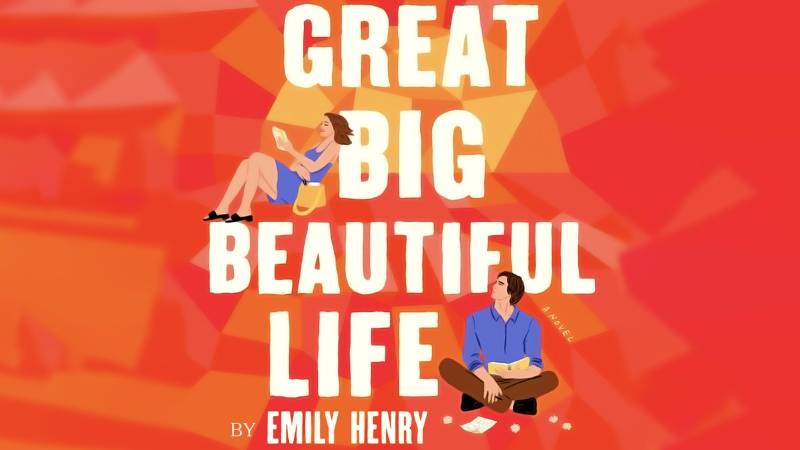
Emily Henry is a New York Times and Sunday Times bestselling author known for her contemporary romance novels, often described as witty and charming, and frequently compared to the work of Nora Ephron. Her books, including Beach Read, People We Meet on Vacation and Book Lovers are popular for their relatable characters, engaging storylines, and exploration of themes like love, friendship, and self-discovery. Many of her novels are being adapted into movies, further solidifying her status as a prominent voice in the romance genre. The novel Great Big Beautiful Life is her latest foray, now into the celebrity romance genre.
The novel was a light read for me, it covered the lives of celebrity Margaret Ives and her meetings with two reporters, Alice Scott and Hayden Anderson – both reporters are competing to write the octogenarian’s biography, but what remains to be seen is whether their own steamy romance will survive their work competition. The hot and rather heavy romance sections reminded me of the Mills and Boon novels and Barbara Cartland novels that are a rite of passage for most teenage girls. Sadly, though, now at the age of 42, I yawned and just skimmed through those portions of the book.
But if the reader wants something slow for their brain, this one is definitely an easy and fun summer read – there is a media empire that Margaret is heir to, there is the curse of the Ives, which leads Margaret’s husband Cosmo to tragedy, there are several great Ives love affairs explored in detail in the book that make love seem worth it all.
What is love? The book questions the meaning of love through Margaret’s parents broken marriage and divorce:
“The truth was, Margaret wasn’t sure she knew precisely what love was. Sometimes she lay awake late at night, thinking about the word until it came apart like little bits of alphabet soup, the letters drifting off in opposite directions and the meaning lost somewhere in the gaps.”
What fascinated me most was the term Nicollet. Margaret’s grandfather had used it for his sister who he adored and after that, how it was used to mean someone most special to you – I have to leave it to the reader to find out how. But it means the person dearest to you. Its usage in the story touched my heart.
The hot and rather heavy romance sections reminded me of the Mills and Boon novels and Barbara Cartland novels that are a rite of passage for most teenage girls
Margaret Ives says about herself during the interview process with Alice: “I was a news story the moment I was born,” she goes on. “From before my first breath, there were two distinct Margaret Iveses. There was me, and then there was the other one, the one who belonged to the public. Who got written about. Who people loved at times and hated at others, and no matter where I stood with the public, I understood that it wasn’t really me.”
Margaret “was not graceful, poised, demure, or reserved. She was silly, irreverent, and clumsy, and the press adored her for it. The Tabloid Princess, they called her.”
The one line that describes Hollywood perfectly for Margaret and Cosmo: “But none of it was real. And now Cosmo knew that too. The love of strangers was mercurial. You did nothing to earn it and so could do nothing to prevent it from vanishing, or souring into hatred.”
The novel isn’t just about celebrity romance though, it’s deeper than that, it delves into the personal friendships between Alice and her newspaper buddies, and explores Alice and her mother Angela’s fraught relationship – in this way exploring the elements of what a mother daughter relationship is. Do mothers love daughters because they are their daughters or can mothers love daughters for themselves? Is love an action or more than that? I found it exceptionally sweet when Alice says: “Mom’s love has always been an action, rather than words. Making that hideous quilt, teaching me how to bake my favourite peach cobbler and my favourite cast-iron cornbread casserole, and serving one or the other every time I come home.”
Hayden and Alice even explore the idea of free will and whether one has it or not. Alice says one does. Hayden says that a lot of things are out of our control but that “That we don’t have to end up with regrets,” he says. “That if we really care about something, we can decide to hold on to it.”
The Laura Ives story is so fascinating that it is one that the reader should delve into themselves. Other than involving the FBI and crime, I shall give no spoilers away. There is a lot to be explored in this novel.
The reader should read it themselves to find out whether Alice and Angela resolve their mother-daughter issues, to see whether Alice or Hayden secures the contract for the biography or are there even deeper skeletons in the Ives closet, and obviously to find out where Alice and Hayden’s romance ends. Hayden does say that when love is real it’s easy, even when it’s complicated, just to give you a teaser. Do we get our picture-perfect Mills and Boon ending by Emily or not?
All these questions will only be answered if you add a copy of Great Big Beautiful Life to your shopping cart, online, or physically as you loiter though the bookshop at the Mall.
The novel leaves us with the questions: Whom do you love? What makes your heart beat? For whom would you unmake the world, and how would you build a new one? Who would you call your Nicollet and welcome them to this big, beautiful life?
For me, the answers are clear. I hope you have yours.