

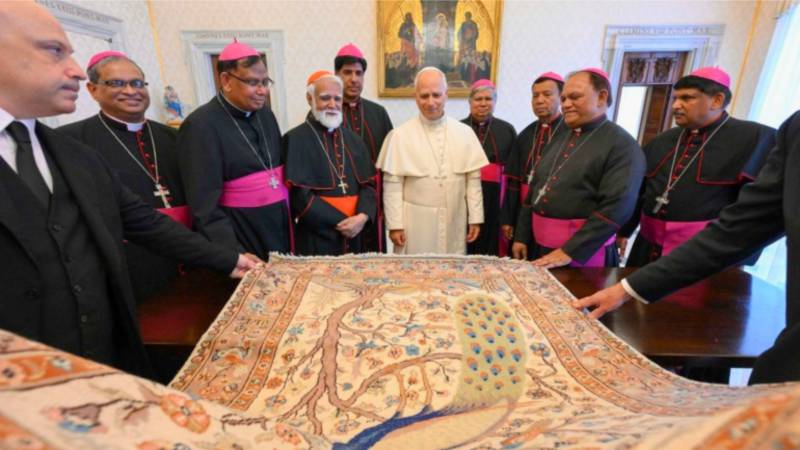
During their ad limina visit to the Vatican from 11–16 May, Pakistan’s Catholic bishops invited Pope Leo XIV to visit Pakistan, where Christians constitute only about 1.5 percent of the population. The ad limina visit, held every five years, allows bishops from different regions to meet the Pope and Vatican officials. The Pakistani delegation included eight Catholic Church leaders — seven bishops and one cardinal — among them three archbishops and four bishops.
During the meeting, the bishops presented Pope Leo XIV with a traditional Pakistani carpet as a symbol of hope, unity, and the connection between Pakistan’s Catholics and the universal Church.
Following the audience, Bishop Samson Shukardin of Hyderabad, President of the Catholic Bishops’ Conference of Pakistan, told Vatican Media that Christians in Pakistan continue to face “serious problems regarding blasphemy cases and forced conversions”, yet remain “strong in faith” despite hardship and discrimination.
Pakistan is nearly 96 percent Muslim, while Christians form a small but significant minority. A papal visit would therefore send a powerful message about Christian-Muslim dialogue, religious coexistence, the protection of minorities, and shared commitments to peace and tolerance.
The Catholic Church is one of the major Christian denominations in Pakistan. Fewer than two million Catholics live in the country, representing less than one percent of the total population, but forming a substantial segment of Pakistan’s overall Christian community, which numbered approximately 3.3 million according to the national census. Catholics are concentrated mainly in Punjab province and major urban centres in other provinces.
Beyond its spiritual mission, the Catholic Church has made major contributions to Pakistani society through education, healthcare, social welfare, and development work. Catholic schools have long provided quality education, particularly to marginalized communities, while Church-run health centres, technical institutions, and development programmes continue to serve people across the country regardless of religion.
Pakistani Christians — especially Catholics — remain hopeful that Pope Leo XIV will eventually make a historic visit to Pakistan. Such a journey would carry profound religious, diplomatic, and social significance. Although no official papal visit has yet been announced, Pope Leo XIV has already demonstrated a strong commitment to interfaith dialogue, peacebuilding, and engagement with Muslim-majority nations through his early international outreach.
A papal visit would symbolize recognition and encouragement for Pakistan’s Christian community while reinforcing the broader message of coexistence among religions. One of the most important aspects of such a visit would be its contribution to interfaith harmony. Pope Leo XIV has consistently emphasized dialogue over division and peace over conflict in his public addresses and foreign engagements. His calls for reconciliation in regions affected by violence, including parts of Africa and the Middle East, reflect his belief that religious leaders can play a crucial role in promoting unity and understanding.
For Pakistan’s Christian population, such a visit would be deeply emotional and historic. Christians in Pakistan have long sought greater recognition, inclusion, and security. The presence of the Pope would provide moral support, international visibility, and renewed encouragement for communities that often face discrimination, social marginalization, mob violence, and accusations under blasphemy laws.
Pope Leo XIV has already emphasized interfaith engagement in visits to Muslim-majority countries such as Turkey, Lebanon, and Algeria. A Pakistan visit would likely be framed in a similar way — as a bridge-building mission between Islam and Christianity. Such a visit could also carry broader geopolitical implications.
Historically, papal visits often transcend religion and become symbols of hope, diplomacy, and humanitarian concern. So far, only one pope has visited Pakistan: Pope John Paul II, who travelled there in 1981 during the rule of General Zia-ul-Haq. A visit by Pope Leo XIV would therefore become only the second papal trip in Pakistan’s history, making it a major historic event.
Ultimately, Pope Leo XIV’s visit to Pakistan would be far more than a ceremonial occasion. It would represent a powerful affirmation of interfaith dialogue, minority inclusion, peacebuilding, and global solidarity. At a time when the world faces growing polarization and division, such a visit could send a meaningful message that mutual respect, understanding, and peaceful coexistence remain essential foundations for a more stable and humane future.