

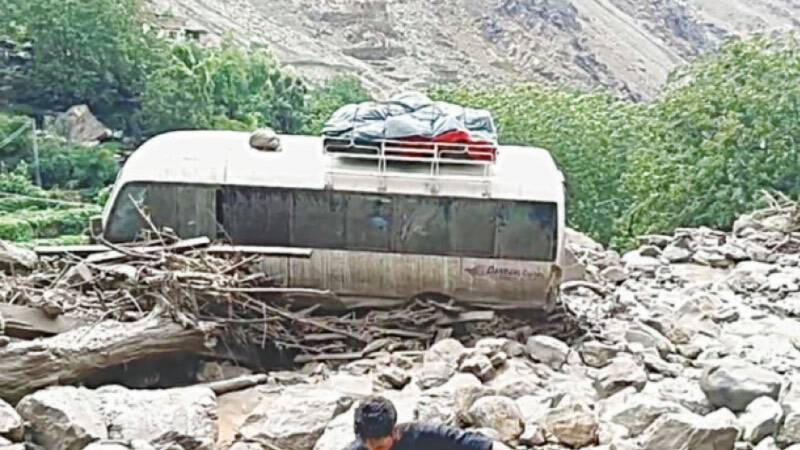
At least four tourists have been killed and over 15 are missing in Gilgit-Baltistan after torrential rains triggered flash floods and a cloudburst near Babusar Top on Monday. The sudden deluge swept away dozens of vehicles, damaged infrastructure, and blocked key roads, prompting a large-scale rescue operation.
Local authorities confirmed that over 200 tourists stranded in the Diamer district were rescued and shifted to safer areas in Chilas. “They’ve been moved to hotels and government rest houses,” said Faizullah Faraq, a spokesperson for the GB government. Helicopters and heavy machinery were mobilised, with the Pakistan Army, local police, and rescue teams working round the clock.
Deputy Commissioner Diamer, Atta-ur-Rehman, reported that rescue teams recovered three bodies, while search efforts continue for the missing. At least two injured tourists were transported to district hospitals. The flash floods have also damaged a large number of private homes, two mosques, a girls’ school, and four bridges, leaving several localities inaccessible.
Babusar Road and parts of the Karakoram Highway remain blocked due to landslides. The National Highway Authority (NHA) has begun clearance operations, allowing one-way traffic through Chilas Bazaar, Zero Point, and Passu. Rehman added that food, medical aid, and water supplies have been dispatched to remote villages that remain cut off.
The National Disaster Management Authority (NDMA) has issued a landslide warning for mountainous districts including Gilgit, Skardu, Hunza, Astore, Diamer, and parts of Azad Jammu and Kashmir. The alert warns of further disruption as monsoon rains continue across northern Pakistan.
Nationwide, monsoon-related incidents have claimed over 225 lives and injured more than 500 people since late June, according to NDMA data. Experts have linked the increased intensity of rainfall and flash floods to global climate change, citing a worrying pattern that resembles the catastrophic floods of 2022.
Communication infrastructure has also been badly affected. Mobile signals and electricity remain suspended in several areas of Diamer. Authorities are urging tourists and locals to avoid unnecessary travel, especially through mountainous terrain prone to landslides.
As climate extremes become more frequent, experts stress the need for stronger early-warning systems, better infrastructure, and sustained investment in disaster preparedness to protect vulnerable mountain communities.
This is a developing story.