

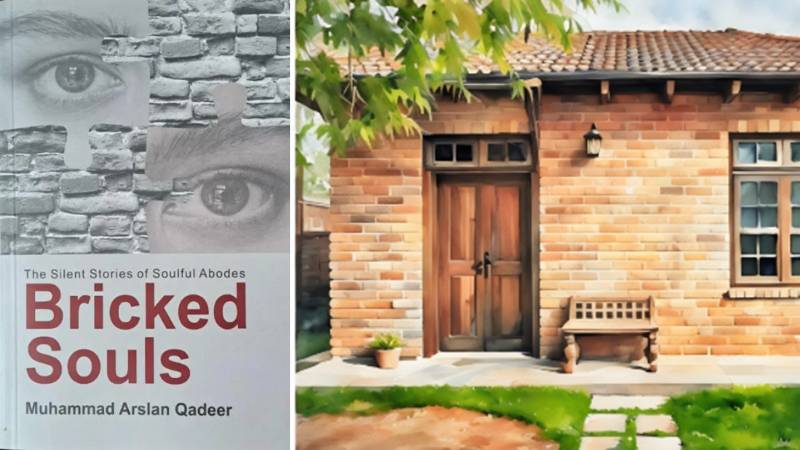
Lieutenant Colonel Muhammad Arsalan Qadeer (retired) was commissioned in an armoured regiment of the Pakistan Army in 1988. Emerging from a family steeped in literary traditions, he embarked on a diverse writing journey, exploring travelogues, historical narratives and articles on foreign affairs in numerous English dailies and journals since 2003. He is a regular contributor to esteemed publications such as The Nation, South Asia and Hilal magazines and his literary footprint spans across genres. Bricked Souls is his second collection of short stories, which showcases his profound insights. His first book, By the Autumn Trees, was published in 2019. A compilation of his selected works translated into Urdu has been released in Karachi as well.
The book Bricked Souls explores the concept that old houses, cars and things have a consciousness just as living beings do. Colonel Arsalan’s father introduced him to this concept in their Gulberg house when he was very young. The book starts with that story and goes on to regale us with tales of many such houses which have spirits living in them, or which helped their owners out in times of need. Colonel Arsalan rightly points out in the novel that “Life as a teacher teaches you…” and he goes on to say that “My father used to say we don’t own things; rather they own us. We are merely their custodians for some time. ‘Amanat’ is the right word.”
There are such pearls of wisdom tucked away throughout the passages of Bricked Souls and I thoroughly enjoyed my slow-reading of it on quiet September afternoons.
As a young boy, Colonel Arsalan’s father taught him that everything in the universe has a consciousness. According to him, even things shaped and crafted by human hands acquire consciousness – just like living things
There is a story about a British teacher and her two daughters – Beatrice and Julian – who taught the Colonel mathematics and English language and how their house used to light up at Christmas time with carols and baking, their uncle on the piano. There is a story about Mohkam Din who died in his house in Anarkali because he loved it so much – beyond its monetary value and he refused to sell it during his lifetime. There is a story about spirits inhabiting and leaving a decrepit government house in Rawalpindi, with a lot of paranormal activity mentioned. There is lovely story about a house on Lawrence Road where all the oldies used to congregate – writers, poets and artists of our time – to have a good time. There are many personal and hard-hitting stories, such as the one about a boy who liked dancing, singing and planes as well, and how he and his mother coped with his gender-identity issues. There are stories about the houses Colonel Arsalan has inhabited with his wife and how they have become home. Each story is written with care, love and dedication to the art of writing.
Colonel Arsalan seems to have a natural talent and flair as a writer and this comes out directly in this prose which is eloquent, methodical, neat, tidy and composed. His command over the English language is wholly complete and I would sometimes forget that I am reading a book not written by a native speaker of the language. As he draws us into his world and tells us tales about houses with spirits and souls, he also forces us to ask ourselves questions of morality.
In one story, Nadeem’s wife is dying of cancer and he marries a second time before her death so as to do nothing wrong and remain within the ambits of religion. That really made me question what I would have done in a similar situation, and the answer, for me at least, was that I would never have married in the presence of a first wife. These are very deep, personal, questions – the answer to which is different for each individual depending upon their moral code – that Colonel Arsalan forces one to ponder upon through the interlinked stories in his book.
As a young boy, Colonel Arsalan’s father taught him that everything in the universe has a consciousness. According to him, even things shaped and crafted by human hands acquire consciousness – just like living things. To his father, as mentioned earlier, this phenomenon applied to machines such as cars and structures such as buildings and houses. He says: “This consciousness improves, amplifies, echoes and resonates with the human connection. The longer the connection endures, the stronger the bond. It even interacts, reacts, and acquires emotions such a joy, happiness, pain, gloom and grief. They laugh, weep and cry. But this is mostly one-sided. Humans with their endowed and acquired characteristics, are still incapable of establishing a tangible bond, but that doesn’t mean they don’t speak, cry or laugh with you. However, one with an inner eye can always feel the vibrations. Yes, you can conceive, hear and even see them lamenting, crying or laughing.”
This book deals with Bricked Souls: the forgotten houses, cars and instruments that play a crucial role in our daily lives, yet we ignore them just because they cannot speak. They carry ‘souls’ within them and we must understand that when dealing with such entities.
For those who want to learn more about the world, this book is a must read and I would recommend it to everyone.