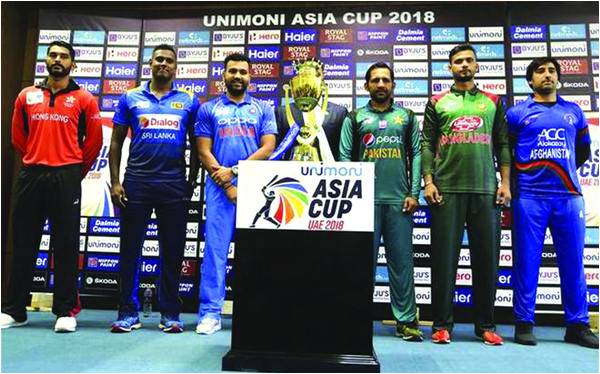
This piece is being written before the India-Pakistan clash at the Asia Cup, discussion on which and the deeper ends of the tournament would follow in the coming weeks. For now there is another critical question that cricket governing bodies need to address with regards to the future of the sport.
This is about the so-called smaller teams or the ‘minnows’ and their participation at the international events. The debate hinges on two very basic aspects; the first being the need to ensure that international tournaments aren’t marred by too many mismatches so as to maintain interest levels, and in turn the finances; and the second being the expansion of the sport to other countries so that more nations can take it up – which in turn has its own economic benefits as well.
Scotland beat England earlier this year
The ongoing Asia Cup adds to the aforementioned debate. The tournament began in 1984 as a tri-series involving India, Pakistan and Sri Lanka. And for the next three decades it has, in large part, been a competition between those three sides, with other sides – mostly Bangladesh – making up the numbers.
The 2004 and 2008 editions – the latter in Pakistan – also involved Hong Kong and UAE, so that the tournament could expand. But the tournament itself always involved two of the abovementioned three sides in the final.
With Bangladesh steadily growing, that triopoly was finally changed in 2012, when they made it to the final of their home tournament, eventually being outdone by Pakistan. The 2014 edition featured Afghanistan for the first time, but did not have Hong Kong or the UAE, in what was a five-team contest. Another five-team tournament followed in 2016, this time in the T20 format.
Ireland beat Pakistan, 2007
This year the tournament has been expanded to six teams, with the top five joined by a team that won the qualifying tournament, which featured Malaysia, Nepal, Oman, Singapore, UAE, Hong Kong – the latter winning it. This ensured that a wide range of teams from Asia got a chance to be a part of the continental cup, but only a select few would play the main tournament.
The six teams have been drawn into two pools, with two teams from each pool qualifying for the Super Four, where they will all play each other once. The format clearly has been designed to ensure that all of the so-called top teams get through to the final four, which is where the business end of the tournament would begin. Hence, the group stage of the main tournament is technically an extension of the prelude that the qualifying was.
Bangladesh beat India, 2007
Pakistan overpowered Hong Kong
It also bears an uncanny resemblance to the 2007 ODI World Cup wherein 16 teams were divided into four pools with the idea that the top two from each – i.e. the eight top sides in the world – would qualify for the Super 8, making that a veritable upper-tier league. Of course, Bangladesh and Ireland spoiled the party by knocking India and Pakistan out in their respective groups, meaning that the seemingly elite league featured them instead!
An early exit for either of India or Pakistan from a World Cup would be a major setback for the tournament given the eyeballs these two countries bring. For both of them to be knocked out would be catastrophic.
Unfortunately that seemed to have influenced the format for the 2019 World Cup, which basically is a league for the top 10 sides. With other sports trying to increase their outreach, for the cricket world cup to shrink from 16 teams in 2007 to 10 in 2019 – when an eight-team Champions Trophy already exists – was arguably one of the first decisions taken in the history of the sport.
The ‘minnows’ question can and should only be addressed by giving them more exposure in continental and world events. Format and size-wise perhaps the 2007 World Cup was the best, and because both India and Pakistan anomalously exited early shouldn’t stop the governing bodies from maximising the participation at global events.