

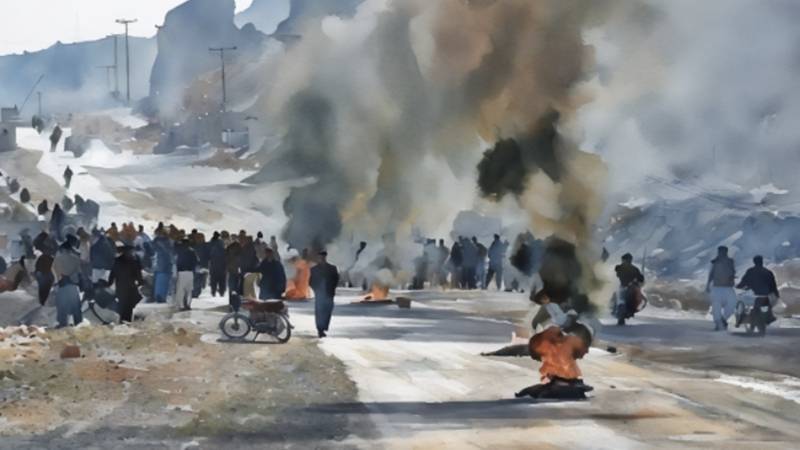
In 1971, Pakistan lost East Pakistan, not due to an external conspiracy, but because of its own failure to govern with justice, inclusion, and respect. Today, as Balochistan faces a deepening crisis, we must ask ourselves: Have we truly learned anything from history?
Balochistan is Pakistan’s largest and most resource-rich province, yet it remains the least developed. Stark economic disparities, political exclusion, and a dismissive attitude toward local grievances have fuelled widespread resentment. Local communities witness their resources being extracted while they remain trapped in poverty. Roads and infrastructure are constructed, but not for their benefit. Investments pour into the province, yet they fail to create meaningful employment opportunities for the local youth. This economic alienation is steadily widening the divide between the state and its people.
The state’s reliance on a security-first approach echoes past miscalculations, where military force was prioritized over political accommodation. The recurring cycle of militarization and repression has only deepened the alienation among Baloch citizens. Pakistan cannot afford to inflict another self-inflicted crisis upon itself.
Learning from history: Balochistan and the politics of inclusion
The situation in Balochistan today bears a striking resemblance to past national crises, where economic disparities and political exclusion led to widespread unrest. Historically, failing to address local grievances has only served to widen the chasm between the state and its people. Given Balochistan’s strategic importance and abundant resource wealth, it demands a governance model that fosters trust, dialogue, and inclusive development rather than relying solely on security measures.
Unlike past national conflicts, Balochistan does not have a single dominant political force uniting its grievances. However, the fragmentation of nationalist movements should not be mistaken for a lack of discontent. If the state continues to overlook Baloch demands for greater autonomy and fair resource distribution, it risks exacerbating the crisis.
The CPEC paradox: development without inclusion
The China-Pakistan Economic Corridor (CPEC) was heralded as a transformative initiative for Pakistan’s economic future, with Balochistan positioned at its core. However, the reality for Balochistan has been starkly different. While Gwadar has witnessed large-scale infrastructure projects, the local population has been largely excluded from reaping the benefits. Instead of generating employment for Baloch citizens, CPEC projects have predominantly relied on external labour, reinforcing the perception that development is happening to Balochistan, not for Balochistan.
Unlike past national conflicts, Balochistan does not have a single dominant political force uniting its grievances. However, the fragmentation of nationalist movements should not be mistaken for a lack of discontent
For development to be sustainable, its benefits must be equitably shared with the local population. Excluding Baloch communities from economic prosperity risks further alienation. If CPEC is to achieve genuine success, it must actively incorporate local stakeholders and ensure that economic progress uplifts Baloch citizens rather than bypassing them.
The state’s approach: security and stability
For decades, Balochistan’s governance has been dictated by security considerations. The establishment views the Baloch insurgency as a national security threat, often attributing it to foreign interference. Intelligence reports have indeed cited external actors as playing a role in the conflict. However, this is the reality of global politics—states exploit existing fault lines in rival nations to advance their strategic interests.
From the Cold War to the present-day Middle East, geopolitical actors have consistently used internal discontent in adversarial states to further their agendas. India accuses Pakistan of supporting militants in Kashmir, while Pakistan alleges Indian involvement in Balochistan. The US and the Soviet Union engaged in proxy conflicts for decades, just as Iran and Saudi Arabia continue to do today. However, external interference does not create insurgencies—it only exploits pre-existing grievances.
This is where Pakistan’s challenge lies: ensuring internal stability through effective governance, economic inclusion, and political reconciliation so that fault lines cannot be easily manipulated by external actors. Addressing legitimate concerns within Balochistan will make it far less susceptible to foreign influence.
The possibility of unintended consequences: TTP and BLA collaboration concerns
Security analysts have raised concerns about the possibility of tactical coordination between the Tehrik-i-Taliban Pakistan (TTP) and the Balochistan Liberation Army (BLA), despite their ideological differences. While the BLA’s nationalist goals and the TTP’s Islamist agenda are fundamentally distinct, their shared hostility toward the state has fueled speculation that limited operational cooperation might occur in certain scenarios.
Factors contributing to such interactions include:
- A common enemy: Both groups are engaged in armed conflict with Pakistani security forces.
- Geographic proximity: The TTP and BLA have reportedly operated in border regions near Afghanistan, creating opportunities for temporary logistical collaboration.
- Resource exchange: The TTP has access to advanced weaponry and financial networks, while the BLA has strong smuggling routes and local intelligence networks.
Although a formal alliance remains unlikely due to ideological differences, any tactical cooperation for arms smuggling, intelligence sharing, or attacks on state infrastructure would pose serious security challenges. Ensuring Balochistan remains politically and economically integrated into Pakistan is crucial in preventing unintended alignments that could complicate an already volatile security landscape.
The role of tribal dynamics in Balochistan
Balochistan’s political landscape is deeply intertwined with its tribal structure. The state has historically relied on certain tribal elites to maintain order, offering them political and economic benefits. However, this approach has also fueled internal rivalries and disenfranchised other tribal groups, deepening divisions within the province.
While some tribal leaders have aligned with the state, others have joined the insurgency. The shifting loyalties of tribal actors underscore the need for a broader governance strategy that does not depend solely on elite cooperation but includes grassroots political representation.
The missing voice of the common Baloch citizen
Amid discussions about insurgency and security, the voices of ordinary Baloch citizens often go unheard. The majority of Baloch people are not militants—they seek education, healthcare, employment, and basic infrastructure.
Protests in Gwadar against the exclusion of locals from economic benefits, fishermen resisting government policies that favour foreign companies, and students demanding scholarships all highlight a wider frustration that goes beyond militancy. Addressing these concerns before they are radicalized is crucial to preventing further unrest.
Traditionally, the conflict in Balochistan has been perceived as male-dominated. However, Baloch women have increasingly taken leadership roles in advocating for human rights and political inclusion.
The rise of women-led protests against enforced disappearances marks a shift from armed militancy to civil resistance. This change signals that there is still space for political engagement rather than armed conflict, and the state should recognize this as an opportunity for dialogue.
The need for a balanced approach: dialogue and security measures
While a governance-first approach is necessary, the state must also recognize that not all actors in Balochistan are open to dialogue. Some militant elements reject political solutions and continue to engage in violent activities against the state. In such cases, the use of force becomes unavoidable to ensure national security and stability.
A balanced approach—where political grievances are addressed through dialogue, but violent insurgents are dealt with through necessary security measures—is essential. The state must differentiate between those seeking legitimate rights and those engaging in terrorism. Counterterrorism efforts should be targeted and precise, ensuring that security actions do not alienate ordinary Baloch citizens who are not part of militant movements.
Engaging with Balochistan does not mean weakness
Engaging with Balochistan’s political grievances should not be viewed as a sign of weakness. A state that listens, negotiates, and integrates its marginalized regions emerges stronger, not weaker. Successful nations resolve internal conflicts through governance, not just military force. Pakistan’s stability depends on addressing grievances rather than suppressing them. A political dialogue with moderate nationalist elements, combined with economic empowerment, can create lasting peace.
In 1971, Pakistan dismissed grievances in East Pakistan as external conspiracies rather than addressing them through political solutions. The result was a conflict that led to national disintegration. Balochistan stands at a similar crossroads today.
Pakistan can avoid repeating history by recognizing that security operations alone cannot resolve long-standing political and economic grievances. A comprehensive approach—one that prioritizes political dialogue, economic inclusion, and local empowerment—is the only sustainable path forward.
The time for half-measures is over. Pakistan must engage in genuine political reconciliation, grant Balochistan greater economic autonomy, and foster inclusive governance. Failure to act decisively now will not just deepen existing fault lines—it will shape the country's future stability. The choice is clear, and the time to act is now.