Quetta has been the scene of terrorism for a long time, despite the presence of a large security apparatus in and around the city.
Over the last four months, Christians of Quetta have been under attack, facing target killings and suicide bombings in a town that was once a melting pot of culture and a fortress for tolerance for the nine different ethnic and religious groups that resided there. As many as 15 people have been killed and more than 50 others injured in this recent spate of violence against Christians.
The latest killing spree took place in the Essa Nagri area of the provincial capital, where unidentified gunmen killed two Christians and injured five others after they were leaving a church on Sunday. What followed was business usual, with condemnations pouring out from the usual quarters - the chief minister, the police chief, the home minister and the administrative and political officials. They promised to arrest the culprits, without ever really identifying them for the public.
This attack follows a series of violent events targeting the Christian community. Earlier this month, four Christians were killed on Shah Zaman Road and nine others died in a suicide attack on the Bethel Methodist Church on Zarghoon Road. The responsibility for these attacks was claimed by the Islamic State, which is said to have presence in Afghanistan and Pakistan through the recruitment of old militants.
Weakened provincial autonomy of Balochistan, which prevents its government from carrying out its responsibilities and duties
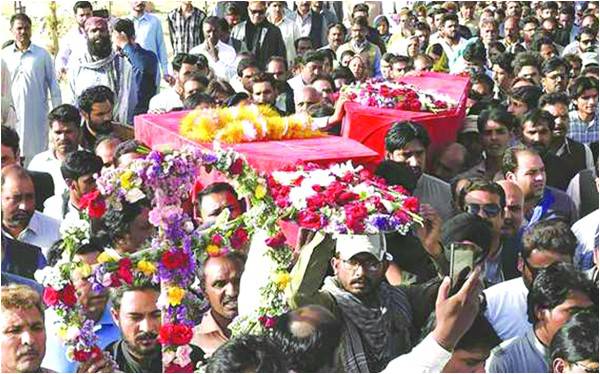
In desperation, the Christian community took to the streets with the bodies of their loved ones. They blocked roads in protest and held the government responsible for failing to secure the lives of citizens of the city, despite the widespread deployment of police and paramilitary forces and the presence of security checkposts across the city.
It is not just Christians who have been at the receiving end of violence in recent times. Hazaras, the city’s most modern and urban community, have also faced sectarian and ethnic violence for more than two decades.
The spokesmen for the government put the blame of terror attacks and violence against minorities on militants who have safe havens and sanctuaries in Afghanistan. These officials claim that these militants want to sabotage the China Pakistan Economic Corridor (CPEC), which, they say, would be instrumental in the economic and social development of Balochistan and which could bring prosperity to the region.
However, most observers dismiss this as propaganda and a trap set by the political and security elites to mask their failure in maintaining security, and to deflect public attention from the real issue: the state’s inability to safeguard the lives and properties of ts citizens.
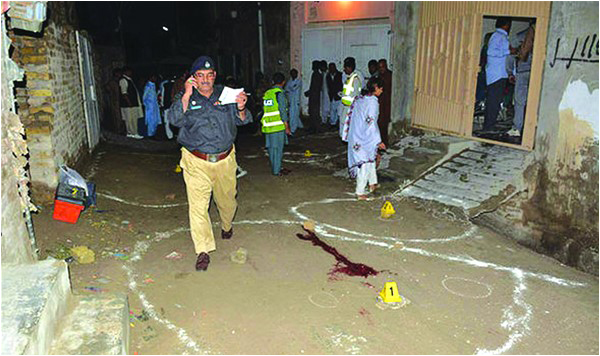
A policeman surveys the crime scene
State officials also claim that violence in the beleaguered city has been greatly reduced, but the manner in which people are being killed in broad daylight tells another story. Quetta is not yet rid of militants.
Despite security and law enforcement agencies claiming that they have cleansed the province of terrorists, some analysts argue that the restive province is still home to militants linked to Taliban, Islamic State and al-Qaeda, who attack the minorities because they are easily accessible to them from across the border. However, the state authorities and officials consistently deny the existence of IS in Pakistan. If the current popular political speeches of the Baloch, Pakhtun and Hazara nationalists on the killings of minorities in the city are anything to go by, one gets the impression that the rise of sectarianism and religious killings in Balochistan is a byproduct of the Pakistani state’s machiavellian misemployment of religion to promote national integration and to whip up popular support for otherwise unpopular agendas. Observers argue that to neutralize Baloch nationalism and other ethnic movements, Islamabad overplayed the religion card which fuelled violence against unprotected minorities. This policy planted seeds of extremism, sectarianism and hate in the secular society of Balochistan. As a result of these misguided state policies, today, Balochistan acts as a breeding ground for various extremist and sectarian groups. They also pointed to the weakened provincial autonomy of Balochistan, which prevents its government from carrying out its responsibilities and duties and which also provides it an excuse to shift the responsibility of its failure on the federal government.
Regardless of the various theories that try to explain the reasons behind the killings of Christians and other minority groups, it can be reasoned that the silence and indifference of the federal government and the establishment and the impotence of the provincial government do not bode well for the future of minorities who are under siege in Quetta.
The writer teaches International Relations at the Balochistan University of Information Technology, Engineering and Management Sciences