

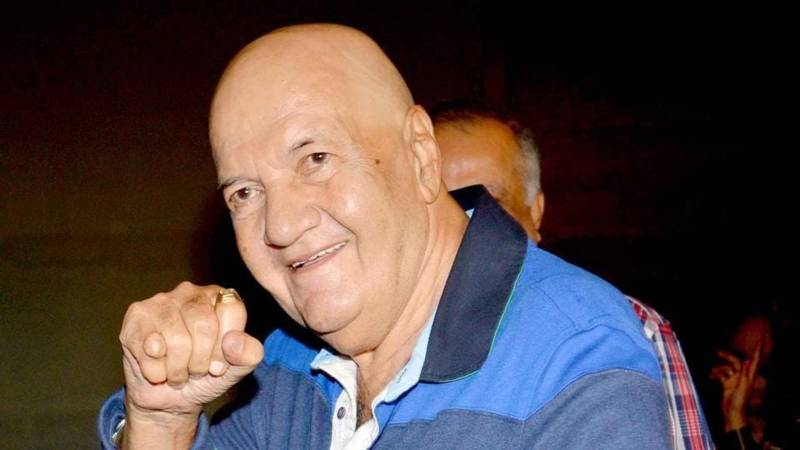
He loved watching films and deeply admired Dilip Kumar for his natural style. Dilip Kumar remained his role model all his life. On those long train rides, Prem often imagined himself on the silver screen, unaware that one day he would act alongside his idol. Although he worked at The Times of India, he continued to visit studios, hopeful that fate would one day call his name. And that day arrived. Travelling by train one afternoon, amid the crowd, a stranger approached and asked, “Would you like to act in films?” Prem looked at him and nodded without hesitation. The stranger took him through Bombay’s streets to a grand building with bold letters above its gate: Ranjit Studio.
That was the turning point in Prem Chopra’s life. The stranger led him to the studio where a Punjabi film, Chaudhry Karnail Singh, was being made. Its producer, Jagjit Sethi, also Punjabi, was looking for a hero. When he saw Prem Chopra, he instantly knew his search was over. The film was a box-office success and even won a National Award. The same year, Prem acted in Hum Hindustani. Two years later came Main Shaadi Karne Chala, during which someone advised him to consider playing villains. That suggestion shaped his destiny. In 1964, he appeared in the suspense thriller Woh Kaun Thi, playing a negative role that became a hit.
Soon after, Manoj Kumar offered him Shaheed, where Prem portrayed Sukhdev, Bhagat Singh’s comrade, a positive character in a successful film. Roles now came steadily: Sikandar-e-Azam, Nishan, Poonam Ki Raat, Mera Saaya, Kunwari, Sagai, Teesri Manzil, Laat Sahib, and Aamne Saamne. Seven years had passed in films, yet he still worked at The Times of India. Acting was still part-time. In 1967, he was offered Upkaar, in which he played a villain. This film changed his life in two ways: he quit The Times of India to act full-time, and his demand as a villain in Bollywood soared.
In 2023, he received the Lifetime Achievement Award, a tribute to his lasting artistry
Prem Chopra revolutionised the concept of villainy. Instead of loud menace, he spoke softly, with calm precision, creating new shades with each role he played. His dialogues live on:
From Bobby: “Prem... mera naam hai Prem Chopra” (“Prem... my name is Prem Chopra”) became his signature.
From Souten: “Main woh bala hoon jo sheeshe se patthar torta hoon” (“I am the monster that shatters stone through glass”).
From Kati Patang: “Main jo aag lagata hoon, use bujhana bhi jaanta hoon” (“The fire I ignite, I can also extinguish”).
From Souten: “Jinke ghar sheeshe ke hote hain, batti bujha kar kapde badalte hain” (“Those who live in glass houses change their clothes in the dark”).
He worked with many stars, but his pairing with Rajesh Khanna became iconic. Together they acted in nearly 25 films, 20 of which were box-office hits. Producers cared less who the heroine was, as long as Rajesh Khanna had Prem Chopra as the villain. Off-screen, however, Prem was the opposite of his screen image, a simple, humorous man. Few knew he also wrote poetry under the pen name Prem Aawargi. He also acted with Amitabh Bachchan in several films and with four generations of the Kapoor family. Eventually, he got to act alongside his idol Dilip Kumar in Daastaan and Bairaag.
Prem Chopra appeared in nearly four hundred films. His cinematic journey began in 1960 and spanned decades, a feat achieved by few. The secret lay in his discipline, creativity, and honesty in his craft. Once asked how he stayed relevant so long, he replied, “Even today, whenever I take up a project, I treat it as if it were my last. Most people, once successful, become relaxed and lose focus, but I never do.”
In 2023, he received the Lifetime Achievement Award, a tribute to his lasting artistry. It has been sixty years since he arrived in Mumbai. The young man from Shimla had become a renowned Bollywood legend. Then came a day when he returned to Shimla, the city of his youth. He stayed once more at Clarke's Hotel. Sitting quietly, eyes closed, he remembered the days gone by when he had waited outside this very hotel for a glimpse of his favourite actors. A knock at the door broke his thoughts.
The hotel’s General Manager was there. “Sir,” he said politely, “a large crowd has gathered outside. People want to see you.” Prem Chopra immediately stood up. “Why didn’t you tell me earlier?” he said with a smile, hurrying to the balcony. The crowd erupted in joy, waving frantically to catch his attention. Tears filled his eyes. He recalled those days when, as a student, he had waited hours outside this hotel just to see the stars. Now, people were waiting for him. At that moment, his thoughts drifted back to Krishna Gali No. 5 of Gawalmandi, Lahore, where a little boy once looked at the world in wonder. He thought, Time, too, is like a river; its current carries us along, revealing life’s strange miracles.