

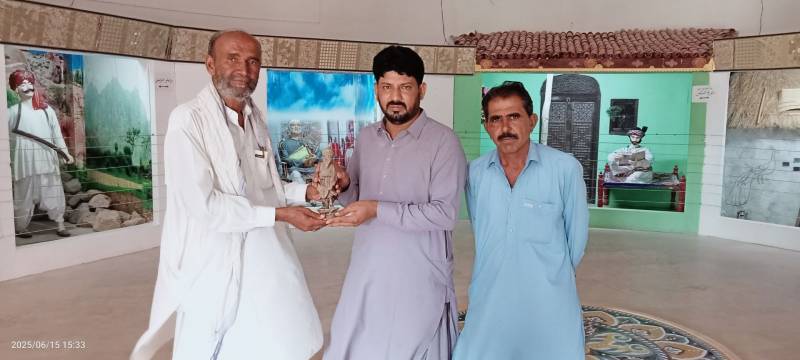
MITHI: An apparently centuries-old wooden sculpture of a robed, bearded man was handed over to the officials of the Culture Department on Sunday. Mr Allah Rakhio Khoso, the known activist of the hilly town of Nagarparkar, handed over the artefact to Kelash Malhi after Syed Zulfikar Ali Shah, the Sindh Minister for Culture, Tourism and Archives, had instructed the officials to reach the hilly town and take possession of the ancient object for its further inspection and preservation. Mr Malhi took the object to the Miskeen Jahan Khan Khoso Museum. The ancient wooden artifact was discovered in the hilly region of the famous Karoonjhar Hills, intriguing historians and archaeologists about its cultural origins.
The intricately carved wooden statue depicts a robed man with traditional features, and is believed to be of considerable antiquity. Preliminary observations suggest it may be linked to ancient eastern cultures, though its exact provenance remains unclear.
Mohammad Qasim Siraj Soomro, the PPP MPA from Nagarparkar, commenting on the discovery of an artefact said " this is latest discovery from the Karoonjhar range stands as yet another testament to our claim- this entire region is steeped in culture and has been home to civilizations that nurtured our ancestors. "We were, are, and always will be committed to protecting this precious heritage site" he added.
Dr Allah Nawaz Samoo, an eminent Thari activist, commenting on the post of MPA Soomro stated " the fact that many local people are skeptical about the veracity of the claim, the wooden sculpture needs to be examined by experts in the relevant field. Nowadays, it is easy to scientifically estimate the age by radiocarbon dating and dendrochronology techniques. The results of such scientific tests, combined with an analysis of the archaeological context, can answer questions which local people are rightly raising: Where does it come from? How and under what circumstances was it found? What does its design and craftsmanship reveal about the cultural context of Parkar" Dr Samoon questioned.
"Wood decays easily in our climate; most of the wooden heritage from ancient Sindh has survived only under very special conditions — waterlogged, buried, or charred.
"The wood found in Makli necropolis has been identified as Teak (Tectona grandis), which is highly resistant to weather and termites. The carvings of these wooden artifacts demonstrate Persian, Central Asian, and local Sindhi influences, reflecting cultural fusion during the Tarkhan and Mughal period ". Dr Samoo said ."However, Parkar is different. only two centuries ago, organic wood was used here - that too insignificantly. organic materials, especially wood, rarely survive. In ancient times, during the 14th and 15th centuries, Karoonjhar and Parkar had limited influence from Thatta, Persian,- and Muslim cultures. Whatever has been discovered in Karoonjhar and Parkar so far, mostly symbolizes Jain heritage, which favored stone over wood. Therefore, the local people have reasons to be skeptical" Dr Allah Nawaz concluded.
A senior Thari lawyer Assaram Alamchandani in his comment said " this statue from appearance and location is believed to be either of Rajput Thakur Ruler, or some Jain Ruler who have lot influence in this region for long time third and last could be of some Parsi priest since Parinagar was developed and operated by them"