

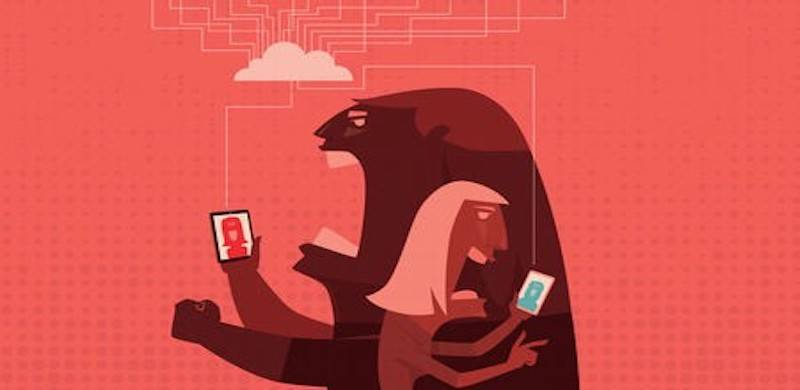
“The sad truth is that most evil is done by people who never make up their minds to be good or evil.” — Hannah Arendt
Sometimes, while scrolling late at night through the endless churn of headlines, memes, and hot takes, you feel it—an unease that doesn’t quite have a name. You pause, not because of what you saw, but because of what you didn’t. The feeling that your perception is being shaped behind the scenes. In a world run by algorithms and fed by outrage, it’s hard to shake the sense that something is off.
Hannah Arendt, writing about the trial of Adolf Eichmann in 1961, introduced a phrase that still rattles: the banality of evil. Eichmann, a key Nazi bureaucrat, wasn’t a raving ideologue. He didn’t seem like a monster. He came off as painfully ordinary—a man who followed orders, stuck to the script, and did his job. He was, as Arendt put it, terrifyingly normal. The evil he committed wasn’t driven by fanaticism, but by a refusal to think critically or morally about his actions.
Fast forward to now. Our world isn’t driven by totalitarian regimes in jackboots. It’s driven by algorithmic systems designed to capture our attention and convert it into profit. What Arendt saw in court—moral disengagement, blind obedience, and the numbing of thought—feels strangely familiar when you look at the way people behave online. The machinery is different, but the logic is hauntingly similar.
Our social media platforms are built to maximize engagement, not understanding. They serve us what we like, confirm what we already believe, and shield us from views that challenge our worldview. This is what researchers call the filter bubble. We live in echo chambers where our own ideas bounce back at us, louder each time. The more we engage, the more we’re fed of the same.
We often say, the internet never forgets. But it also rarely thinks. And that makes it the perfect environment for banal evil to take root
This isn’t just annoying—it’s dangerous. When you only see one version of reality, your thinking shrinks. You lose the habit of asking hard questions. Your empathy narrows. This is how confirmation bias tightens its grip. And when bad information spreads unchecked—misinformation, conspiracy theories, dehumanizing rhetoric—it becomes normalized. It doesn’t arrive with a bang. It seeps in, drip by drip, scroll by scroll.
Here’s the catch: no one is telling us what to believe. No dictator is barking orders. Instead, we’re being nudged—by design. These platforms learn what keeps us clicking and tweak our feeds to keep us hooked. It's algorithmic curation, and it’s not evil in itself. But it operates without conscience. It rewards speed, outrage, and emotional response over accuracy, complexity, and reflection.
The result? People become passive participants in systems that often promote polarisation and division. They scroll, like, share, move on. No questions asked. Out of sight, out of mind. This is where Arendt’s warning hits home. The problem isn’t hatred—it’s indifference. The problem isn’t extremism—it’s routine. People cause harm not by plotting it, but by going along with what’s popular, easy, and unexamined.
We’ve already seen how digital platforms have helped spread fake news, incite violence, and silence dissent. Yet the response is often a shrug. That’s just how the internet works. But that shrug is the very thing Arendt warned about—a failure to think, a surrender of moral judgment. And the scariest part? It doesn’t feel like evil. It feels like scrolling on autopilot.
So where does that leave us? Arendt didn’t offer simple answers, but she made one thing clear: resistance starts with thought. With stopping to ask, What am I looking at? Why do I believe this? Who benefits if I don’t question it?
We need to rebuild the habit of moral responsibility in the digital age. That means doing the slow work—checking sources, reading opposing views, sitting with discomfort. It means resisting the temptation to reduce every issue to a viral headline or a 10-second clip. It means treating what we share as if it matters—because it does.
This isn’t just about personal integrity. It’s about the health of the public sphere. Because if enough people stop thinking, the whole system becomes vulnerable—not just to misinformation, but to manipulation, authoritarianism, even violence. We’ve already seen glimpses of it in election interference, hate speech, and digital witch hunts. When critical thinking dies, extremism fills the vacuum.
We often say, the internet never forgets. But it also rarely thinks. And that makes it the perfect environment for banal evil to take root—not loud, not dramatic, but persistent and corrosive.
The platforms bear responsibility, without question. There need to be better checks, more transparency, more ethical accountability in how these systems are built and run. But Arendt reminds us that systems only work because individuals allow them to. We’re not just users. We’re participants.
Every click is a choice. Every share is a statement. Every silence is a decision.
The algorithm won’t save us. But maybe thought will.