

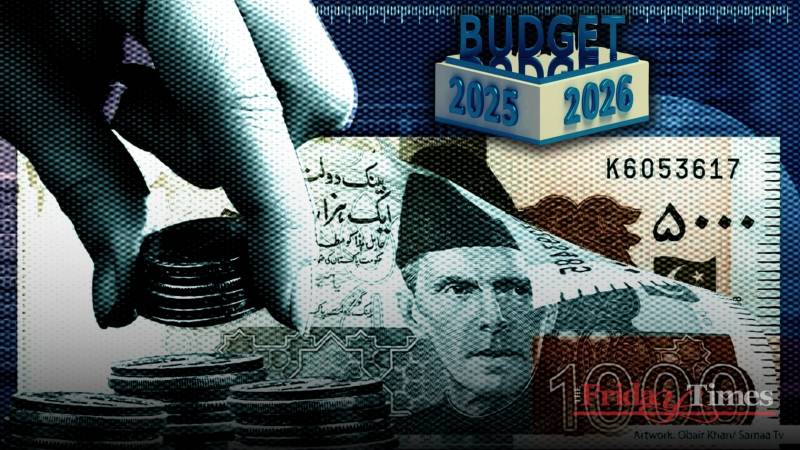
Pakistan’s federal budget for FY 2025–26 is not a strategy—it is a spreadsheet. It is a solemn recitation of expenditures and a passive reflection of structural decay. There is no macroeconomic transformation, no vision for state productivity, and certainly no path to sustainable development. The country continues to legislate survival, not revival.
What Pakistan needed was a generational reset. What it received was statistical theatre.
Debt Servicing: The Shadow Government
Pakistan will spend over ₨ 8.2 trillion—nearly half the federal budget—on debt servicing. This is not a development state; it is a debt colony. We are governed by compounding interest, not constitutional intent.
There is no debt management framework, no maturity profiling strategy, and no currency hedging mechanism. The Finance Ministry is allocating more to past mistakes than to future potential. The longer we fail to restructure public debt, the tighter our fiscal noose becomes.
A sovereign state cannot permanently lease its sovereignty.
Defence & Pensions: Security Without Economic Sovereignty
₨ 3.1 trillion is allocated to defence and military pensions. National security is non-negotiable—but when it consumes more than education, health, and innovation combined, it becomes economically unsustainable.
Defence must evolve from territorial posturing to geopolitical leverage. We must pivot toward regional trade diplomacy—using CPEC as a continental bridge, not just a bilateral route.
Security in the 21st century is not armoured—it is competitive, digital, and export-driven.
Bureaucracy: High Cost, Low Yield
₨ 2.5 trillion is earmarked for pensions and operating costs of government, yet state productivity remains negligible. We operate one of the most expensive bureaucracies per capita in Asia.
Budgeting is not about balancing books. It is about balancing purpose, power, and people
This is not a service delivery apparatus—it is a financial privilege structure. Pakistan must shift from defined-benefit to contributory pensions, cap the size of government relative to GDP, and implement productivity-linked promotions across civil services.
The government cannot remain the country’s largest consumer of taxes while producing no public ROI.
BISP: Social Protection Without Social Mobility
The Benazir Income Support Programme crosses ₨ 500 billion in annual outlays—but Pakistan remains off-track on every human development index. This is welfare without graduation, redistribution without capacity building.
A restructured BISP 2.0 must link direct cash transfers with verifiable social outcomes:
- School attendance
- Skills certification
- Primary healthcare metrics
- Exportable vocational training (domestic work, elder care, hospitality)
We must pivot from consumption subsidies to productivity enhancement. Otherwise, we are institutionalising inertia, not empowerment.
PSDP: Development as a Contractual Monopoly
The Public Sector Development Programme (₨ 1.2 trillion) is neither meritocratic nor productive. Military-linked firms such as FWO and NLC dominate project awards through legal exemptions and no-bid contracts—then subcontract to private firms at half the price.
Pakistan is building infrastructure without economic linkages. We are laying roads to nowhere.
A National Infrastructure Commission—staffed by economists, urban planners, engineers, and technocrats—must be formed under parliamentary mandate to plan, audit, and monitor national infrastructure based on ROI and regional competitiveness, not political constituency.
Education & IT: A Fantasy Budget
Pakistan spends more on public school students than most private institutions, yet learning outcomes are catastrophic. Worse, the government now touts $25 billion in IT export ambitions—despite no AI policy, no skilled coders, no national curriculum reform, and no digital ecosystem.
This is Silicon Valley rhetoric with Stone Age readiness.
We must immediately declare a National AI & Digital Skills Emergency, including:
- Universal coding and English literacy from Grade 6
- Provincial IT incubators
- AI and cloud-based vocational training
- Public-private tech apprenticeships
- Regulatory fast-tracks for data exports and e-commerce platforms
Exports, Remittances & FDI: The Missing Triangle
Pakistan’s current account challenge cannot be balanced by remittances and exports alone. The third—and most fragile—pillar is foreign direct investment (FDI). That pillar is absent.
To attract long-term FDI, Pakistan must ensure tax and regulatory predictability. Investors do not fear taxes—they fear uncertainty. The Finance Bill changes tax rates, capital gains regimes, and levies annually. This is fiscal roulette, not policy consistency.
We need:
- A 10-year rolling FDI Tax & Investment Framework
- Bilateral Investment Treaty (BIT) enforcement mechanisms
- Currency hedging and repatriation predictability
- Special Economic Zones (SEZs) with tax stability clauses
Only then can Pakistan convert investor interest into capital flow. Foreign reserves will not grow through austerity—they will grow through trust.
NFC & Provincial Paralysis
Provinces collect less than 10% of national revenues yet receive over 57% through the NFC Award. Development funds go unspent, then disappear through late-year procurement manipulation. There is no incentive for tax effort, transparency, or development innovation.
We must make NFC transfers conditional on provincial performance metrics—such as own-source revenue, budget utilisation, and independent audit clearance. Fiscal devolution cannot become fiscal dilution.
A Nation Budgeting for Yesterday
This is not a forward-looking document. It is a bookkeeping exercise in state stagnation. We continue to:
- Borrow to repay
- Tax without reform
- Spend without audit
- Govern without learning
We have no sovereign digital policy, no AI governance law, no export sector acceleration plan, and no credible debt sustainability framework. Budgeting has become a ritual, not a reform.
A Charter for Economic Rebirth
What Pakistan needs is not just a new budget—it needs a 20-year Economic Charter, including:
- Debt restructuring and fiscal sustainability law
- Government expenditure cap as % of GDP
- Productivity-linked public salaries
- AI & tech human capital masterplan
- Transparent PSDP pipeline tied to economic returns
- Pension system overhaul
- Predictable tax regime to anchor FDI
- Provincial tax effort benchmarks
Final Word: From Spreadsheeters to Statesmen
Budgeting is not about balancing books. It is about balancing purpose, power, and people. Pakistan is running out of time, and the cost of inertia is compounding.
A real budget builds competitiveness, empowers people, and strengthens institutions. Until we see these priorities reflected in our fiscal documents, Pakistan will remain trapped in a vicious cycle of debt, decay, and dependency.
This is not a reformist budget. This is a memo to history about missed chances.