

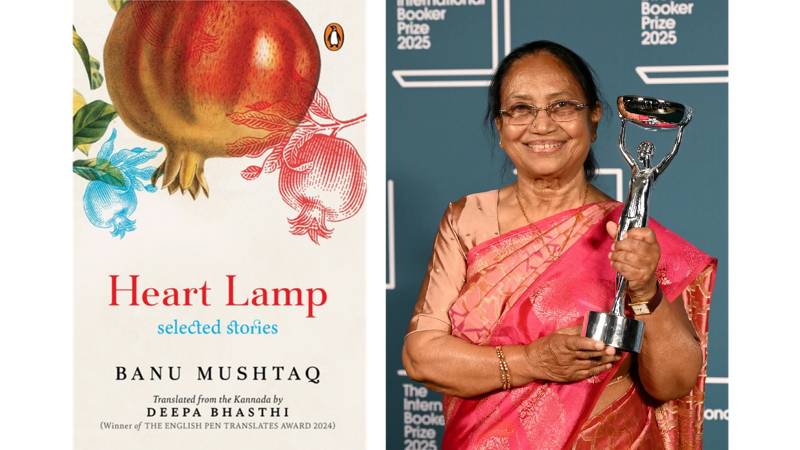
Even if the writer and reader live in different countries or on different continents, compelling, spellbinding stories have the power to shape ideologies and leave an indelible mark on readers. Banu Mushtaq, the author of Heart Lamp, has written this magnum opus based largely on her own life experiences. At one point, she was so overwhelmed by despair that she even attempted to end her life. Instead, she chose to live and become a voice for women enduring unbearable lives in many forms.
Heart Lamp is a collection of twelve selected stories, and almost every story is rife with emotion, apathy, and the barbaric treatment of Muslim women. Originally written in Kannada, a language spoken primarily in the state of Karnataka, India, Deepa Bhashti translated twelve stories into English from Mushtaq’s large oeuvre. The stories resonated with countless readers across the globe and, after Mushtaq and Bhashti received the English PEN Translates Award in 2024, helped pave the way for them to win the International Booker Prize in 2025.
It is hard to determine which stories are more poignant and evocative than the others, but two stories, Black Cobras and A Decision of the Heart, particularly stand out for their emotionally charged narratives and idiosyncratic plots.
The story Black Cobras revolves around Aashraf, a woman heartlessly ignored by her husband Yakub because she is unable to give him a male heir, and her three daughters, including Munni, who is very ill and requires special care and treatment.
“She was banging on the grand door of Allah’s house. Not for herself – hers was a dog’s belly that could be filled somehow or the other – but to beg for justice for her children.”
Banu Mushtaq’s stories, already quite famous among the Kannada community, received international acclaim after being translated into English
First, she does all she can to arrange treatment for her daughter. She even begs her husband to provide for their daughters, yet her pleas go unanswered. When nothing works, she turns to the Muttawali (caretaker of the area’s mosque) to seek his assistance. Muttawalis are powerful people and can influence decisions. In her case, however, she is met with severe delays and endless ifs and buts. All her attempts are dismissed, and she is labelled a nuisance. The story and Ashraf’s grief reach their climax with Munni’s death, caused by the criminal negligence of Yakub and the abhorrent apathy of society. The women of the neighbourhood, who had remained silent until Munni’s death, now curse Yakub and the Muttawali without restraint.
The second story, A Decision of the Heart, has a theme which is not so uncommon. Like all other stories in the book, the women characters, Akhila and Mehaboob Bi, dominate the narrative. Yusuf, son of Mehaboob Bi and husband of Akhila, is a fruit seller by profession. He is a modest man and takes great care of both his wife and widowed mother. He is placed as the central and emotional pivot of the conflict. In almost all Muslim households in South Asia, it is the sons who look after their parents. And in case either of the parents dies, sons are expected to make an extra to ensure that the surviving parent does not feel desolate and lonely. Yusuf is constantly seen trying to go the extra mile to provide for his mother. He visits her quite often and has his meals with her. This fact is nothing less than a hard pill to swallow for Akhila.
“Instinctively Akhila had shouted at Yusuf and cursed his mother. She went to the front door so that Mehaboob Bi could hear, called her a homewrecker and cracked her knuckles. When none of this got a reaction, she began to beat her chest and cry, ‘You are making my stomach burn by behaving like a co-wife.”
Every time he visits his mother, Akhila is up in arms and cannot help creating a scene and swearing against her mother-in-law. Yusuf’s daily life becomes unbearably difficult. After a long day of tiresome work, he always comes back home only to listen to his wife's expletives against his own mother. Fed up with the routine scruples, he decides to marry his mother off. This decision makes Akhila think sensibly and helps her change her approach towards her mother-in-law and her husband. Yusuf’s judgement also turns out to be flawed when Mehaboob Bi refuses to marry for the second time. It is also one of the themes of the story that caring for someone means listening to what they have to say. It is not about deciding someone’s fate without taking their due consent.
Throughout the stories, the theme of a woman suffering at the hands of her husband never grows old. This does not mean the book becomes dull or monotonous. In fact, it enriches the narrative and highlights the various dimensions of emotional and social burdens that women endure—partly in silence and partly for the sake of their children.
Banu Mushtaq’s stories, already quite famous among the Kannada community, received international acclaim after being translated into English. This highlights the crucial role and importance of translators. In Pakistan alone, there are around 70 living languages. Most likely, each language has its own body of literature, which, I believe, should be translated into English to reach audiences across the globe. Just like Heart Lamp, we need more powerful stories to challenge parochial mindsets and break unnecessary patterns.