

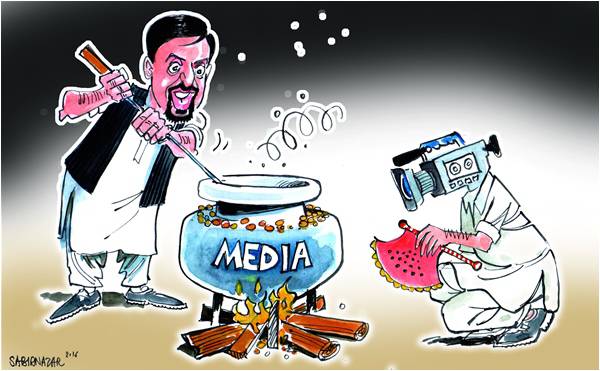
The military establishment has signalled its decision to knock out Altaf Hussain and create an alternate MQM leadership that disavows violent criminality, terrorism and links with India. All this while continuing to represent the hopes and aspirations of the muhajir community of urban Sindh.
The return of Altaf Hussain’s once-favourite ex-Mayor Karachi, Mustafa Kamal, and ex-henchman, Anis Qaimkhani, from exile is touted as a pointer in that direction. Both gentlemen have been joined by MQM-MPA Dr Saghir to denounce their ex-great leader Altaf Hussain as evil incarnate and pledge their determination to form a new party to represent muhajirs.
If there is a sense of déjà vu, we can hardly be blamed. From 1992-1996, the military establishment led by Generals Asif Nawaz, Waheed Kakar and Jehangir Karamat, went after the MQM hammer and tongs, creating the Haqqiqi faction of Afaq and Amir. But the policies of two army chiefs have muddied the waters. From 1989-91, General Mirza Aslam Beg joined hands with the MQM to overthrow the Benazir Bhutto government and then destabilize the Nawaz Sharif government. And from 1999 to 2008, General Pervez Musharraf embraced the MQM, gave it political succour and revived it as a full fledged adjunct of state policy in order to thwart the PPP in Sindh in the same manner in which he crafted the PMLQ to weaken the PMLN in Punjab. During this decade, the MQM entrenched itself in the bowels of urban Sindh as a terrorist organization protected by the state. It is no coincidence that both generals were “muhajirs” with avowed interventionist political agendas while the generals who have given it short shrift were not muhajirs and had no interventionist ambitions.
In short, we can draw the rough conclusion that when an army chief is inclined towards political intervention, he has no qualms about allying with the devil to further his ambitions. We can also draw the more significant conclusion that such interventions have proved disastrous for state and society. They end up distorting the political system and polluting the political environment by creating monsters in the form of non-state actors. These then become uncontrollable existential threats to the state itself. The jihadi groups, the Taliban and the MQM all fall in this category.
A string of political interventions by the military establishment under General Raheel Sharif, however, is in a class all of its own. The army under General Sharif has not overthrown the elected government of the day. Indeed, it has not sought to impose any opportune political policies on the Nawaz Sharif government. In fact, it has consciously reversed its pro-Taliban, pro-Jihad and pro-MQM policies in no uncertain manner in order to give the political government greater scope in foreign and domestic policy and also to stabilize the polity. If there are running tensions with the PPP in Sindh and PMLN in Islamabad, these emanate more from the anti-terrorist-criminal “clean-up” agenda at hand than any hidden agenda to weaken and discredit the civil dispensation as a prelude to seizing power.
Under the circumstances, if there is some justification in dispensing with our usual dose of cynicism at the political engineering currently underway in Karachi, it is still worth asking whether or not this will yield fruit or be stillborn as similar efforts in the past.
Altaf Hussain is still alive and kicking. Indeed, he seems to have had a reprieve from the British government recently that has deliberately slow-tracked the money laundering and murder case against him. He has fortified himself by lining up the likes of Nadeem Nusrat and Mohammad Anwar as his successors in the event he himself is neutralized in any manner – both gentlemen being his point men with India and the UK. His lieutenants in Karachi led by Farooq Sattar are going to try and rally the faithful to rout the proposed rump led by Mustafa Kamal and Anis Qaimkhani. Unless the military establishment is successful in nudging disgruntled MQM leaders who have made themselves scarce in recent times to come out of hiding and join the rump, this move will end in failure. It will make a second attempt later down the line even more difficult. The establishment will also have to be careful not to invite discredited criminals to join the rump if its own credibility is not to be challenged. The presence of Anis Qaimkhani aimed at giving the rump some muscle is already disquieting. For a long time, he was the point man for many ill-conceived and criminally executed orders of Altaf Hussain.
The PPP and PMLN are quiet, watching from the sidelines. They would dearly love this minus-One formula to succeed. Therefore, having taken the plunge, the military establishment cannot now afford any halfway house. This initiative must gather political speed and clout, otherwise it is going to fizzle out in a whimper. In the event, Altaf Hussain could remerge as a stronger leader than before and become a bigger headache for all.
The return of Altaf Hussain’s once-favourite ex-Mayor Karachi, Mustafa Kamal, and ex-henchman, Anis Qaimkhani, from exile is touted as a pointer in that direction. Both gentlemen have been joined by MQM-MPA Dr Saghir to denounce their ex-great leader Altaf Hussain as evil incarnate and pledge their determination to form a new party to represent muhajirs.
If there is a sense of déjà vu, we can hardly be blamed. From 1992-1996, the military establishment led by Generals Asif Nawaz, Waheed Kakar and Jehangir Karamat, went after the MQM hammer and tongs, creating the Haqqiqi faction of Afaq and Amir. But the policies of two army chiefs have muddied the waters. From 1989-91, General Mirza Aslam Beg joined hands with the MQM to overthrow the Benazir Bhutto government and then destabilize the Nawaz Sharif government. And from 1999 to 2008, General Pervez Musharraf embraced the MQM, gave it political succour and revived it as a full fledged adjunct of state policy in order to thwart the PPP in Sindh in the same manner in which he crafted the PMLQ to weaken the PMLN in Punjab. During this decade, the MQM entrenched itself in the bowels of urban Sindh as a terrorist organization protected by the state. It is no coincidence that both generals were “muhajirs” with avowed interventionist political agendas while the generals who have given it short shrift were not muhajirs and had no interventionist ambitions.
In short, we can draw the rough conclusion that when an army chief is inclined towards political intervention, he has no qualms about allying with the devil to further his ambitions. We can also draw the more significant conclusion that such interventions have proved disastrous for state and society. They end up distorting the political system and polluting the political environment by creating monsters in the form of non-state actors. These then become uncontrollable existential threats to the state itself. The jihadi groups, the Taliban and the MQM all fall in this category.
A string of political interventions by the military establishment under General Raheel Sharif, however, is in a class all of its own. The army under General Sharif has not overthrown the elected government of the day. Indeed, it has not sought to impose any opportune political policies on the Nawaz Sharif government. In fact, it has consciously reversed its pro-Taliban, pro-Jihad and pro-MQM policies in no uncertain manner in order to give the political government greater scope in foreign and domestic policy and also to stabilize the polity. If there are running tensions with the PPP in Sindh and PMLN in Islamabad, these emanate more from the anti-terrorist-criminal “clean-up” agenda at hand than any hidden agenda to weaken and discredit the civil dispensation as a prelude to seizing power.
Under the circumstances, if there is some justification in dispensing with our usual dose of cynicism at the political engineering currently underway in Karachi, it is still worth asking whether or not this will yield fruit or be stillborn as similar efforts in the past.
Altaf Hussain is still alive and kicking. Indeed, he seems to have had a reprieve from the British government recently that has deliberately slow-tracked the money laundering and murder case against him. He has fortified himself by lining up the likes of Nadeem Nusrat and Mohammad Anwar as his successors in the event he himself is neutralized in any manner – both gentlemen being his point men with India and the UK. His lieutenants in Karachi led by Farooq Sattar are going to try and rally the faithful to rout the proposed rump led by Mustafa Kamal and Anis Qaimkhani. Unless the military establishment is successful in nudging disgruntled MQM leaders who have made themselves scarce in recent times to come out of hiding and join the rump, this move will end in failure. It will make a second attempt later down the line even more difficult. The establishment will also have to be careful not to invite discredited criminals to join the rump if its own credibility is not to be challenged. The presence of Anis Qaimkhani aimed at giving the rump some muscle is already disquieting. For a long time, he was the point man for many ill-conceived and criminally executed orders of Altaf Hussain.
The PPP and PMLN are quiet, watching from the sidelines. They would dearly love this minus-One formula to succeed. Therefore, having taken the plunge, the military establishment cannot now afford any halfway house. This initiative must gather political speed and clout, otherwise it is going to fizzle out in a whimper. In the event, Altaf Hussain could remerge as a stronger leader than before and become a bigger headache for all.