

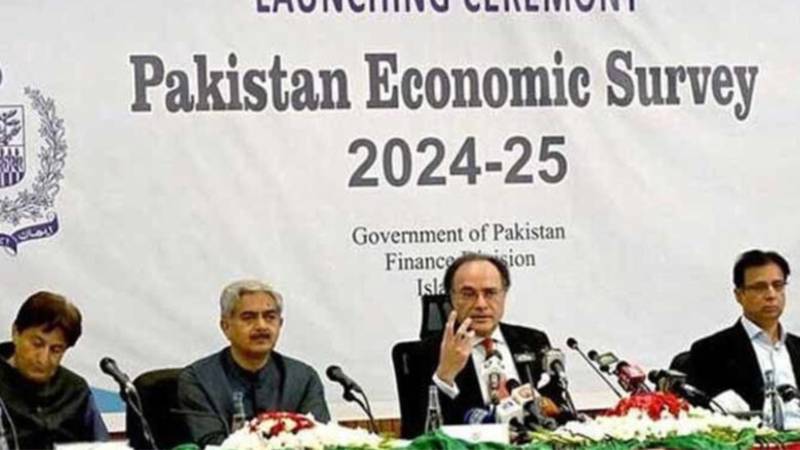
In the maze of global economic uncertainty and domestic fragility, Pakistan’s Economic Survey 2024–25 paints a cautiously optimistic picture. It reflects tangible strides in macroeconomic stabilisation—once a distant aspiration—but also underscores the economy’s persistent structural weaknesses and the urgent need for reforms. While the survey highlights progress, it also misses a critical opportunity for introspection, leaning too heavily on self-congratulatory narratives rather than confronting enduring policy failures.
At the core of this year's economic trajectory is a real GDP growth of 2.68%, revised downward from an earlier estimate of 3.5%. Though a positive shift from contraction, this rate remains modest compared to regional peers: India (6.5%), China (5%), Bangladesh (4.2%), and Sri Lanka (5%). Quarter-wise figures—Q1 at 1.34%, Q2 at 1.53%, and Q3 at 2.4% (subject to revision)—further reveal that Pakistan remains stuck in a low-growth trap, a result of successive governments’ failure to implement long-overdue structural reforms in taxation, energy, and public sector enterprises.
Despite these limitations, nominal gains are visible. The economy expanded to Rs 114,692 billion, up 9.1% from last year, and per capita income rose by 9.7% to $1,824. Encouraging medium-term projections forecast 5.7% GDP growth, though these remain conditional on continued reform momentum, something that has historically proven elusive.
One of the headline achievements was the fiscal consolidation: a fiscal surplus of Rs 1.896 trillion (1.7% of GDP) in Q1 and a primary surplus of 3% for July–March, marking a significant departure from past profligacy. The fiscal deficit shrank to 2.6% of GDP, even amid a 19.4% rise in government expenditure. But this fiscal prudence coexists uneasily with regressive tax structures, as the government continues to avoid taxing powerful lobbies such as retailers, real estate speculators, big farmers, and high earners in the informal economy. This tax avoidance not only deepens inequality but also undermines revenue potential and public trust.
The Economic Survey 2025 is both a testament to macroeconomic stabilisation and a reminder of Pakistan’s structural inertia
Tax collection surged by 25.8%, and non-tax revenue by 68%, but the investment-to-GDP ratio remained weak at 13.8%, only slightly up from 13.1%, and far below regional counterparts: Vietnam and Bangladesh at 31%, and Sri Lanka at 23%. Foreign investment remained subdued, constrained by policy inconsistencies, political instability, and recurring economic crises, exposing the country’s vulnerability to external shocks.
A rare bright spot came in inflation management: year-on-year inflation fell sharply from 17.3% in April 2024 to 0.3% in April 2025, a six-decade low. Food inflation declined around 1.5% in rural areas and hovered slightly above 1% in urban centres. The central bank halved its policy rate from 22% to 11%, encouraging private borrowing (which inflated by 189%) and fostering broad money growth of 4.5%. Yet, this monetary loosening came late, and critics note that contractionary fiscal and monetary policies persisted despite early signs of slowdown, reflecting policy misalignment and weakening the recovery.
The external sector tells a mixed tale. A current account surplus of $1.9 billion from July to April reversed previous deficits, supported by record remittances of $31.2 billion (a 31% increase YoY). Foreign exchange reserves improved to $16.64 billion, but a significant portion came from rollovers and temporary inflows, not from durable external sector reforms. Meanwhile, net outflows of $1.6 billion due to debt repayments (reversing from a net inflow of US$ 4.2 billion last year), and a widening services account deficit, highlight the fragility of the financial account, which remains heavily dependent on borrowing.
On the debt front, public debt hit Rs 76 trillion (domestic: Rs 51 trillion and external debt at Rs 24 trillion (US$ 87 billion)), a daunting figure, though efforts to lengthen domestic debt maturity (from 2.9 to 3.5 years) and introduce zero-coupon bonds and Sukuk instruments reflect intent toward better debt management. Active buybacks and T-bill retirements further signal a shift to reduce rollover risks and reliance on short-term expensive borrowing.
Pakistan’s capital markets surged, with the KSE-100 index climbing over 50%, and market capitalisation expanding nearly 40%. The corporate sector welcomed over 26,000 new company registrations, led by IT and services, highlighting the country’s latent digital potential. However, these financial market gains still rest on a narrow base and require deeper capital market reforms to sustain momentum.
Sectorally, agriculture remains troubled. Growth was just 0.56%, dragged by a 13.5% drop in major crops, including cotton (-30.7%), maize (-15.4%), and wheat (-9%). Livestock (growth of 4.72%), fisheries (growth of 1.42%), and forestry (growth of 3.03%) partially offset these declines, but the sector’s vulnerability to climate and policy shocks persists.
Industry performed unevenly: manufacturing grew by 1.3%, with large-scale manufacturing contracting by 1.5% during July–March FY2025. Structural bottlenecks, high input costs, and declines in key sectors like food, chemicals, steel, and electrical equipment are stalling LSM recovery. High-growth segments like automobiles (+40%) and mineral extraction (+300%) provided some cushion. Meanwhile, energy production declined (electricity consumption fell by 3.6% to 80,111 GWh from 83,109 GWh in the same period of FY 2024), signalling long-term structural issues in power generation and distribution.
Services, contributing 58.4% to GDP, continued to expand at 2.9%, driven by recovering consumer demand. However, sustaining service sector growth will require broader income generation and productivity improvements.
On social development, the picture remains sobering. The literacy rate stands at 60.65%, with deep rural-urban (74% vs 52%) and gender gaps; female literacy is only 52.8%. Out-of-school children remain at 38%, and in Balochistan, it’s a staggering 69%. While the Higher Education Commission received increased funding and international support, outcomes lag due to weak implementation and oversight, as is obvious from the quality of graduates vis-à-vis the globe.
Lastly, data transparency remains a concern, with the IMF noting major gaps in source data for sectors comprising a third of GDP and weaknesses in GFS reliability. Frequent data revisions and lack of full-year figures undermine credibility and hinder informed policymaking.
CODA: The Economic Survey 2025 is both a testament to macroeconomic stabilisation and a reminder of Pakistan’s structural inertia. The government's emphasis on headline achievements risks ignoring deeper, more persistent challenges. Without measurable progress on structural reforms, particularly in taxation, power, SOEs, health, and education, and without a serious broadening of the tax base, Pakistan’s path to sustainable, inclusive growth remains uncertain.
This is not just a story of resilience; it is also a missed opportunity for course correction. If policymakers can move beyond cosmetic reforms toward transparency, equity, and genuine transformation, then perhaps the next economic survey will tell a fuller, fairer story.