

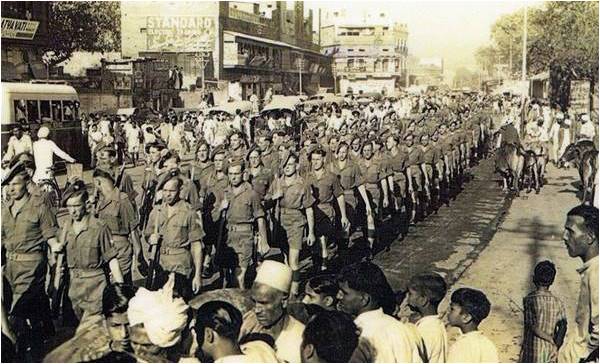
Soldiers of the Royal Irish Infantry Regiment march through a street of Lahore in 1947.
Raised as a volunteer force in 1688 to counter a possible Jacobite attack on Enniskillen, the Inniskillingers were accepted into the army a year later. For the next few centuries, the regiment saw action all over the world, including the two world wars and the Indian mutiny in 1857. It underwent several reductions and amalgamations during this time.
“On 19 September the 1st Battalion Royal Inniskilling Fusiliers were ordered to Lahore, to restore law and order,” according to a website dedicated to the Royal Irish Regiment. “It was a job requiring both patience and firmness. On occasions when the rioting was serious enough to require the use of troops, the Inniskillings acted successfully without causing any unnecessary bloodshed.”
Raised as a volunteer force in 1688 to counter a possible Jacobite attack on Enniskillen, the Inniskillingers were accepted into the army a year later. For the next few centuries, the regiment saw action all over the world, including the two world wars and the Indian mutiny in 1857. It underwent several reductions and amalgamations during this time.
“On 19 September the 1st Battalion Royal Inniskilling Fusiliers were ordered to Lahore, to restore law and order,” according to a website dedicated to the Royal Irish Regiment. “It was a job requiring both patience and firmness. On occasions when the rioting was serious enough to require the use of troops, the Inniskillings acted successfully without causing any unnecessary bloodshed.”